

Key ministers address Assembly of First Nations in Ottawa after Hodgson is bumped
Advertisement
Read this article for free:
or
Already have an account? Log in here »
To continue reading, please subscribe:

Digital Subscription
One year of digital access for only $205*
- Enjoy unlimited reading on winnipegfreepress.com
- Read the E-Edition, our digital replica newspaper
- Access News Break, our award-winning app
- Play interactive puzzles
*First annual payment billed as $205.00 + GST for one year. This annual subscription will automatically renew at $233.00 + GST every 52 weeks (10% off the regular annual price of $259.35). Offer available to new and qualified returning subscribers only. Cancel any time.
To continue reading, please subscribe:
Add Free Press access to your Brandon Sun subscription for only an additional
$1 for the first 4 weeks*
- Enjoy unlimited reading on winnipegfreepress.com
- Read the E-Edition, our digital replica newspaper
- Access News Break, our award-winning app
- Play interactive puzzles
*Your next Brandon Sun subscription payment will increase by $1.00 and you will be charged $17.95 plus GST for four weeks. After four weeks, your payment will increase to $24.95 plus GST every four weeks.
Read unlimited articles for free today:
or
Already have an account? Log in here »
Hey there, time traveller!
This article was published 04/12/2025 (300 days ago), so information in it may no longer be current.
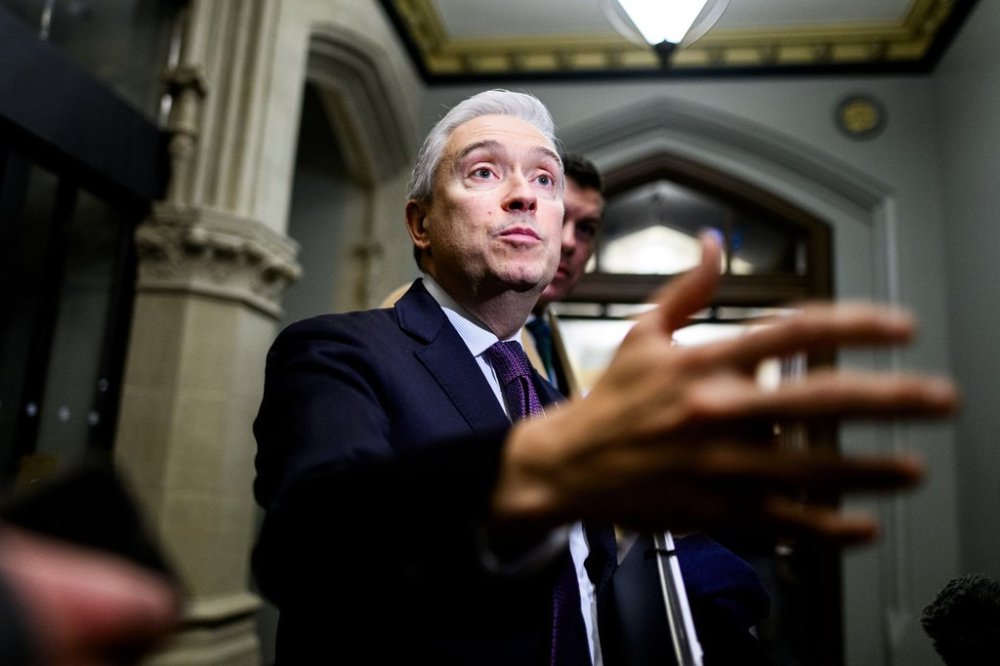
OTTAWA – Several key federal cabinet ministers addressed the Assembly of First Nations gathering in Ottawa Thursday, including Finance Minister François-Philippe Champagne.
But Energy Minister Tim Hodgson — who is helping to advance Prime Minister Mark Carney’s major projects agenda — was taken off the agenda, despite being previously scheduled to appear before the chiefs Thursday.
Hodgson’s office said he would still take part in a midday meeting with B.C. chiefs but would not be speaking on the panel he was initially slated to join. His office said at first that the decision was made by “organizers” — and later clarified that it meant organizers from the federal government’s side.
“There was a shuffling of the agenda by organizers from the federal government, not at (Natural Resources Canada). Minister Hodgson would have been happy to participate in the panel and was very glad to meet with chiefs on-site today,” said Hodgson’s spokesperson Carolyn Svonkin.
Hodgson landed in hot water last week when he brushed off concerns from Coastal First Nations about his failure to meet with them before signing the pipeline agreement with Alberta.
“It’s called Zoom,” Hodgson quipped on CBC’s “Power and Politics” when asked about Coastal First Nations president Marilyn Slett’s inability to make the trip to Vancouver on short notice for a meeting.
He later apologized for those remarks, saying on social media it was a “poor choice of words” and offering to meet with the First Nations “at their convenience.”
Last month, the federal and Alberta governments signed an agreement committing them to working toward building an oil pipeline to the West Coast — and opening the door to changes to the coastal tanker ban.
The agreement says Ottawa’s commitment is contingent on the pipeline being approved as a project of national interest, and on the project providing “opportunities for Indigenous co-ownership and shared economic benefits.”
Following Hodgson’s meeting with B.C. chiefs, Indigenous resource lawyer Merle Alexander said he wasn’t satisfied by what he heard from the minister about the proposed pipeline.
“I think they’re withholding information,” said Alexander, who was serving as a proxy for Heiltsuk First Nation Chief Marilyn Slett.
“I suspect that their conversation has advanced, that there is a potential proponent or a conglomeration of proponents … That’s not good-faith action.”
B.C. Regional Chief Terry Teegee expressed a similar sentiment, saying while he’s glad Hodgson addressed his caucus, there’s more work to do by meeting with affected First Nations.
He said there is suspicion among First Nations about the agreement signed with Alberta.
“This MOU is a slap in the face to British Columbia,” Teegee said.
In the meeting, Hodgson pledged to visit chiefs in the province and said there is a “lot of misinformation” about the agreement. He said it’s a roadmap, not an endpoint.
“It’s about a process,” he said. “First Nations — all Indigenous Peoples — will be at the table when projects affect you.”
The federal government’s major projects agenda was a major theme of this week’s gathering, which sees chiefs vote on resolutions that the AFN — which serves as their advocacy body — works to implement.
And while only chiefs and their proxies have voting power, a youth delegation from northern Ontario attending the gathering made it clear Thursday that they intend to protect their lands and waters — and they expect the chiefs to do the same.
“We’re being attacked,” said Ramon Kataquapit, a youth councillor and founder of First Nations youth movement Okiniwak.
“We’re in a time where we’re fighting for our way of life. The government, they’re after us. They’re after our rights, after our treaties … This is a ticking time bomb. We see that very clearly.”
Jeronimo Kataquapit from Attawapiskat First Nation, who is a member of youth-led Here We Stand and who has opposed development in the mineral-rich Ring of Fire, called federal and provincial legislation meant to fast-track development an attack on First Nations rights.
“(The land) is where we come from. It’s who we are — the lands, the water, the rivers, all of it,” he said.
“It’s our responsibility to protect the land, protect the water. It’s who we are as First Nations people from coast to coast and in all four directions.”
Champagne, Indigenous Services Minister Mandy Gull-Masty and Crown-Indigenous Relations Minister Rebecca Alty addressed the chiefs Thursday morning. They defended the recent federal budget and pointed to sections of the fiscal plan they said could benefit Indigenous communities.
“With this budget, we’re really working on putting forward measures that strengthen First Nations’ economic power and autonomy,” Alty said. “We’re investing in capacity, expanding access to capital and making sure that opportunities don’t bypass First Nations.”
Champagne said Indigenous partnership is essential to speeding up major projects, boosting economic growth and strengthening Canada’s position at home and abroad.
He said the budget put Indigenous priorities “at the heart” of the economic strategy.
“Indigenous people have always been part of the fabric of this country and they will be part in shaping a common future,” Champagne said.
National Chief Cindy Woodhouse Nepinak has said Budget 2025 failed First Nations because it did not include more infrastructure funding and educational resources for their communities.
Gull-Masty assured chiefs her government is committed to reforming the First Nations child welfare system and ensuring First Nations children get the supports they need, when they need them.
New Brunswick Regional Chief Joanna Bernard asked ministers where First Nations rank on the prime minister’s list of priorities, pointing to former prime minister Justin Trudeau’s oft-quoted remark that no relationship was more important to his government than the one with Indigenous Peoples.
She requested a written response to the question from Prime Minister Mark Carney, but Champagne answered in the interim.
“I think actions speak louder than anything,” Champagne said.
Carney spoke with chiefs on Tuesday and attempted to quell their concerns about the pipeline agreement he signed with Alberta Premier Danielle Smith.
Chiefs unanimously passed a resolution calling for that agreement to be rescinded, and to push the federal government to uphold its tanker ban on the northern B.C. coast.
During a meeting with Carney on Wednesday, chiefs from Treaties 6, 7 and 8 expressed openness to pipeline ownership.
Chiefs in Alberta do not have a regional representative at the Assembly of First Nations.
This report by The Canadian Press was first published Dec. 4, 2025.
Note to readers:This is a corrected story. An earlier version incorrectly stated that Jeronimo Kataquapit was a member of Okiniwak. He is a member of Here We Stand.