

B.C. murder suspect had risk factors on confidential police intimate violence tool
Advertisement
Read this article for free:
or
Already have an account? Log in here »
To continue reading, please subscribe:
Monthly Digital Subscription
$0 for the first 4 weeks*
- Enjoy unlimited reading on winnipegfreepress.com
- Read the E-Edition, our digital replica newspaper
- Access News Break, our award-winning app
- Play interactive puzzles
*No charge for 4 weeks then price increases to the regular rate of $19.00 plus GST every four weeks. Offer available to new and qualified returning subscribers only. Cancel any time.
Monthly Digital Subscription
$4.75/week*
- Enjoy unlimited reading on winnipegfreepress.com
- Read the E-Edition, our digital replica newspaper
- Access News Break, our award-winning app
- Play interactive puzzles
*Billed as $19 plus GST every four weeks. Cancel any time.
To continue reading, please subscribe:
Add Free Press access to your Brandon Sun subscription for only an additional
$1 for the first 4 weeks*
*Your next subscription payment will increase by $1.00 and you will be charged $16.99 plus GST for four weeks. After four weeks, your payment will increase to $23.99 plus GST every four weeks.
Read unlimited articles for free today:
or
Already have an account? Log in here »
VANCOUVER – A confidential document that is used by police to assess risk in intimate partner violence cases lists a range of considerations to help determine if a suspect should be held in custody, should legal justification exist.
Have they engaged in threats? Has violence involved choking or strangulation? Have they discussed or attempted suicide?
Every one of those factors — associated with an “increased severity of future violence” and marked with a stick-of-dynamite logo on the police document — were met by James Plover, according to evidence at a trial in Kelowna, B.C., where he was convicted of choking and uttering threats on July 4.
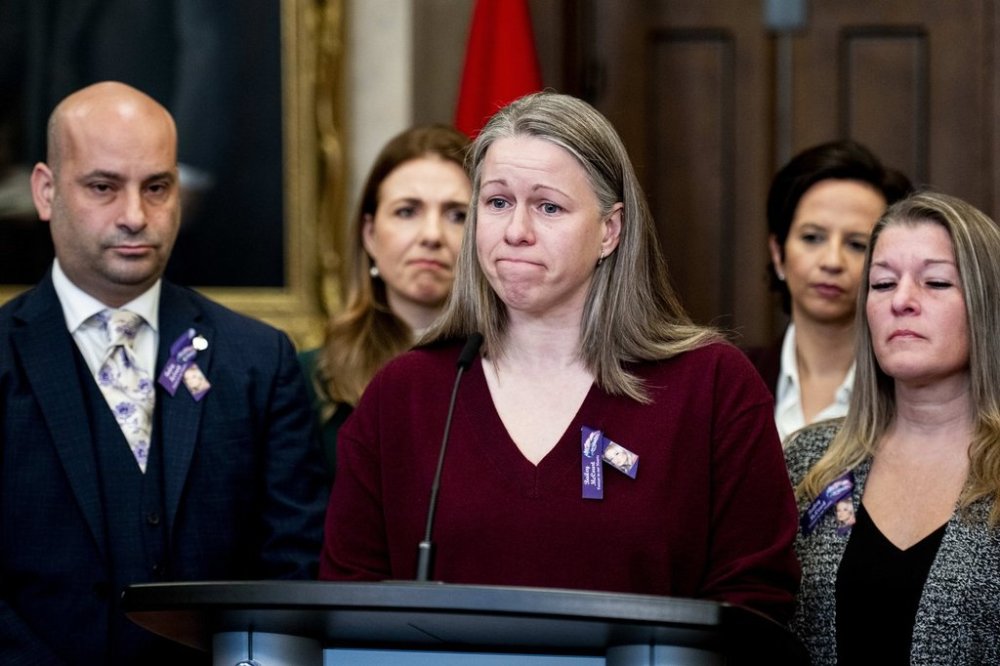
Yet he was released on $500 bail. Less than three hours later, police found Plover’s estranged wife, Bailey McCourt, fatally injured in a hammer attack in a parking lot about four kilometres from the courthouse. The next day, Plover was arrested and charged with her murder.
McCourt’s killing helped trigger a new provincial framework to guide those in the justice system to better respond to intimate partner violence, as well as new federal legislation to address violence against women, both unveiled on Tuesday.
But advocates say risk-assessment tools have existed for decades — yet are underused, often ignored and applied inconsistently.
These tools include a wallet card for police, the “BC Summary of Intimate Partner Violence Risk Factors,” that guides police as they investigate, provide victim support and consider “offender management.”
The B.C. Ministry of Public Safety and Solicitor General had declined to provide the guidelines, saying they would not share “training materials or tools used by police,” while acknowledging that the risk-factor tool was used “to collect and share risk information with Crown counsel for bail purposes.”
RCMP in Ottawa also declined to share its risk-assessment policy.
But The Canadian Press obtained a copy of the B.C. document, marked “confidential.” It lists nine risk factors associated with increased likelihood and severity of future intimate partner violence, including strangulation, escalation of abuse, coercive behaviour, suicidal ideation by a suspect and previous use of weapons.
“Complete mandatory B.C. bail comments and intimate partner violence risk page on PRIME,” it says, referring to a police records management system.
The ministry confirmed in a statement that Crown counsel relies on police and correctional agencies to provide information about the risk posed by an accused person.
“The Summary of Intimate Partner Violence Risk Factors is not a formal risk assessment tool but rather, is a tool to structure approaches to investigations and evidence gathering for IPV cases,” it said.
The statement said police share risk information with Crown counsel for bail purposes, adding that it recognizes “the need for better risk assessments in cases involving intimate partner violence.”
‘NOBODY DIGS IN DEEPER’
Angela Marie MacDougall, the executive director of Battered Women’s Support Services in Vancouver, said her organization has been calling for standardized risk assessments in intimate partner violence cases since the killing of Stephanie Forster three years ago. She was shot to death outside her Coquitlam, B.C., home on Dec. 8, 2022.
Forster had reported being stalked by her ex-husband, who was later identified as the main suspect in her killing, but he shot himself two days later when his vehicle was pulled over by police.
MacDougall said advocacy in Forster’s case was “very specific” because “police got away without acting on the risk.”
She said if police don’t do the risk assessment, they can’t provide it to the court and “nobody digs in deeper.”
“That’s the issue,” she said. “Crown counsel relies on their risk assessment, so if there’s no risk assessment, then the Crown may or may not request one, and then the judges have no information either.”
Justice Canada said in a statement there is no federal standard for risk assessments and each province is responsible for conducting criminal investigation and prosecutions.
However, similar calls for evenly applied and standardized risk assessments are also happening elsewhere in Canada.
Lawyer Deepa Mattoo, executive director of the Barbra Schlifer Commemorative Clinic in Toronto, echoed MacDougall’s calls. She said assessments used by law enforcement tend to focus on the accused person’s risk of reoffending, but, in the case of intimate partner violence, sometimes excludes the person at the centre of that risk.
She said that’s why her clinic created its own tool called the Risk Identification and Safety Assessment, a standardized questionnaire for mediators, lawyers and other front-line workers so they can assess women’s situations, provide the right resources, and help guide them and their children to safety.
The tool assesses risk and safety, using a questionnaire and worksheet that examines safety and risk factors.
“We believe that there should be a risk assessment that should be done with survivor-centred framework, so that the decision-makers can better anticipate the risks that survivor is expecting, and then there can be mitigation of those risks,” Mattoo said.
B.C.’s Attorney General Niki Sharma said on Tuesday that calls for consistency in the use of risk assessments “across B.C.’s legal system” had been heard as she announced the provincial measures, while calling newly tabled federal legislation “a step toward justice.”
Sharma said one of the top three areas of focus will be “exploring how to implement timely, appropriate and standardized risk assessments, screening and safety planning, both in criminal and family court processes.”
She said the province will also be establishing a comprehensive provincial framework to provide guidance to all those within the justice system to help better respond to intimate partner violence. B.C. will also be creating an “internal government accountability mechanism to monitor the implementation” of reforms, she added.
The changes come after the release of a systemic review in June of the province’s treatment of victims and survivors of sexual assault and intimate partner violence in the legal system.
Meanwhile, the federal government’s new Protecting Victims Act includes classifying femicide — including cases relating to an intimate partner — as first-degree murder.
That move came after it tabled the Bail and Sentencing Reform Act in October, which included more than 80 proposed amendments to the Criminal Code including stricter bail laws that would reverse onus and require the accused to prove why they should be released on bail.
Amanda Ross, lawyer and partner at Goldbloom Ross Cunningham in Toronto, said the idea of reverse onus would likely work in the worst cases, but would have negative impacts if such a “sweeping change” is made. She said judges assess each situation individually because “no two cases are the same.”
Politicizing the issue with overarching policies may have negative consequences in most cases because nuance is needed in criminal court, she said.
Ross said that though the Criminal Code is applied federally, each province uses different mechanisms in court.
She said she was aware of a risk assessment that Ontario police use in consultation with a complainant in cases where intimate partner violence is alleged, but said it is a form that often does not hold much weight in the courtroom.
“You will see that in bail court as part of the bail plan,” Ross said of risk assessments done by police.
But she said the information is “really premised on the police doing that and then notifying the Crown attorney of it.”
Ross, who has worked as a defence lawyer and as a victim advocate in such cases, noted she has never heard a Crown attorney refer to the assessment in a bail hearing.
“I would not be confident looking at these forms, that the answers that are provided are one, accurate, or two, very meaningful, and so that might also be an aspect of why you don’t typically see them referred to in bail hearings.”
Ross noted that it is rare for a judge to order someone into custody before sentencing, if they were out on bail before conviction, as was Plover.
But judges do have the power to revoke bail after conviction.
Stephen Hayes was convicted in October of careless use of a firearm and breaking into a home in West Kelowna, B.C., for the purpose of uttering a death threat, in what B.C. Supreme Court Judge Briana Hardwick called “obvious intimate partner violence.”
Hayes had been out on bail since his arrest but after his conviction by a jury, Hardwick revoked it, in a decision MacDougall called “notable” and “rare” in B.C. and across Canada.
MacDougall said the move to standardize risk assessments in B.C. is the “most meaningful” action announced on Tuesday — both provincially and federally.
“It takes the potential for harm out of the hands of the victim, and it (puts) more of the onus on the system to act on those clearly identifiable evidence based risks of lethality,” she said.
She said lethal violence in an intimate partner violence context “rarely comes out of nowhere.”
“Instead, it follows patterns, and the risk assessment helps us recognize those patterns to support intervention and protection for victims, but also to hold those that are doing harm accountable.”
This report by The Canadian Press was first published Dec. 10, 2025.