

Carney heads to China next week for first visit by a prime minister in eight years
Advertisement
Read this article for free:
or
Already have an account? Log in here »
To continue reading, please subscribe:

Digital Subscription
One year of digital access for only $205*
- Enjoy unlimited reading on winnipegfreepress.com
- Read the E-Edition, our digital replica newspaper
- Access News Break, our award-winning app
- Play interactive puzzles
*First annual payment billed as $205.00 + GST for one year. This annual subscription will automatically renew at $233.00 + GST every 52 weeks (10% off the regular annual price of $259.35). Offer available to new and qualified returning subscribers only. Cancel any time.
To continue reading, please subscribe:
Add Free Press access to your Brandon Sun subscription for only an additional
$1 for the first 4 weeks*
- Enjoy unlimited reading on winnipegfreepress.com
- Read the E-Edition, our digital replica newspaper
- Access News Break, our award-winning app
- Play interactive puzzles
*Your next Brandon Sun subscription payment will increase by $1.00 and you will be charged $17.95 plus GST for four weeks. After four weeks, your payment will increase to $24.95 plus GST every four weeks.
Read unlimited articles for free today:
or
Already have an account? Log in here »
Hey there, time traveller!
This article was published 07/01/2026 (271 days ago), so information in it may no longer be current.
OTTAWA – Prime Minister Mark Carney will meet with President Xi Jinping in Beijing next week as he makes the first official trip to China by a Canadian prime minister in more than eight years.
Carney’s office on Wednesday confirmed the China trip and a planned visit to Switzerland for the World Economic Forum. The China visit is part of Ottawa’s efforts to restore ties with China after years of trade and political tensions.
“We should go in there with our eyes wide open,” said Lynette Ong, a professor of Chinese politics at the University of Toronto’s Munk School of Global Affairs. “We need to engage with China out of necessity.”
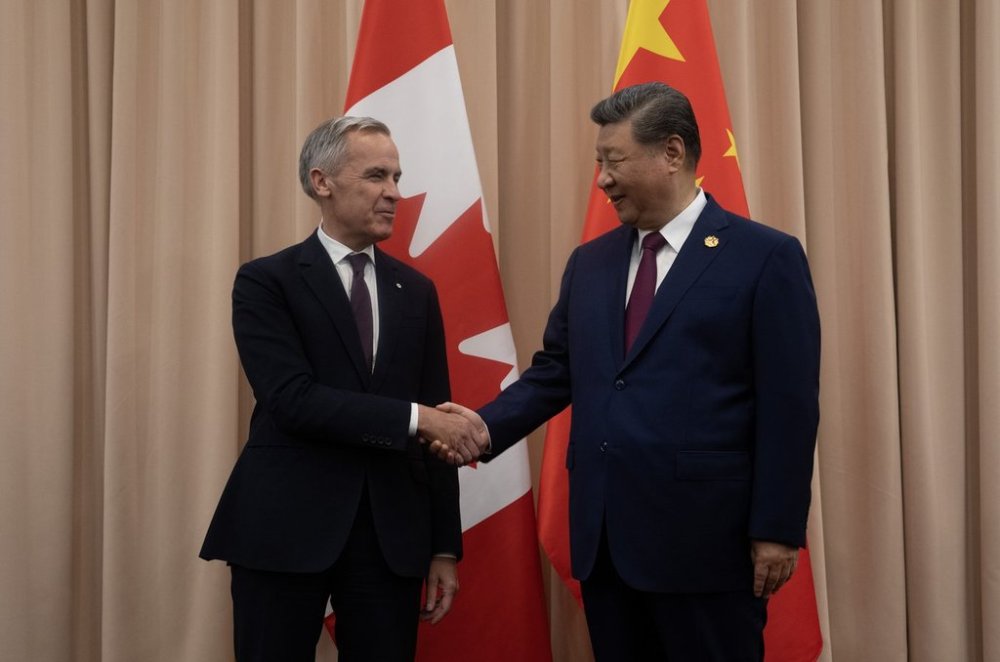
A statement from the Prime Minister’s Office said the trip, which runs Jan. 13 to 17, will build on the first meeting between Carney and Xi at the Asia-Pacific Economic Cooperation forum in South Korea on Oct. 31.
That was the first official meeting between the leaders of Canada and China since former prime minister Justin Trudeau travelled to China in December 2017.
Carney is also set to attend the World Economic Forum in Davos, Switzerland, from Jan. 19 to 21. The Prime Minister’s Office said he plans to meet with investors and government and business leaders at the event.
The diplomatic relationship between Canada and China nearly disintegrated in 2018 following Canada’s arrest of a Chinese telecom executive at the request of the United States. Beijing subsequently jailed two Canadians who had been working in China — acts which Canada called arbitrary.
Michael Kovrig and Michael Spavor were held in jail for nearly three years. They were released in September 2021 after a deferred prosecution agreement was reached between the U.S. and China in the fraud case against Huawei executive Meng Wanzhou.
In 2022, Xi was recorded berating then-prime minister Justin Trudeau at a reception during a G20 summit in Indonesia. Beijing has repeatedly criticized Canada for calling out human rights abuses in China.
Trade relations have also suffered. Canada has imposed a 100 per cent tariff on Chinese electric vehicles and a 25 per cent import tax on steel and aluminum over the last two years.
China responded by hitting Canada with a 100 per cent tariff on various agricultural products last March, including canola and peas, plus a 25 per cent levy on pork and seafood products.
China’s ambassador to Canada has said that Chinese tariffs would be removed if Canada dropped its EV tariffs.
Ong said Carney and Xi could land a deal to draw down Canada’s electric vehicle tariffs in exchange for China loosening its agricultural levies. That, she said, could be part of a statement about deeper engagement and possibly the first step toward trade talks.
Ong said that if Canada and China don’t agree to drop their tariffs entirely, a 50 per cent reduction “would be quite a concession (and) would be a gesture of goodwill. And I think it would benefit Canadian consumers.
“I am pretty hopeful. I think geopolitics has changed quite a bit from 2018 (and) the arrest of the two Michaels.”
Saskatchewan Premier Scott Moe wrote on social media he’s pleased that Carney is visiting China and he hopes the prime minister can convince Beijing to drop its agricultural tariffs.
“If we are truly serious about securing, diversifying and expanding Canadian markets around the world, this is a country we should engage with in a serious way,” Moe wrote.
Ong said China is motivated to build stronger ties with Canada because its economy is suffering from a weak property market and high youth unemployment, despite a thriving tech sector. Both countries are trying to diversify their trade away from the U.S. market.
Still, Ong said her research has found China slaps restrictions on Canadian goods that have the lowest economic impacts on China, while encouraging countries to rely on Chinese goods that they would struggle to source elsewhere.
“We need to be very careful about China weaponizing dependency,” she said.
She also said Canada “should maximize our interests” by seeking economic gains while not abandoning its values. “It is in Canadian interests to defend democracies, to defend liberty and freedom,” she said.
Carney said in September that Ottawa should be “clearer about where we engage” with China — that Canada could collaborate “deeply” with Beijing on energy, climate change and basic manufacturing, while maintaining “guardrails” around national security matters.
Since taking office, Carney has said that Canada’s strategy is to work with China where there is common ground and respect differences while defending Canadian interests.
For years, Beijing has urged Canada to focus on shared priorities instead of flashpoints such as China’s repression in Hong Kong and allegations of human rights abuses targeting Uyghurs and other minorities.
Carney’s private meeting with Xi in October lasted about 40 minutes. While no movement on trade issues came out of it, Xi invited Carney to visit China in the new year.
Carney said he was “very pleased’ with that meeting and suggested it represented a “turning point” in Canada-China relations.
That’s a sharp turn from comments Carney made during the leaders’ debate in the spring federal election, when he described China as “the biggest security threat” facing Canada. Carney later attributed the threat to Chinese foreign interference activities in Canadian politics and China’s activity in the Arctic.
After the October meeting, Carney said he raised the issue of foreign interference with Xi and that Beijing does not understand how seriously Canada takes the issue.
Last January, a federal inquiry concluded that “China is the most active perpetrator of foreign interference targeting Canada’s democratic institutions” at all levels.
Beijing insists it does not interfere in other countries’ affairs and has called on Canada to do the same regarding matters it deems to be domestic, such as the status of Taiwan.
Ong said Beijing likely will continue to target Chinese-Canadians through political interference and transnational repression, regardless of how much trade takes place between the two countries, “because of the sheer size of Chinese diaspora in this country.”
“We have to think about separate measures to insulate ourselves from those harms,” she added.
While in China, Carney will also meet Chinese Premier Li Qiang and business leaders to discuss trade, energy, agriculture and international security.
Carney is likely to visit China again this year in November, when the Asia-Pacific Economic Co-operation forum hosts leaders in the tech hub of Shenzhen.
This report by The Canadian Press was first published Jan. 7, 2026.
— With files from Sarah Ritchie