

Harper paints picture of united Canada in face of danger

Advertisement
Read this article for free:
or
Already have an account? Log in here »
To continue reading, please subscribe:

Digital Subscription
One year of digital access for only $205*
- Enjoy unlimited reading on winnipegfreepress.com
- Read the E-Edition, our digital replica newspaper
- Access News Break, our award-winning app
- Play interactive puzzles
*First annual payment billed as $205.00 + GST for one year. This annual subscription will automatically renew at $233.00 + GST every 52 weeks (10% off the regular annual price of $259.35). Offer available to new and qualified returning subscribers only. Cancel any time.
To continue reading, please subscribe:
Add Free Press access to your Brandon Sun subscription for only an additional
$1 for the first 4 weeks*
- Enjoy unlimited reading on winnipegfreepress.com
- Read the E-Edition, our digital replica newspaper
- Access News Break, our award-winning app
- Play interactive puzzles
*Your next Brandon Sun subscription payment will increase by $1.00 and you will be charged $17.95 plus GST for four weeks. After four weeks, your payment will increase to $24.95 plus GST every four weeks.
Read unlimited articles for free today:
or
Already have an account? Log in here »
Hey there, time traveller!
This article was published 05/02/2026 (224 days ago), so information in it may no longer be current.
There are moments in Canadian politics when a message is so pointed, so carefully chosen, it’s impossible to pretend it was meant only for the people in the room.
The unveiling of former prime minister Stephen Harper’s official portrait on Tuesday in Ottawa was one of those moments.
On paper, it was a ceremony steeped in tradition — a gathering of ministers, former MPs and dignitaries in the Sir John A. Macdonald Building, the sort of Ottawa event where the words are usually polite and the stakes are low.
But Harper’s remarks were anything but ceremonial filler. They were not the safe, soft platitudes of a retired leader content to be politely applauded and quietly shelved into history.
They sounded more like a warning shot about the very existence of Canada. It’s difficult not to conclude he was speaking directly to separatist forces in Quebec and in his home province of Alberta.
“I sincerely hope that mine is just one of many portraits of prime ministers from both parties that will continue to be hung here for decades and centuries to come,” Harper said.
“But that will require that in these perilous times, both parties, whatever their other differences, come together against external forces that threaten our independence and against domestic policies that threaten our unity.”
And then came the kicker.
“We must preserve Canada,” said Harper. “We must make any sacrifice necessary to preserve the independence and the unity of this blessed land.”
That is not the language of a person simply reflecting on their legacy. That is the language of someone who thinks the country is in danger, not only from the outside, but from within.
He is not wrong.
Canada is living through an era when separatism, once considered an exhausting relic of the 1980s and 1990s, is creeping back into respectable conversation in different forms and in different provinces, but with the same corrosive effect.
In Quebec, the sovereignty movement never truly died. It simply hibernates until conditions are favourable again. A constitutional dispute. A cultural flashpoint. A federal government that stumbles into arrogance. A leader who decides the moment is right.
And there is talk again by the Parti Quebecois of holding another referendum on separation should they win the next provincial election.
In Alberta, separatism used to be the political equivalent of yelling at a television: loud, emotional, but ultimately unserious. Today, it is closer to a strategy. It has been dressed up in the language of “sovereignty,” “autonomy,” “provincial rights,” and “standing up to Ottawa.”
The problem is that too many politicians now treat it like a harmless rhetorical device — something to be flirted with, not something to be feared.
Alberta Premier Danielle Smith is the most obvious example. She has built her political brand around conflict with Ottawa, and her government has spent considerable time normalizing the idea that Alberta is trapped in a federation rigged against it.
There are legitimate grievances in Alberta. Anyone pretending otherwise is not paying attention. Equalization remains a sore point. Energy policy is a constant battleground.
But there is a difference between grievance and rupture.
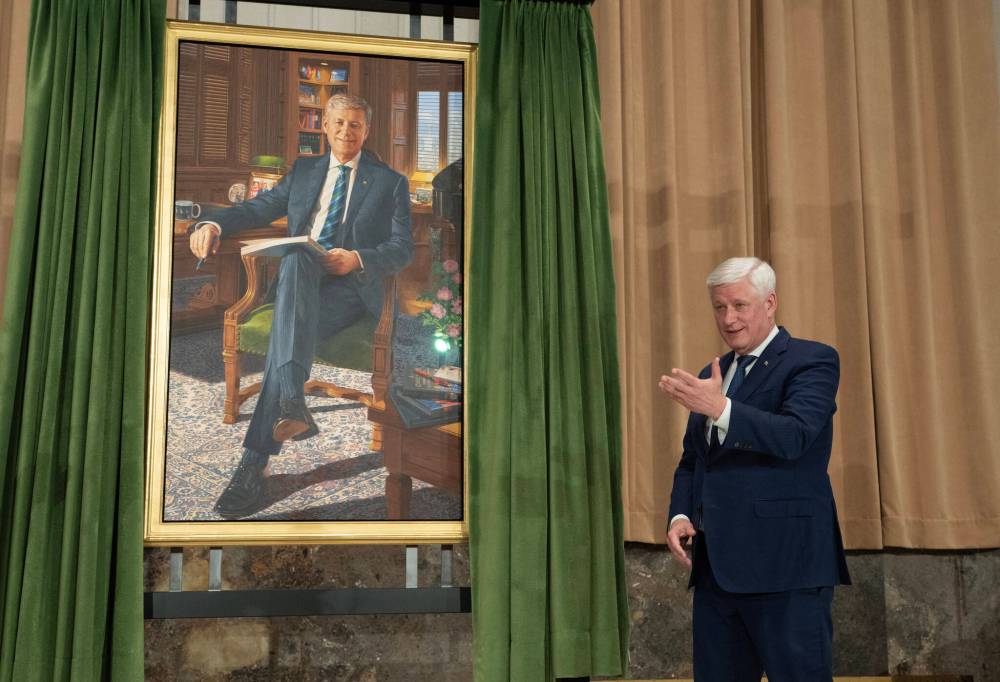
Former prime minister Stephen Harper gestures to the artist after he unveiled his official portrait during a ceremony in Ottawa, on Tuesday. (Adrian Wyld / The Canadian Press)
Harper understood that difference instinctively. Smith, too often, seems willing to blur it for political advantage.
Which brings us to the deeper irony of Tuesday’s ceremony: Harper, the very symbol of modern Conservative power, was making the case for national unity at a time when parts of the conservative movement in Canada are increasingly comfortable playing footsie with disunity.
Whatever one might think about Harper during his time in office, he was a nation builder. And he he did so by constructing a coalition that was not confined to Alberta’s boundaries. He understood the blunt truth that too many Alberta politicians forget: you cannot change Canada by threatening to leave it.
You change Canada by winning it.
That required Harper to be something that today’s separatist-curious Conservatives rarely attempt to be: persuasive to Canadians who don’t already agree with them.
Harper didn’t treat the rest of the country as an enemy. He treated it as a challenge.
That’s why one of the most significant moves of his early tenure was his government’s motion recognizing Quebec as a “nation” within a united Canada.

Contrast that with what we see now in Alberta, where the language of “sovereignty” is increasingly used not to strengthen Alberta’s position inside Canada, but to keep one foot permanently outside the door.
Smith and others may insist they do not support separation. But politics is not only about what leaders personally believe; it is about what they legitimize.
When a premier regularly frames Ottawa as an occupying force, when provincial legislation is designed to test constitutional limits, when separation talk is tolerated as “understandable frustration,” the message to voters is clear: Canada is optional.
Harper’s message Tuesday was the opposite: Canada is essential and it’s worth keeping together.
tom.brodbeck@freepress.mb.ca
Tom Brodbeck is an award-winning author and columnist with over 30 years experience in print media. He joined the Free Press in 2019. Born and raised in Montreal, Tom graduated from the University of Manitoba in 1993 with a Bachelor of Arts degree in economics and commerce. Read more about Tom.
Tom provides commentary and analysis on political and related issues at the municipal, provincial and federal level. His columns are built on research and coverage of local events. The Free Press’s editing team reviews Tom’s columns before they are posted online or published in print – part of the Free Press’s tradition, since 1872, of producing reliable independent journalism. Read more about Free Press’s history and mandate, and learn how our newsroom operates.
Our newsroom depends on a growing audience of readers to power our journalism. If you are not a paid reader, please consider becoming a subscriber.
Our newsroom depends on its audience of readers to power our journalism. Thank you for your support.
Tom Brodbeck is an award-winning author and columnist with over 30 years experience in print media. He joined the Free Press in 2019. Born and raised in Montreal, Tom graduated from the University of Manitoba in 1993 with a Bachelor of Arts degree in economics and commerce. Read more about Tom.
Tom provides commentary and analysis on political and related issues at the municipal, provincial and federal level. His columns are built on research and coverage of local events. The Free Press’s editing team reviews Tom’s columns before they are posted online or published in print – part of the Free Press’s tradition, since 1872, of producing reliable independent journalism. Read more about Free Press’s history and mandate, and learn how our newsroom operates.
Our newsroom depends on a growing audience of readers to power our journalism. If you are not a paid reader, please consider becoming a subscriber.
Our newsroom depends on its audience of readers to power our journalism. Thank you for your support.
Related Articles
Harper says Canada's difficulties can't all be blamed on Trump in gala speech
Advertisement Advertise With Us
Advertisement Advertise With Us