

What is dry lightning and why is it worrying firefighters in British Columbia?
Advertisement
Read this article for free:
or
Already have an account? Log in here »
To continue reading, please subscribe:

Digital Subscription
One year of digital access for only $205*
- Enjoy unlimited reading on winnipegfreepress.com
- Read the E-Edition, our digital replica newspaper
- Access News Break, our award-winning app
- Play interactive puzzles
*First annual payment billed as $205.00 + GST for one year. This annual subscription will automatically renew at $233.00 + GST every 52 weeks (10% off the regular annual price of $259.35). Offer available to new and qualified returning subscribers only. Cancel any time.
To continue reading, please subscribe:
Add Free Press access to your Brandon Sun subscription for only an additional
$1 for the first 4 weeks*
- Enjoy unlimited reading on winnipegfreepress.com
- Read the E-Edition, our digital replica newspaper
- Access News Break, our award-winning app
- Play interactive puzzles
*Your next Brandon Sun subscription payment will increase by $1.00 and you will be charged $17.95 plus GST for four weeks. After four weeks, your payment will increase to $24.95 plus GST every four weeks.
Read unlimited articles for free today:
or
Already have an account? Log in here »
The BC Wildfire Service has warned that this week could be a crucial period for firefighters in the province as conditions converge to create what director of wildfire operations Cliff Chapman calls a “significant wildfire event.”
Chapman says the phenomenon of dry lightning is “highly concerning,” and combined with parched conditions and high winds it could be associated with up to 150 fire starts in a day. As of Wednesday morning, British Columbia had a total of about 20 active fires.
Here’s an explanation about dry lightning and why it’s now of such concern.
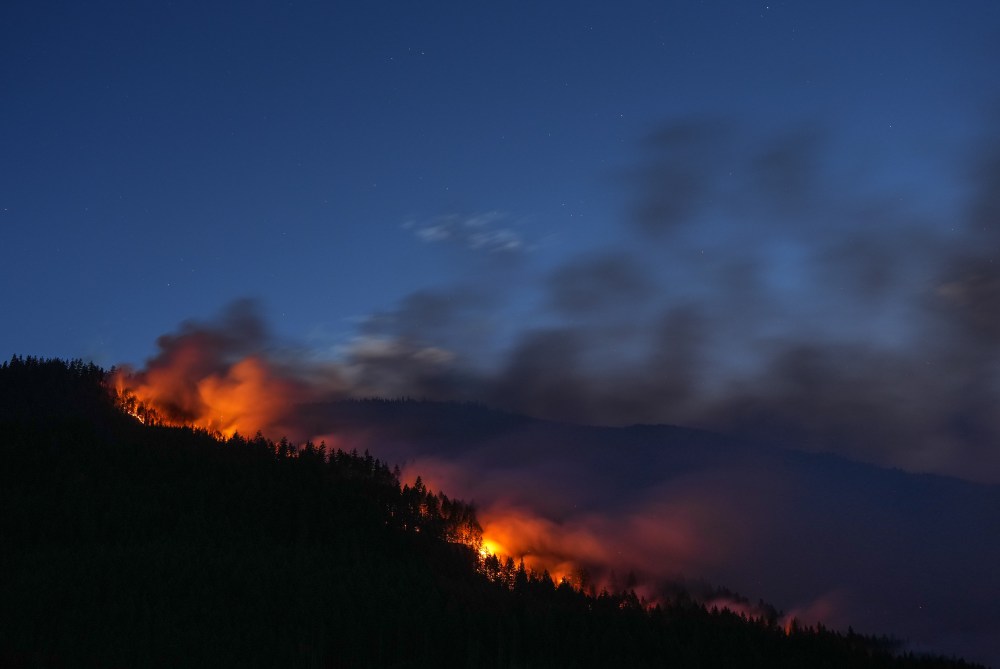
WHAT IS DRY LIGHTNING?
As the name suggests, dry lightning is associated with little or no precipitation. Chapman says that without moisture to inhibit fire growth, firefighters lose the time needed to respond in the early stages of a blaze.
Natural Resources Canada says it can result in a destructive cycle — large fires can produce their own weather in the form of towering pyro-cumulonimbus clouds that often produce dry lightning.
WHERE AND WHEN IS IT EXPECTED?
Chapman says that the southeast third of the province can expect high winds and dry lightning “with very little or no precipitation” from Wednesday afternoon into Friday. He says that means a “very high potential of wildfire starts and wildfire spreads” from what he calls a “swath of dry lightning.”
While lightning is also expected in the northeast of B.C., Chapman says fuels there are expected to be “less receptive” to fire starts.
HOW ARE FIREFIGHTERS PREPARING?
Chapman says the wildfire service has “all aviation assets engaged,” on alert and ready to respond to new starts. He says crews are ready for “aggressive initial attack,” and that communities should prepare by having go-bags ready and evacuation procedures prepared.
The wildfire service says it uses Environment and Climate Change Canada’s Canadian Lightning Detection Network for an instantaneous supply of lightning data, while comparing it with other data to see if it is associated with rainfall.
Air and ground patrols in known lightning pathways then look for smoke or heat, using thermal scanning devices to find hot spots.
This report by The Canadian Press was first published July 15, 2026.
Related Articles
Northern Ontario fires prompt large-scale evacuations, destroy homes in First Nation
Advertisement Advertise With Us