

What to know about the Bald Range fire and B.C.’s wildfire emergency
Advertisement
Read this article for free:
or
Already have an account? Log in here »
To continue reading, please subscribe:

Digital Subscription
One year of digital access for only $205*
- Enjoy unlimited reading on winnipegfreepress.com
- Read the E-Edition, our digital replica newspaper
- Access News Break, our award-winning app
- Play interactive puzzles
*First annual payment billed as $205.00 + GST for one year. This annual subscription will automatically renew at $233.00 + GST every 52 weeks (10% off the regular annual price of $259.35). Offer available to new and qualified returning subscribers only. Cancel any time.
To continue reading, please subscribe:
Add Free Press access to your Brandon Sun subscription for only an additional
$1 for the first 4 weeks*
- Enjoy unlimited reading on winnipegfreepress.com
- Read the E-Edition, our digital replica newspaper
- Access News Break, our award-winning app
- Play interactive puzzles
*Your next Brandon Sun subscription payment will increase by $1.00 and you will be charged $17.95 plus GST for four weeks. After four weeks, your payment will increase to $24.95 plus GST every four weeks.
Read unlimited articles for free today:
or
Already have an account? Log in here »
Premier David Eby has said British Columbia’s wildfire season turned “brutal,” with a ferocious blaze that led to the death of an 80-year-old woman and forced some 20,000 people out of their homes in the south Okanagan last weekend.
Here are key facts about B.C.’s ongoing wildfire situation, which prompted officials to declare a provincial state of emergency on Aug. 8.
The Bald Range fire
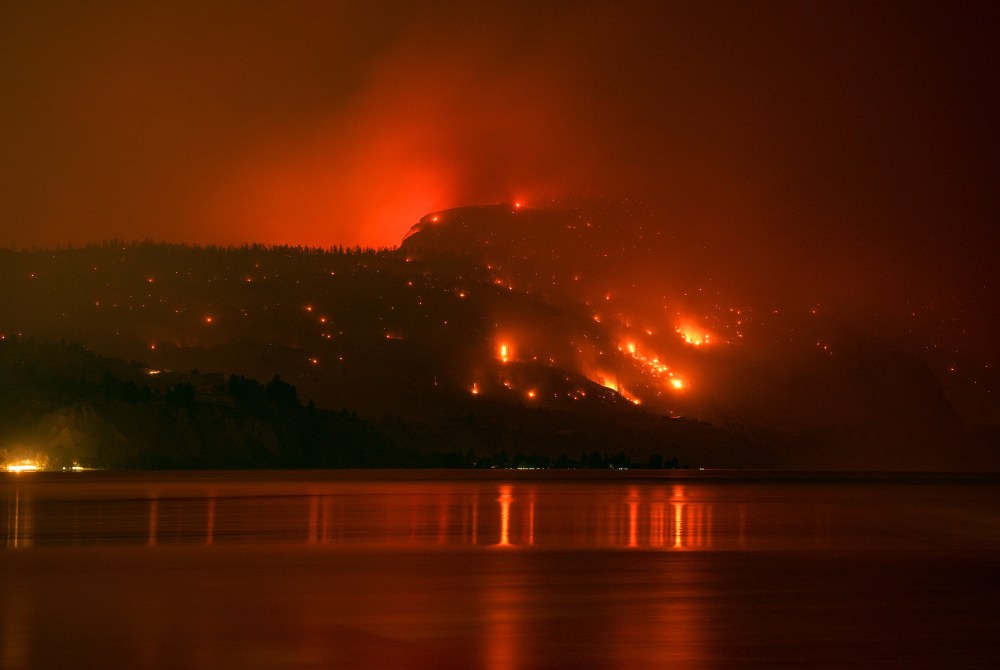
— The stretch of Highway 97 through the evacuated community of Summerland, B.C., has been reopened between 7 a.m. and 7 p.m. after the wildfire forced its closure overnight on Aug. 7.
— The Regional District of Okanagan-Similkameen said there was no stopping and no access to side roads leading to areas still subject to evacuation orders without a temporary pass.
— A drive-through showed parts of Summerland visible from the highway appeared unscathed, though most of the community couldn’t be seen. The La Punta Norte Guest House between the highway and Lake Okanagan was heavily damaged, while a home on the opposite of the route appeared intact, even as the grass surrounding it was blackened.
— The Regional District of Okanagan-Similkameen has said rapid damage assessments started Tuesday in areas north and south of Summerland. There was no timeline for when evacuees may be able to return home.
— The fire spanned about 191 square kilometres on Thursday, up from about 184 square kilometres the day before, burning on the western shores of Okanagan Lake.
— An update from the BC Wildfire Service said periods of clearer skies later Thursday could expose the fire to more direct sunlight, potentially intensifying its behaviour, though cloud cover could be a mitigating factor.
— The service said there was also a chance of thunderstorm activity, which could produce erratic winds, though the extent of the weather system will depend partly on smoke that was moving south towards Penticton, B.C.
— On its southern flank, the fire remained on the western side of Mount Conkle, where crews with heavy equipment had built a roughly 40-kilometre fire guard to help limit its spread.
— The region has seen just two millimetres of rain since July 1, with no measurable rain since the start of August, contributing to the extreme fire risk.
— The B.C. government has said a small herd of iconic mountain goats living on the slopes above Highway 97 in the Summerland area was “thought to have escaped” the blaze.
— Chief Greg Gabriel of the Penticton Indian Band, whose members are among the evacuees, said Wednesday that intensifying wildfires aren’t natural occurrences and more action must be taken to mitigate the blazes along with worsening drought.
— Gabriel also asked the province to address the need for an alternative escape route in the area, where residents described long lines of vehicles as they fled the blaze.
The Brunswick complex
— The Brunswick complex includes the Brunswick Creek and Ainslie Creek fires, together spanning more than 700 square kilometres in B.C.’s Fraser Canyon.
— The fires continue to burn out of control, with the Ainslie Creek blaze pushing east in the direction of the Coquihalla Highway and the City of Merritt, B.C.
— An update from the BC Wildfire Service on Thursday said the fire’s “aggressive” behaviour on its southern flank in the Fraser Canyon was challenging control lines, but the flames hadn’t crossed them.
— The service has said rockfall remained a hazard along stretches of Highway 1, particularly in the China Bar area outside the community of Boston Bar, B.C., where the fire was burning on steep slopes and dislodging debris.
The Pear Lake fire
— The Pear Lake fire continues to burn out of control, scorching nearly 1,500 square kilometres of land since it was detected July 17 in the south Cariboo region, around Clinton, B.C., about 380 or so kilometres northeast of Vancouver.
— A series of evacuation orders and alerts cover parts of the south Cariboo due to the blaze and two others burning nearby, stretching from South Chilcotin Mountains Park in the west to the outskirts of Cache Creek, B.C., in the east.
— The Pear Lake fire prompted the Bonaparte First Nation to issue an evacuation order for two of its reserves located along Highway 99 west of Cache Creek this week.
— An evacuation order was downgraded for a handful of properties south of 70 Mile House on Wednesday but remained in effect for about 450 properties in the Bonaparte Plateau, part of the Thompson-Nicola Regional District.
— An evacuation alert remained in surrounding areas, along with several other alerts from the Squamish-Lillooet and Cariboo regional districts.
— The wildfire service has said crews were continuing to extinguish hot spots around the perimeter of the massive blaze, guided by infrared scanning completed at night.
— The Pear Lake blaze surged about a week after its discovery, and while the village of Clinton, B.C., was largely spared, officials have said the fire has destroyed structures on 170 properties in the area.
Elsewhere in B.C.
— RCMP in Princeton, B.C., said Thursday that they arrested a person for starting a fire that was quickly extinguished by the local fire department on Aug. 9.
— The Mounties said they received a 911 call reporting a fire in an open area near Similkameen Avenue that evening and investigators identified a suspect who was held for consideration of charges before they were released with conditions.
— Orange-level air quality warnings from Environment Canada were in effect Thursday for parts of the Fraser Valley and south Okanagan regions, while lower-level yellow bulletins covered much of the rest of the southern Interior, stretching from the Fraser Canyon to the West Kootenays.
— The Metro Vancouver Regional District also issued an orange-level warning due to elevated levels of fine particulate matter in the air, with the highest risk in the eastern Fraser Valley, around Chilliwack, B.C.
— The Quilpituk Creek fire has been declared “held,” meaning it’s expected to remain within its current boundary based on forest fuels, weather conditions and firefighting resources as it burns on the western shores of Okanagan Lake.
— An update from the Central Okanagan emergency management centre on Thursday said it was deploying a rapid damage assessment team that would look at any damaged power infrastructure and potentially dangerous trees.
— The centre said it would share details with evacuated residents on Friday about when they can expect to return home.
— To the north, the Bradley Creek fire was declared “held” on Aug. 8, a week after destroying more than 200 homes on Okanagan Indian Band lands, but it wasn’t yet clear when residents would be able to return to those homes spared by the flames.
This report by The Canadian Press was first published Aug. 13, 2026.