

QuickQuotes: Reaction to Canada’s retaliation against Trump tariffs
Advertisement
Read this article for free:
or
Already have an account? Log in here »
To continue reading, please subscribe:

Digital Subscription
One year of digital access for only $205*
- Enjoy unlimited reading on winnipegfreepress.com
- Read the E-Edition, our digital replica newspaper
- Access News Break, our award-winning app
- Play interactive puzzles
*First annual payment billed as $205.00 + GST for one year. This annual subscription will automatically renew at $233.00 + GST every 52 weeks (10% off the regular annual price of $259.35). Offer available to new and qualified returning subscribers only. Cancel any time.
To continue reading, please subscribe:
Add Free Press access to your Brandon Sun subscription for only an additional
$1 for the first 4 weeks*
- Enjoy unlimited reading on winnipegfreepress.com
- Read the E-Edition, our digital replica newspaper
- Access News Break, our award-winning app
- Play interactive puzzles
*Your next Brandon Sun subscription payment will increase by $1.00 and you will be charged $17.95 plus GST for four weeks. After four weeks, your payment will increase to $24.95 plus GST every four weeks.
Read unlimited articles for free today:
or
Already have an account? Log in here »
OTTAWA – Canada is hiking tariffs to 50 per cent on some American products after the U.S. did the same on billions of dollars worth of Canadian exports on Saturday.
The latest trade escalation comes after the two countries failed to reach a new deal by a deadline imposed by U.S. President Donald Trump.
Here’s what politicians and industry leaders are saying in response:
———
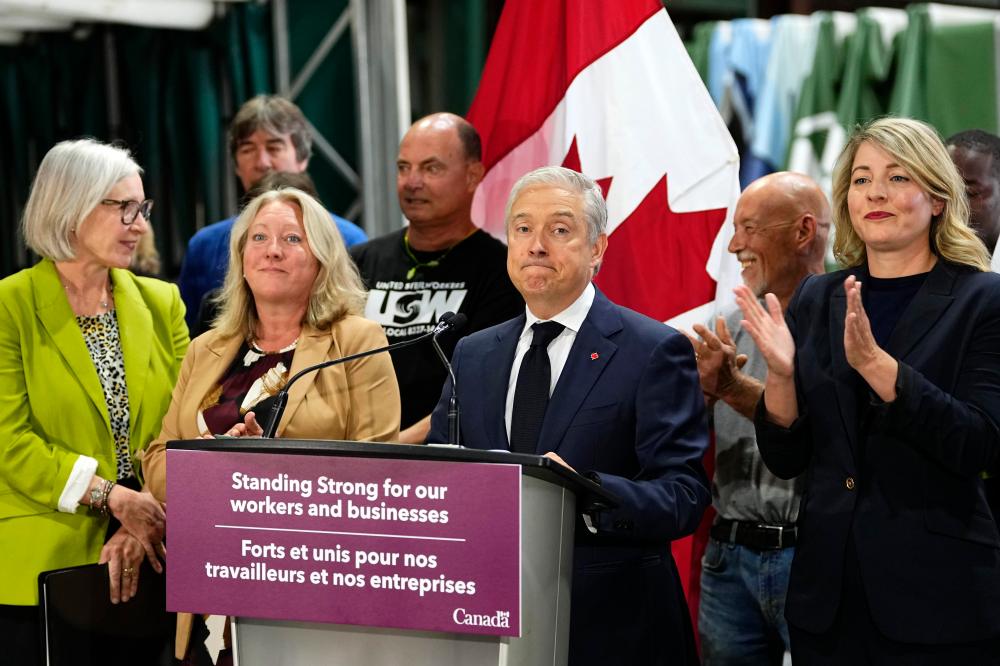
“This is an unprecedented challenge imposed on Canada, but Canada will meet the moment. Canadians will meet the moment, we will meet the moment together. And as the prime minister has said, we will support our workers, our businesses and our industry with whatever it takes for as long as it takes.”
“When the United States of America asked too much and offered too little, we made a choice. We chose Canada.”
Finance Minister François-Philippe Champagne
———
“We cannot control the decisions made in Washington, but we can control what we build here at home. And we are already seeing Canadian companies step up like never before. These companies are showing us what Canada can do when we bet on ourselves.”
“Economic sovereignty means having the capacity to produce, invest and grow in Canada. Building at home is not plan B, it’s plan A.”
Industry Minister Mélanie Joly
———
“We understand the government’s urgency to deliver rapid, agile and simple relief measures, which is why we cannot let red tape get in the way of being effective. We want to give business urgent relief and breathing space at this time, while they work to figure out the path ahead. So, we see that the intention of loans is helpful, but they can also be a monkey on the back when they come due.”
Candace Laing, president and CEO of the Canadian Chamber of Commerce
———
“Canada’s steel producers are highly competitive and throughout this trade dispute initiated by the U.S. administration, we have sought to ensure that we have as level a playing field as possible. The measures the Canadian government took today to increase the tariff on U.S. steel to 50 per cent advances this goal.
Canadian steel producers maintain that no deal is better than a bad deal, and that we continue to have confidence in the Canadian negotiation team in finding a durable, successful path forward.”
Canadian Steel Producers Association
———
“We appreciate the government’s quick action to address the serious pressures facing Canadian industries and impacted families. The forest sector has been one of the hardest hit sectors in this ongoing trade dispute. Duties and tariffs on billions of dollars worth of our products now range from 25 per cent to 85 per cent. The addition of Section 338 tariffs over the weekend make immediate federal support essential to help keep facilities operating and employees connected to their places of work.”
Derek Nighbor, president and CEO of The Forest Products Association of Canada
———
“Associated Equipment Distributors has always had a stance supporting free and fair trade in North America, as the best means for achieving economic prosperity and growth in the sectors our members serve. Tariffs and retaliatory tariffs damage the economies on both sides of the border. Any measures that target equipment that builds, feeds and fuels both countries are detrimental regardless of if they’re imposed by Canada or the United States. AED will continue to work with officials and political leaders on both sides of the border to encourage a return to the bargaining table.”
Brian McGuire, president and CEO of Associated Equipment Distributors
———
“I am encouraging the prime minister to look at non-tariff measures to respond as well to what the Americans are trying to do to Canadians.”
“If you’re angry, I’m angry too. It’s an unjustified attack on our families, and we have been nothing but good to the United States. It makes absolutely no sense. It is an extortionate attempt by the president to force Canada through any means necessary to bend to his whims and his will. We are a sovereign country, we’ve got to stand up for that.”
B.C. Premier David Eby
———
“If reports are correct that the United States was asking for a veto on Canada’s other free trade deals, Prime Minister Mark Carney did the right thing by walking away from the negotiating table. Any language that would have also given the U.S. the ability to change the terms of the deal at a moment’s notice also justifies Carney’s decision. However, the collapse of negotiations and President Donald Trump’s new tariffs should not automatically mean that Canada imposes retaliatory tariffs. Canada’s politicians have been all over U.S. airwaves arguing that tariffs are taxes paid for by domestic consumers. They’re right in making that argument, which is precisely why it would be wrong to impose them here.”
Jay Goldberg, North American affairs manager for the Consumer Choice Center
———
“While we appreciate that the government is trying to move quickly, at first glance it looks like small business owners are being served the usual alphabet soup of complicated programs. They will be challenging for small business owners to figure out, let alone use.”
“While I respect Canada’s need to respond to the U.S. threat, the giant list of counter tariffs will create their own severe challenges for many small businesses who have already done what they can to seek new sources of supply. Canada’s support programs need to be available for companies that use, import or distribute U.S. products too.”
Dan Kelly, president of the Canadian Federation of Independent Businesses
———
“Alberta will continue working directly with small businesses and industry to understand the pressures they are facing and determine whether additional provincial measures are needed. Alberta’s government remains concerned that tariffs and counter-tariffs increase costs, disrupt supply chains, put pressure on businesses and workers, and ultimately risk escalation to even higher and broader tariffs that will impact even more Canadians. We should do all we can to avoid further escalation.
“There is still time before these counter-tariffs take effect on Sept. 8, and I am urging the federal government to use that time to get back to the negotiating table with the United States.”
Alberta Premier Danielle Smith
———
“We are analyzing the counter-tariff list closely and working with affected industries to determine its potential impact on jobs and consumer prices, while also reviewing the federal government’s support measures to ensure they work for Saskatchewan businesses and workers.
“While this is the appropriate response to the latest round of U.S. tariffs, we can never lose sight of the fact that all tariffs hurt businesses, jobs, consumers and families on both sides of the border, and our ultimate goal must be to get back to a free and fair trade relationship with the U.S., as we have enjoyed for many years.”
Saskatchewan Premier Scott Moe
———
“Today’s measures will help workers and keep people on the job. But as the trade war escalates, support for workers needs to keep pace.
“Too many workers still fall through the cracks of EI, and for many who qualify, the benefits aren’t enough when a good-paying job disappears. The government needs to be ready to go further, making EI easier to access, increase the amount workers receive, and ensuring workers have the support they need for as long as this trade war lasts.”
Bea Bruske, president of the Canadian Labour Congress
———
“Canada has every right to respond to unjustified U.S. tariffs. However, counter-tariffs can also increase costs for Canadian manufacturers that depend on U.S. inputs, particularly small manufacturers with limited ability to change their supply chains. The government must continue providing timely tariff remission where essential goods cannot be sourced competitively or efficiently in Canada.
These measures will help manufacturers weather the immediate shock, but they cannot replace stable, tariff-free trade. The ultimate objective must remain the removal of U.S. tariffs and a durable agreement that restores certainty for manufacturers and workers on both sides of the border.”
Dennis Darby, president and CEO of Canadian Manufacturers & Exporters
———
“Choosing no deal over a deeply damaging deal required resolve and was the responsible course of action. Accepting an inadequate agreement now would have imposed deeper, long-term costs on Canadians than the immediate pressure of a tariff dispute. This moment demands national discipline and unity. Canada’s leverage depends on one clear, co-ordinated position.
We do not minimize the impact of these tariffs. Canadian families will face higher costs, businesses will confront disrupted supply chains, and workers will feel the pressure directly.”
“We cannot waver from our long-term objective of a strong and durable trade agreement that serves Canadians from coast to coast to coast. We urge business, civic and political leaders across the country to publicly and consistently reinforce that objective.”
Canadian Global Cities Council chair Loren Remillard and vice-chair Giles Gherson
This report by The Canadian Press was first published Aug. 25, 2026.
Related Articles
Ottawa to hit U.S. back with tariffs on steel, aluminum, smartphones and golf clubs
Advertisement Advertise With Us
Advertisement Advertise With Us