

More than 50 countries vow at Toronto summit to save Ukrainian kids from Russia
Advertisement
Read this article for free:
or
Already have an account? Log in here »
To continue reading, please subscribe:

Digital Subscription
One year of digital access for only $205*
- Enjoy unlimited reading on winnipegfreepress.com
- Read the E-Edition, our digital replica newspaper
- Access News Break, our award-winning app
- Play interactive puzzles
*First annual payment billed as $205.00 + GST for one year. This annual subscription will automatically renew at $233.00 + GST every 52 weeks (10% off the regular annual price of $259.35). Offer available to new and qualified returning subscribers only. Cancel any time.
To continue reading, please subscribe:
Add Free Press access to your Brandon Sun subscription for only an additional
$1 for the first 4 weeks*
- Enjoy unlimited reading on winnipegfreepress.com
- Read the E-Edition, our digital replica newspaper
- Access News Break, our award-winning app
- Play interactive puzzles
*Your next Brandon Sun subscription payment will increase by $1.00 and you will be charged $17.95 plus GST for four weeks. After four weeks, your payment will increase to $24.95 plus GST every four weeks.
Read unlimited articles for free today:
or
Already have an account? Log in here »
TORONTO – More than 50 countries signed a pledge Tuesday at a conference in Toronto to boost their efforts to return Ukrainians from Russian captivity — including an estimated 20,000 children.
“We have pledged to find Ukrainians who have been taken from their homes. We have pledged to bring them back, knowing that it can be dangerous, complex, difficult, but above all necessary,” Foreign Affairs Minister Anita Anand said at the conference on Tuesday.
In 2024, Canada and Ukraine jointly launched an international coalition of nations committed to finding and returning Ukrainian children abducted by Russia since it began its full-scale invasion in 2022.
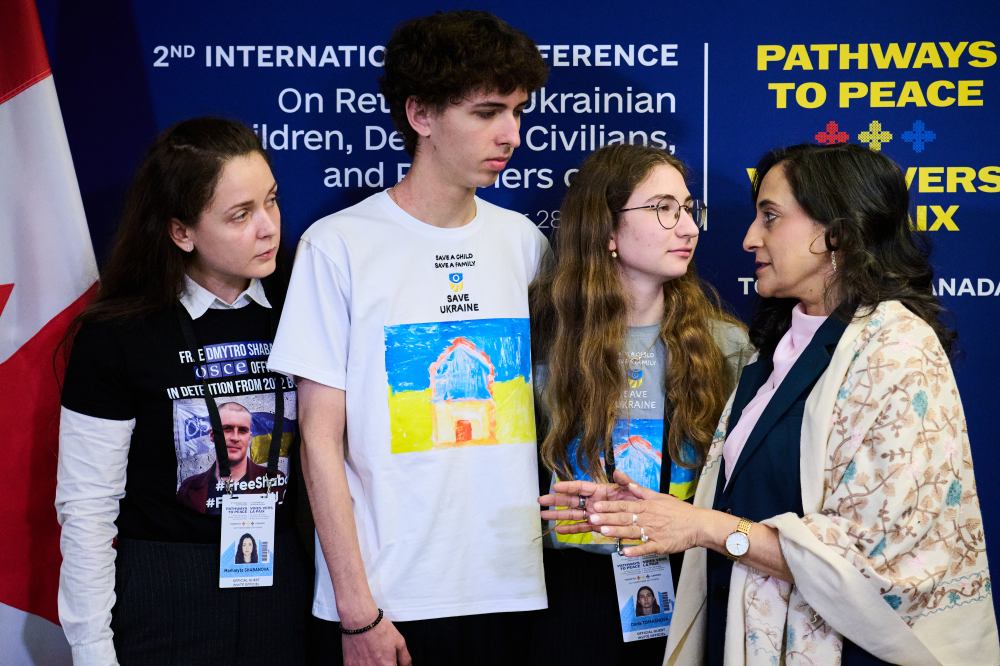
That work has since expanded to include efforts to return adult civilians and prisoners of war taken by Russia since its 2014 seizure of Crimea.
Anand co-hosted the conference in Toronto this week with Ukraine and Norway focused on marshalling efforts to return abducted Ukrainians. She said the conference included representatives from 83 countries and international organizations such as the Council of Europe.
More than 50 of those pledged to better co-ordinate the efforts of governments, civil society and international organizations to reunite Ukrainian families.
Officials in Ukraine say 2,650 of the 20,000 children deported to Russia have been returned. Anand said two-thirds of those returns have taken place since a Montreal conference two years ago.
Bring Kids Back, a coalition launched by Ukrainian President Volodymyr Zelenskyy, has said many of those children have reported being subjected to physical and sexual violence while in captivity.
“Children are brainwashed. They are geared toward military service in the Russian armed forces,” coalition leader Maksym Maksymov said in a Tuesday interview.
“Ukrainian language, culture and history are removed from schools. Everything that is happening there is designed to sever the legal and emotional path back to Ukraine for these young people.”
Maksymov said a report published in July by the Organization for Security and Co-operation in Europe offers independent confirmation of what Ukraine has been saying.
The OSCE — of which Russia and Canada are both members — reported Russian officials have compelled children to change their identities, physically tortured at least 10 kids and placed many in foster families where sexual violence has occurred.
“The practices of systemic indoctrination and militarization may also amount to a crime against humanity in the form of persecution, directed against Ukrainian children on discriminatory grounds, as part of a widespread and systematic attack,” the report reads.
“Canada has provided very significant practical support when it comes to tracing, when it comes to returns, when it comes to reintegration, all of the fronts,” Maksymov said.
Ukrainians attending the conference Monday shared first-hand accounts of life under Russian control. Teenagers from Crimea said they were being primed to fight against their fellow Ukrainians. One woman described her anguish after her husband vanished in Luhansk, only to show up in an online video three months later looking emaciated.
“These aren’t simply unfortunate consequences of war. They are documented violations of international law that demand attention,” Anand said Tuesday.
Ukrainian Social Policy Minister Denys Uliutin urged countries Tuesday to commit to concrete steps.
“Small things that are actually done are worth more to us than large things that were proclaimed on paper,” he told delegates at the close of the meeting.
He said the Montreal summit of two years ago was a success because countries took specific actions. They included the United Arab Emirates and the Vatican taking part in mediation efforts with Russia, and Qatar helping 80 children leave Ukraine. Lithuania also helped by setting up transportation routes.
Uliutin said more pressure needs to be put on Russia to identify the Ukrainians it’s still holding.
He noted 95 per cent of Ukrainian prisoners of war interviewed by United Nations monitors reported experiencing torture.
This week, the European Union announced a new round of sanctions on officials accused of helping to abduct Ukrainian children — something the International Criminal Court calls a war crime.
The European sanctions target a camp in North Korea where Brussels says Russia has sent abducted Ukrainian children. The Songdowon camp is not among the entities Canada has sanctioned.
On Monday, Anand told reporters Canada is using artificial intelligence to help identify Ukrainian children taken into Russia. She said Russian authorities have changed the names of some children, making them harder to track.
Alexandra Chyczij, head of the Ukrainian Canadian Congress, said Tuesday her understanding is that Canada is using data from cellphones owned by Ukrainian youth to establish their initial whereabouts, and using satellite imagery to identify detention centres.
Chyczij said this technology allows authorities to understand what is happening to children deported to Russia and those living in the occupied Ukrainian territories.
“The children who still remain living in occupation are absolutely as vulnerable,” she told reporters. “It really is important to keep raising awareness.”
This report by The Canadian Press was first published Sept. 29, 2026.