

Canada defends refugee pact with United States in appeal hearing
Advertisement
Read this article for free:
or
Already have an account? Log in here »
To continue reading, please subscribe:
Digital Subscription
One year of digital access for only $1.44 a week*
- Enjoy unlimited reading on winnipegfreepress.com
- Read the E-Edition, our digital replica newspaper
- Access News Break, our award-winning app
- Play interactive puzzles
*Billed as $5.77 plus GST every four weeks. After 52 weeks, price increases to the regular rate of $19.95 plus GST every four weeks. Offer available to new and qualified returning subscribers only. Cancel any time.
To continue reading, please subscribe:
Add Free Press access to your Brandon Sun subscription for only an additional
$1 for the first 4 weeks*
- Enjoy unlimited reading on winnipegfreepress.com
- Read the E-Edition, our digital replica newspaper
- Access News Break, our award-winning app
- Play interactive puzzles
*Your next Brandon Sun subscription payment will increase by $1.00 and you will be charged $17.95 plus GST for four weeks. After four weeks, your payment will increase to $24.95 plus GST every four weeks.
Read unlimited articles for free today:
or
Already have an account? Log in here »
Hey there, time traveller!
This article was published 23/02/2021 (1922 days ago), so information in it may no longer be current.
OTTAWA – Judges peppered a federal lawyer with questions Tuesday as the Canadian government argued a refugee pact between Ottawa and Washington is consistent with the Charter of Rights and Freedoms.
Canada’s lawyers contend the Federal Court misinterpreted the law when it declared in July that the Safe Third Country Agreement breaches constitutional guarantees of life, liberty and security.
The court’s declaration of invalidity was suspended for six months and later extended, leaving the law in place while a three-judge panel of the Federal Court of Appeal examines the issue.
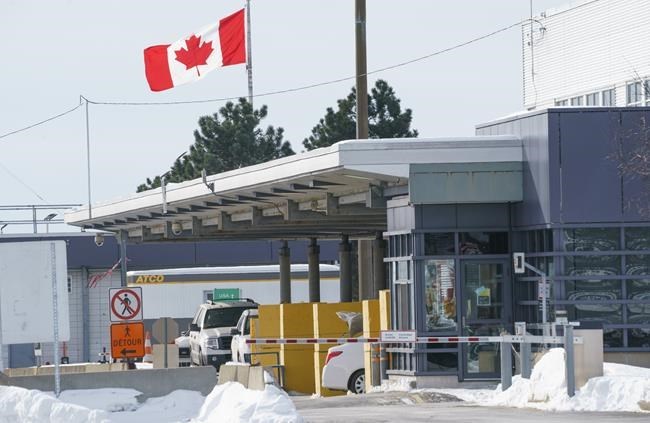
The two-day hearing is slated to proceed through Wednesday.
Under the bilateral refugee agreement, which took effect in 2004, Canada and the U.S. recognize each other as safe places to seek protection.
It means Canada can turn back a potential refugee who arrives at a land port of entry along the Canada-U.S. border on the basis the person must pursue their claim in the U.S., the country where they first arrived.
Canadian refugee advocates have steadfastly fought the asylum agreement, arguing the U.S. is not always a safe country for people fleeing persecution.
Several refugee claimants took the case to court along with the Canadian Council for Refugees, the Canadian Council of Churches and Amnesty International, who participated in the proceedings as public interest parties.
In each case, the applicants, who are citizens of El Salvador, Ethiopia and Syria, arrived at a Canadian land entry port from the U.S. and sought refugee protection.
They argued in court that by returning ineligible refugee claimants to the U.S., Canada exposes them to risks in the form of detention and other rights violations.
In her decision last year, Federal Court Justice Ann Marie McDonald concluded the Safe Third Country Agreement results in ineligible claimants being imprisoned by U.S. authorities.
Detention and the consequences flowing from it are “inconsistent with the spirit and objective” of the refugee agreement and amount to a violation of the rights guaranteed by Section 7 of the charter, she wrote.
“The evidence clearly demonstrates that those returned to the U.S. by Canadian officials are detained as a penalty.”
In a written submission filed in advance of the appeal hearing, the government says the court’s decision should be overturned because the refugee agreement does not breach the principles of fundamental justice.
The government argues McDonald made serious legal mistakes in striking down the pact.
Federal lawyers say that in finding detention makes it more difficult for asylum claimants in the U.S. to access legal counsel, McDonald ignored evidence that about 85 per cent of asylum claimants in the U.S. are represented.
During the appeal hearing Tuesday, Justice David Stratas questioned the notion the judge’s findings were in error.
“You would admit, wouldn’t you, that there is a risk that someone is turned back at the Canadian border and encounters the U.S. system, including detention, without counsel? That’s a possibility?” he asked Martin Anderson, a lawyer for the government.
Anderson replied that when one looks at the “totality of the evidence,” it tends to support the notion more people have access to counsel in detention than not.
The government argues the evidence before the Federal Court showed that neither U.S. asylum law nor practice means automatic detention for those determined to be ineligible to claim refugee status in Canada under the bilateral agreement.
The U.S. asylum regime has “many safeguards to protect against inhumane detention” and Canadian law provides “safety valve mechanisms” to exempt someone from being returned to the U.S., should they face a likely risk of unlawful detention, the federal filing says.
In their submission to the court, the refugee claimants and public interest parties say the federal immigration and public safety ministers have not identified a reviewable error of law.
Even so, they say, the government asks the court to accept “bald assertions that purported ‘safety valves’ at the border found ‘illusory’ by the Federal Court are nevertheless sufficient to save the unconstitutional regime.”
This report by The Canadian Press was first published Feb. 23, 2021.