Holocaust denial — and downplaying the Nazis’ murder of Jews — to be outlawed

Advertisement

Advertise with us

OTTAWA - Holocaust denial is to be outlawed in Canada, in a further effort to stamp out rising antisemitism.

Read this article for free:


or

Already have an account? Log in here »

To continue reading, please subscribe:

Subscribe and receive a limited-edition Free Press branded hat or tote.

Digital Subscription

One year of digital access for only $205*

  • Enjoy unlimited reading on winnipegfreepress.com
  • Read the E-Edition, our digital replica newspaper
  • Access News Break, our award-winning app
  • Play interactive puzzles

*First annual payment billed as $205.00 + GST for one year. This annual subscription will automatically renew at $233.00 + GST every 52 weeks (10% off the regular annual price of $259.35). Offer available to new and qualified returning subscribers only. Cancel any time.

To continue reading, please subscribe:

Add Free Press access to your Brandon Sun subscription for only an additional

$1 for the first 4 weeks*

  • Enjoy unlimited reading on winnipegfreepress.com
  • Read the E-Edition, our digital replica newspaper
  • Access News Break, our award-winning app
  • Play interactive puzzles
Start now

*Your next Brandon Sun subscription payment will increase by $1.00 and you will be charged $17.95 plus GST for four weeks. After four weeks, your payment will increase to $24.95 plus GST every four weeks.

Hey there, time traveller!
This article was published 08/04/2022 (1635 days ago), so information in it may no longer be current.

OTTAWA – Holocaust denial is to be outlawed in Canada, in a further effort to stamp out rising antisemitism.

The federal government is set to make it a criminal offence to make a statement denying the Holocaust took place or condoning or downplaying the killing of Jews by the Nazi regime, except in a private conversation.

Ministers plan to use a bill enacting the budget to swiftly change the Criminal Code, budget documents show.
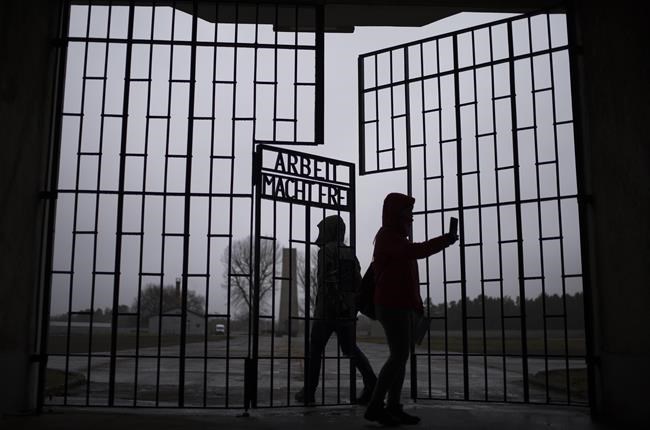
People take photos as they enter the Sachsenhausen Nazi death camp through the gate with the phrase 'Arbeit macht frei' (work sets you free), in Oranienburg, about 30 kilometres north of Berlin, Tuesday, Jan. 25, 2022. The Federal government is to use a bill enacting the budget to change the Criminal Code this year, building on existing laws outlawing the incitement of hatred. THE CANADIAN PRESS/AP-Markus Schreiber

The move to outlaw Holocaust denial comes as MPs and anti-hate groups warn about the rise of white-supremacism and antisemitism in Canada.

“Jewish Canadians comprise one per cent of the Canadian population yet are the target of 62 per cent of all religiously motivated hate crimes,” said Richard Marceau, vice-president of the Centre for Israel and Jewish Affairs. “We live in a time of rising antisemitism.”

Canada will join a string of European countries, including Germany, Greece, France, Belgium and the Czech Republic, which have already prohibited Holocaust denial.

Six million Jews were systematically killed in Nazi-occupied Europe while Hitler was in power, along with other groups, such as Roma.

“Holocaust denial and distortion constitute a cruel assault on memory, truth, and justice — an antisemitic libel to cover up the worst crime in history — and thereby a cruel and mocking rebuke to Holocaust survivors and their legacy,” said Irwin Cotler, the prime minister’s special envoy on preserving Holocaust remembrance and combating antisemitism.

The budget earmarked $5.6 million over five years to support Cotler’s office.

Public Safety Minister Marco Mendicino said “there is no place for antisemitism and Holocaust denial in Canada.”

“That’s why we’ve pledged to prohibit the wilful promotion of antisemitism through condoning, denying or downplaying the Holocaust,” Mendicino added. “The Holocaust was one of the darkest chapters in human history. We must preserve its memory, combat contemporary antisemitism and be unequivocal when we say: never again.”

The government move to change the law follows the introduction by Saskatoon Tory MP Kevin Waugh of a private member’s bill prohibiting Holocaust denial earlier this year.

Waugh said the government proposal was “word for word” the same as in his bill and he was surprised to see it in the budget.

But the Conservative MP said having the government push through the law was a “win for everybody.”

“There is no place for racism in this country,” he said.

Waugh said he would not withdraw his bill, which has its second reading debate at the end of April in the Commons, even though banning Holocaust denial will be part of the budget bill.

He said he wanted to ensure the change to the Criminal Code is enacted as soon as possible.

The budget does not say what the penalty would be for a person convicted of Holocaust denial. Waugh’s bill proposes up to two years in prison.

The NDP has said it will vote for the budget, under the terms of its confidence and supply pact with the Liberals, which will mean the bill will pass through the Commons.

If the law is changed through the budget bill first, Waugh’s bill aiming to prohibit denying the Holocaust happened in statements will be rendered redundant.

The Department of Justice did not immediately respond for a request for comment.

The budget set aside more than $70 million for initiatives benefiting Canada’s Jewish community.

This includes $20 million for the relocation and expansion of the Montreal Holocaust Museum and $2.5 million to support the Sarah and Chaim Neuberger Holocaust Education Centre in Toronto.

This report by The Canadian Press was first published April 8, 2022.

Report Error Submit a Tip

The Free Press acknowledges the financial support it receives from members of the city’s faith community, which makes our coverage of religion possible.

More Stories

Four Jets clear waivers to join Moose

Ken Wiebe 3 minute read Preview

Four Jets clear waivers to join Moose

Ken Wiebe 3 minute read Saturday, Sep. 26, 2026

The Winnipeg Jets organizational depth has yet to take a hit on the waiver wire.

On Saturday afternoon, all four players exposed to waivers — defenceman Isaak Phillips and forwards Nikita Chibrikov, Noah Gregor and Parker Ford — cleared, which means they can be assigned to the Manitoba Moose of the American Hockey League.

Owing to injuries to captain Adam Lowry and winger Cole Perfetti, both Chibrikov and Ford started last season on the NHL roster but spent the bulk of last season with the Moose.

Chibrikov, chosen in the second round of the 2021 NHL Draft, has dealt with multiple lower-body injuries during the prior two seasons and is still working his way back to peak form.

Read
Saturday, Sep. 26, 2026

Kinew adds cabinet portfolio to focus on first responders

Carol Sanders and Nicole Buffie 5 minute read Preview

Kinew adds cabinet portfolio to focus on first responders

Carol Sanders and Nicole Buffie 5 minute read Updated: Yesterday at 6:40 PM CDT

Premier Wab Kinew shuffled his cabinet Monday and created a new ministerial position that will oversee first responders in the province.

Kinew appointed David Pankratz, the MLA for Waverley, as minister responsible for first responder initiatives.

Tuxedo MLA Carla Compton was appointed minister responsible for accessibility, taking over the role from Families Minister Nahanni Fontaine.

The new ministers were sworn in at a ceremony at the legislature Monday afternoon.

Read
Updated: Yesterday at 6:40 PM CDT

Canada resorting to its tried and true playbook

Niigaan Sinclair 5 minute read Preview

Canada resorting to its tried and true playbook

Niigaan Sinclair 5 minute read Yesterday at 6:00 AM CDT

In 1846, Britain faced an emergency influenced by the Irish famine, so leaders repealed the country’s “Corn Laws” and restrictions on imported food and grain, transitioning to a system of free trade.

This created a crisis in the then Province of Canada, which had relied on British “preferential” status to prop up its agricultural and resource industries.

As a result, Canada looked south for new markets and eventually negotiated a free trade agreement with the United States.

This required land to be acquired and converted for industrial use quickly, so Canada quickly dispatched Commissioner William Robinson to negotiate with Indigenous communities along Lake Huron and Lake Superior for land.

Read
Yesterday at 6:00 AM CDT

What’s open, what’s closed, what’s up in Winnipeg on National Day for Truth and Reconciliation Sept. 30, 2026

Free Press staff 4 minute read Preview

What’s open, what’s closed, what’s up in Winnipeg on National Day for Truth and Reconciliation Sept. 30, 2026

Free Press staff 4 minute read Sunday, Sep. 27, 2026

The National Day of Truth and Reconciliation, or Orange Shirt Day, as it's known in Manitoba, happens Sept. 30 with many commemorative community events scheduled.

Read
Sunday, Sep. 27, 2026

Retiree sues neighbour over alleged dog attack

Scott Billeck 2 minute read 2:00 AM CDT

A Winnipeg man is suing his neighbour over an alleged dog attack he says occurred while he was helping him with a lawnmower.

Arthur Cabel, a retiree who lives on Selkirk Avenue, is seeking unspecified damages from neighbour Saisamone Saegone, according to a statement of claim filed in the Manitoba Court of King’s Bench last week.

Cabel claims he went to Saegone’s home in the afternoon on Sept. 23, 2024, to help him with his lawnmower.

According to the lawsuit, Saegone’s large dog, initially in a fenced backyard, escaped, approaching Cabel and “mauling, attacking and biting him.”

Restaurants ‘under pressure’

Gabrielle Piché 5 minute read Preview

Restaurants ‘under pressure’

Gabrielle Piché 5 minute read Friday, Sep. 25, 2026

Happy hour outings are on Jackie Piggott’s calendar — but even those are fewer.

She and her husband might visit a restaurant once a month. It’s a change over the past year: earlier, they might go twice, thrice or weekly.

“It’s something that we’ve talked about, my husband and myself, just because the pricing is so expensive,” Piggott said, stopping during a grocery run in St. Vital. “It’s also better for our health.”

She’s in the majority: a new Restaurants Canada report found 80 per cent of Canadians are eating out less frequently because of higher living costs, up from 75 per cent in 2025.

Read
Friday, Sep. 25, 2026