Northern lights may be visible in much of the country this weekend after solar storm
Advertisement
Read this article for free:
or
Already have an account? Log in here »
To continue reading, please subscribe:

Digital Subscription
One year of digital access for only $205*
- Enjoy unlimited reading on winnipegfreepress.com
- Read the E-Edition, our digital replica newspaper
- Access News Break, our award-winning app
- Play interactive puzzles
*First annual payment billed as $205.00 + GST for one year. This annual subscription will automatically renew at $233.00 + GST every 52 weeks (10% off the regular annual price of $259.35). Offer available to new and qualified returning subscribers only. Cancel any time.
To continue reading, please subscribe:
Add Free Press access to your Brandon Sun subscription for only an additional
$1 for the first 4 weeks*
- Enjoy unlimited reading on winnipegfreepress.com
- Read the E-Edition, our digital replica newspaper
- Access News Break, our award-winning app
- Play interactive puzzles
*Your next Brandon Sun subscription payment will increase by $1.00 and you will be charged $17.95 plus GST for four weeks. After four weeks, your payment will increase to $24.95 plus GST every four weeks.
Read unlimited articles for free today:
or
Already have an account? Log in here »
Hey there, time traveller!
This article was published 30/10/2021 (1783 days ago), so information in it may no longer be current.
MONTREAL – The northern lights may be visible Saturday and Sunday in parts of the country where they’re rarely seen.
The federally-funded AuroraMAX observatory in Yellowknife said in a post on social media that auroras may be visible across most of the country this weekend.
The only parts of the country not included in an “alert” issued by the observatory are the southernmost points in Ontario, southwestern Vancouver Island and southeastern parts of the Atlantic provinces, including all of Nova Scotia.
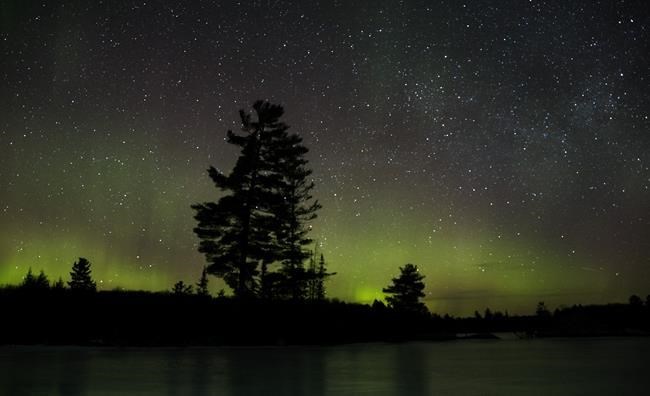
But the observatory, run through a partnership between the University of Calgary, the City of Yellowknife, the Canadian Space Agency and a local astronomy organization, says it is still possible that the lights may be visible in those parts of the country.
Eric Donovan, a professor at the University of Calgary’s department of physics and astronomy who studies the aurora, said while he’s always hesitant to make predictions, observations suggest a large magnetic storm may make the aurora more visible further south than usual.
“There’s a very good chance that tonight there will be very good aurora over large parts of Canada that don’t see it often,” he said, adding that the sky will have to be clear and other factors are at play.
“The aurora is driven by the solar wind, the solar wind is this gas of ionized particles that comes out of the sun all the time,” he said in an interview Saturday. “What happens is that gas interacts with the Earth’s magnetic field and that process extracts energy from the solar wind.”
One of the effects of that process is the aurora.
“What people are predicting tonight, is that there will be a dramatic increase in the rate that energy is being delivered to this system. That means the solar wind is more dense, has more charged particles, and it’s moving faster,” he said.
That would make the aurora brighter, visible over a wider area and move it farther south, he said.
The Space Weather Prediction Center of the U.S. National Oceanic and Atmospheric Administration said in a release the solar storm is the result of a solar flare and the ejection of plasma and magnetic field from the sun, a phenomenon called a coronal mass ejection.
This report by The Canadian Press was first published Oct. 30, 2021.
———
This story was produced with the financial assistance of the Facebook and Canadian Press News Fellowship.