Protesters show no sign of rolling off as Ottawa residents brace for more disruption
Advertisement
Read this article for free:
or
Already have an account? Log in here »
To continue reading, please subscribe:

Digital Subscription
One year of digital access for only $205*
- Enjoy unlimited reading on winnipegfreepress.com
- Read the E-Edition, our digital replica newspaper
- Access News Break, our award-winning app
- Play interactive puzzles
*First annual payment billed as $205.00 + GST for one year. This annual subscription will automatically renew at $233.00 + GST every 52 weeks (10% off the regular annual price of $259.35). Offer available to new and qualified returning subscribers only. Cancel any time.
To continue reading, please subscribe:
Add Free Press access to your Brandon Sun subscription for only an additional
$1 for the first 4 weeks*
- Enjoy unlimited reading on winnipegfreepress.com
- Read the E-Edition, our digital replica newspaper
- Access News Break, our award-winning app
- Play interactive puzzles
*Your next Brandon Sun subscription payment will increase by $1.00 and you will be charged $17.95 plus GST for four weeks. After four weeks, your payment will increase to $24.95 plus GST every four weeks.
Read unlimited articles for free today:
or
Already have an account? Log in here »
Hey there, time traveller!
This article was published 30/01/2022 (1694 days ago), so information in it may no longer be current.
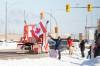
OTTAWA – Many of the horn-honking demonstrators who brought Ottawa to a near standstill showed no signs of budging Sunday as parliamentarians, businesses and school administrators were left wondering when the usual rhythm of the frazzled national capital would resume.
Several criminal investigations are underway into actions — including the desecration of monuments — during the ongoing protest of government-imposed vaccine mandates and COVID-19 restrictions, Ottawa police said Sunday.
A discordant symphony of truck horns blared across downtown as demonstrators wound up their second full day on local streets, but the effects of the protest were felt far beyond Parliament Hill.
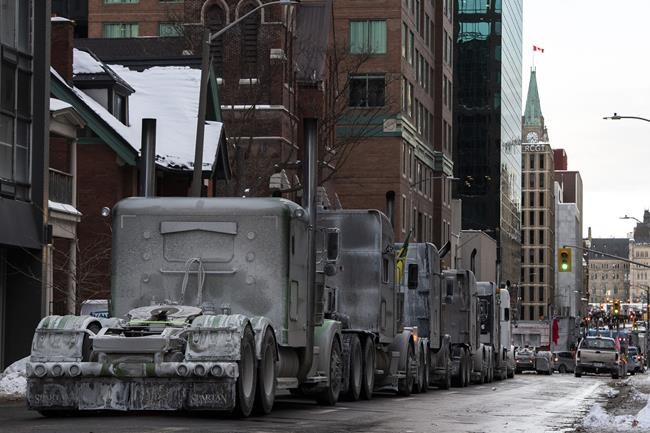
Residents of the capital were again told to avoid travelling to the city centre as trucks snarled numerous roads. Several city bus routes were redirected to avoid the area around the Hill, and the nearby Rideau Centre shopping mall remained closed after shutting down early on Saturday.
The House of Commons is slated to resume sitting Monday morning, though many members had already planned to attend virtually to help curb the spread of COVID-19.
Canada Unity, the primary group behind the truck convoy, said speeches would take place Monday at Confederation Park, just south of the parliamentary precinct.
The group’s website also suggested the demonstrators planned to arrive at shopping centres en masse without masks to flout public health rules, throw loud block parties and pressure the media.
Ottawa police said Sunday they were working to enable those who wanted to leave the congested downtown to do so.
Truck driver Erik Mueller, who arrived Saturday from Alberta, wasn’t going anywhere. He parked his rig on Wellington Street, just east of the Parliament Buildings, and hasn’t moved since.
Mueller said he’ll stay “as long as it takes” to get a response from the government.
“We have to do something, and if Ottawa is crazy right now for the next one or two weeks we have to do it,” Mueller said, adding he believes the demonstrators have the support of local residents.
The protest has been “exceptionally disruptive” for people who live downtown, said Catherine McKenney, a city councillor who represents Ottawa’s core.
Many residents resigned themselves to the overwhelming noise from honking trucks and road blockages, but by Sunday morning people were fed up, said McKenney, who fielded complaints about demonstrators urinating and defecating on lawns.
“I understand to a large extent why emergency services, police services both local and national, would not want to incite this crowd,” McKenney said.
“However, at some point we need assurances that we’re not going to allow our city and our downtown to be seized and to push out others and make people frightened to live and move about in their own neighbourhoods.”
Mathieu Fleury, a city councillor who represents an area just east of Parliament Hill, tweeted that the people “intimidating our neighbours, blocking our streets, blaring noise & harassing our authorities & journalists have no place in our city. They must go.”
Kevin McHale, executive director of the Sparks Street Business Improvement Association and Mall Authority, said congestion caused by the large trucks at the Ottawa protest could make it difficult for workers to get to downtown area shops on Monday.
“We’re a block from Parliament Hill, it’s the national spot to protest,” he said. “The difference this time is the trucks are occupying a fair bit of space.”
There’s a risk protest vehicles could interfere with supply trucks delivering goods businesses need to operate, which could force some to close, he added.
Protesters are typically encouraged to get a permit from the city before staging a demonstration in the capital, though it’s not mandatory as the right to peacefully demonstrate is protected under the Charter of Rights and Freedoms.
Such an application would allow the city to co-ordinate services and road closures, and give officials a sense of when the protest might end.
Canada Unity opted not to apply for a permit, leaving the city more or less in the dark as to the group’s plans.
Ottawa police, meanwhile, said the force and city staff were very aware of complaints relating to parking, idling, noisemaking and other inappropriate behaviour.
“At this time, due to safety concerns, management of the protest and traffic must take precedence.”
They said officers had avoided ticketing and towing vehicles in an attempt to stave off confrontations — an effort they said had not been entirely successful.
Police said Sunday they were looking into desecration of the National War Memorial and the Terry Fox statue near Parliament Hill that took place a day earlier.
Protesters drew widespread condemnation for fastening an inverted Canadian flag and anti-vaccine sign to the sculpture of Fox, who braved illness to run cross-country to raise money for cancer research. A woman was also seen standing and cheering on the Tomb of the Unknown Soldier at the National War Memorial.
Police said they were also investigating threatening behaviour toward officers, city workers and other individuals, as well as damage to a city vehicle.
The Ottawa force said it had investigative and evidence-gathering teams in place for the demonstration, and pegged the cost of policing the protest at $800,000 a day.
One truck flew a Confederate flag during Saturday’s demonstration, while other protesters misappropriated the Star of David and brandished Nazi symbols and slogans. Their actions drew vehement disapproval from Jewish groups.
“The only way to get these toxic ideologies to crawl back under the rock they slipped out from is for all Canadians to roundly and unambiguously reject and condemn these symbols of hatred,” said Andrea Freedman, CEO of the Jewish Federation of Ottawa.
“The pernicious nature of antisemitism is that it morphs and becomes a convenient hook for all manner of grievance, real or imagined.”
Deirdre Freiheit, president of Shepherds of Good Hope, said donations were pouring in after protesters allegedly harassed staff at an Ottawa soup kitchen.
The rally disrupted social services and blocked road access to their shelter, Freiheit said.
Several protesters showed up at the soup kitchen on Saturday and verbally abused staff and volunteers while demanding they be served, she said. Some protesters were given food to defuse the situation, but going forward meals will only be given to those who need them.
Since Shepherds of Good Hope tweeted about the incident, the organization has been overwhelmed with tens of thousands of dollars in donations, she added.
A large crowd gathered Sunday around a trailer parked in front of Parliament Hill to chant “Freedom” and listen to speeches decrying COVID-19 vaccine mandates and pandemic restrictions.
Kathleen Biggar, one of the demonstrators, wondered what would happen Monday. She said she would not want this protest in her backyard, and was picking up trash left behind on streets.
She planned to leave after Sunday’s events, saying she suspects that if the crowds stick around, conflict with local residents would only deepen.
“I don’t know the solution and that’s probably the point we’re all asking, where does this go?” Biggar said.
The demonstration was initially aimed at denouncing vaccine mandates for truck drivers crossing the Canada-U.S. border, but the movement has morphed into a protest against a variety of COVID-19 restrictions and Prime Minister Justin Trudeau’s government.
A memo being pushed by Canada Unity unlawfully demands Gov. Gen. Mary Simon and the Senate force federal and provincial governments to lift all COVID-19 restrictions, including vaccine mandates. It does not mention truckers, and was initially sent to the Senate and Simon on Dec. 11.
The vast majority of truck drivers are vaccinated. The Canadian Trucking Alliance has previously estimated about 10 per cent of drivers were affected when vaccinations became a requirement to cross the Canada-U.S. border earlier this month.
This report by The Canadian Press was first published Jan. 30, 2022.
–with files from Brett Bundale in Halifax.
Related Articles
Nazi analogies all too common PM Justin Trudeau tests positive for COVID-19

Advertisement Advertise With Us
Advertisement Advertise With Us