

Analysis: One job done, plenty to go
New Chief Peguis section completed
Advertisement
Read this article for free:
or
Already have an account? Log in here »
To continue reading, please subscribe:

Digital Subscription
One year of digital access for only $205*
- Enjoy unlimited reading on winnipegfreepress.com
- Read the E-Edition, our digital replica newspaper
- Access News Break, our award-winning app
- Play interactive puzzles
*First annual payment billed as $205.00 + GST for one year. This annual subscription will automatically renew at $233.00 + GST every 52 weeks (10% off the regular annual price of $259.35). Offer available to new and qualified returning subscribers only. Cancel any time.
To continue reading, please subscribe:
Add Free Press access to your Brandon Sun subscription for only an additional
$1 for the first 4 weeks*
- Enjoy unlimited reading on winnipegfreepress.com
- Read the E-Edition, our digital replica newspaper
- Access News Break, our award-winning app
- Play interactive puzzles
*Your next Brandon Sun subscription payment will increase by $1.00 and you will be charged $17.95 plus GST for four weeks. After four weeks, your payment will increase to $24.95 plus GST every four weeks.
Read unlimited articles for free today:
or
Already have an account? Log in here »
Hey there, time traveller!
This article was published 03/12/2011 (5409 days ago), so information in it may no longer be current.
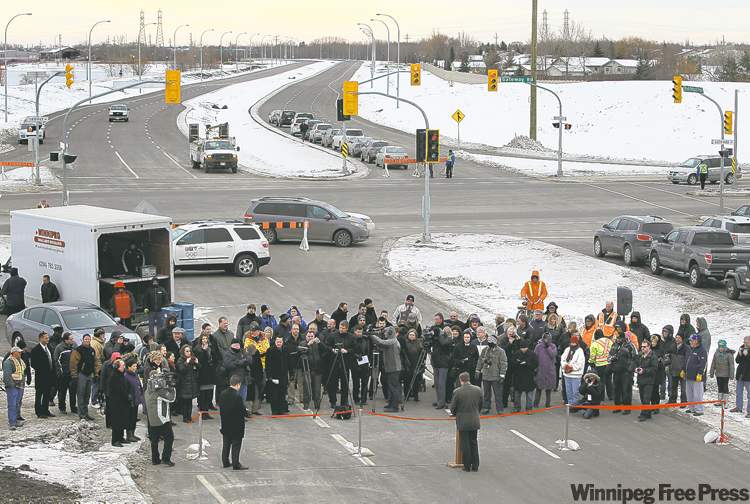
POLITICIANS from all three levels of government stood on a fresh patch of asphalt Friday to proudly declare the early completion of a road first envisioned 43 years ago.
The city sent Mayor Sam Katz and Couns. Scott Fielding (St. James) and Jeff Browaty (North Kildonan). The province had MLAs Erna Braun (Rossmere) and Matt Wiebe (Concordia), while Elmwood-Transcona MP Lawrence Toet represented Ottawa.
Together, these brave men and women picked up scissors, faced a stiff south wind and successfully cut a ribbon strung across a new section of Chief Peguis Trail.
From this day forward, children will be told stories of the moment when an additional 3.5 kilometres of asphalt connected Henderson Highway with Lagimodiere Boulevard. Great works of art will be dedicated to the triumph of North Kildonan pedestrians who lobbied for an underpass at Rothesay Street, as well as a bikeand- pedestrian bridge at the Northeast Pioneers Greenway.
Congratulations, Winnipeg — you just built a $109-million road. Not just any road, but a section of the “suburban beltway” recommended by the Winnipeg Area Transportation Study back in 1968. According to the plan’s sequel, the city’s new Transportation Master Plan, it will only take another $670 million, in 2011 dollars, to complete that beltway by 2031, a full 63 years after the inner ring road was first envisioned.
The same study suggests the tab to complete four rapid-transit corridors in Winnipeg by 2031 will be anywhere from $671 million to $2.7 billion. During the same time frame, the city expects to complete a combined sewer upgrade with a potential $3-billion price tag.
And in the background, the city faces an overall infrastructure deficit — that is, a repair bill for roads, bridges, buildings, water mains and sewers that already exist — of $3.8 billion.
Where will you find the money for the rest of your to-do list?
When you listen to the feds, they’re working on the problem. With the Building Canada Fund set to expire in 2014, Ottawa says it’s preparing a new pot of money to pay for infrastructure renewal.
When you listen to the province, it’s working on the problem. Manitoba offers municipalities more cash than any other provincial government, the NDP government has insisted.
And when you listen to the city, it too is working on the problem. Katz even struck a committee to examine the infrastructure deficit. Chris Lorenc, the former chairman of that committee, was so satisfied with the result he’s appeared before councillors at least eight times this year to remind them the infrastructure deficit still exists.
To be fair to Katz, he’s bemoaned the shortage of cash for infrastructure renewal since 2007, when he took his first stab at trying to convince the province to part ways with a chunk of the provincial sales tax.
This effort has not borne fruit. So council is talking about taking whatever means necessary to find the cash. Property taxes will likely rise next year, albeit not to pay for infrastructure. Given the rising cost of services such as policing, the city may raise property taxes just to cover operating expenses in 2012.
So frontage levies could go up again. Or user fees may rise. Or the city may lobby the province to create a gasoline surtax to pay for infrastructure, knowing full well Manitobans pay among the lowest gas taxes in the nation.

“I think everybody else is following that lead,” Katz said Friday. “You hear the comment from levels of government, ‘We’re not here to raise taxes.’ The reality is, I think you have to be creative to find ways to pay for infrastructure. Is that one way that could work? I think other cities have shown it does.”
Now before you freak out, a gas tax is just one option. But the mayor is not using hyperbole when he calls the infrastructure deficit a crisis. What we don’t fix now will cost more to fix down the road. And what we build down the road makes it harder to find cash to fix what exists.
So congratulations, Winnipeg — you built a road. Now get on with the tougher task of convincing your citizens they’ll have to pony up for more of the same.
bartley.kives@freepress.mb.ca