

Rising deer population: to cull or let crash?
Rise in number of costly highway crashes with wildlife stirs debate
Advertisement
Read this article for free:
or
Already have an account? Log in here »
To continue reading, please subscribe:
Monthly Digital Subscription
$1 per week for 24 weeks*
- Enjoy unlimited reading on winnipegfreepress.com
- Read the E-Edition, our digital replica newspaper
- Access News Break, our award-winning app
- Play interactive puzzles
*Billed as $4.00 plus GST every four weeks. After 24 weeks, price increases to the regular rate of $19.95 plus GST every four weeks. Offer available to new and qualified returning subscribers only. Cancel any time.
Monthly Digital Subscription
$4.99/week*
- Enjoy unlimited reading on winnipegfreepress.com
- Read the E-Edition, our digital replica newspaper
- Access News Break, our award-winning app
- Play interactive puzzles
*Billed as $19.95 plus GST every four weeks. Cancel any time.
To continue reading, please subscribe:
Add Free Press access to your Brandon Sun subscription for only an additional
$1 for the first 4 weeks*
*Your next subscription payment will increase by $1.00 and you will be charged $16.99 plus GST for four weeks. After four weeks, your payment will increase to $23.99 plus GST every four weeks.
Read unlimited articles for free today:
or
Already have an account? Log in here »
Hey there, time traveller!
This article was published 14/01/2012 (5193 days ago), so information in it may no longer be current.
When Beth Neville saw something move it was already too late.
The 25-year-old was behind the wheel of her family’s van last Easter weekend as she and her mother drove home to Notre Dame de Lourdes from church in the dark. Neville said she had her high beams on when she noticed something on the roadway.
A split second later, the van slammed into two deer, killing them instantly.
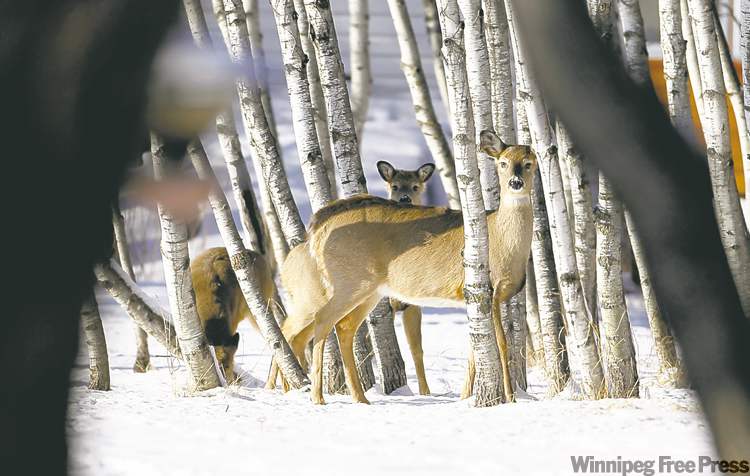
“I hit my brakes so fast I left tread marks on the road,” Neville said.
“I felt sorry for them because they’re beautiful animals. It happened so fast, you’re not even expecting it.”
A new city report says the number of wildlife collisions reported in Manitoba has increased by 50 per cent in the last decade, and the bulk of these accidents involve deer. While no study has been undertaken to determine whether the deer population has grown, residents in some of the province’s hot spots have little doubt it has.
Areas such as Birds Hill Park and Charleswood have been identified as areas of concern and Manitoba Public Insurance data show the annual cost of wildlife collisions is approaching that of impaired-driving accidents. Wildlife collisions cost the public insurer $31 million each year, compared to $33 million for drunk driving.
While efforts are underway to reduce damage and injuries from these crashes by educating drivers to slow down and pay attention, there are no plans to study whether these collisions are on the rise due to a simultaneous jump in the number of deer. Part of the problem, some say, is a split in public opinion: For every person who thinks greater wildlife control is required to reduce the number of accidents, someone else thinks nature should simply be left alone.
“Some people say, ‘We feed them, we welcome them in our yard.’ Others say, ‘We need a culling program’ because they feel the numbers have grown and there’s been so many accidents,” said Charleswood-area Coun. Paula Havixbeck.
Provincial data found wildlife contributed to 37 per cent of all collisions on provincial highways between 1994 and 2007 — a significant number that includes instances where vehicles swerve off the road and into ditches to avoid an animal. Preliminary figures contained in a City of Winnipeg report released this week show the number of deer collisions has steadily risen in Manitoba in recent years — from 6,330 in 2005 to 7,475 in 2010.
MPI spokesman Brian Smiley said the numbers have increased, and the costs associated with these crashes add up quickly. Big deer cause big damage, Smiley said, and it can cost thousands to repair the front end of a vehicle or a windshield damaged by deer.
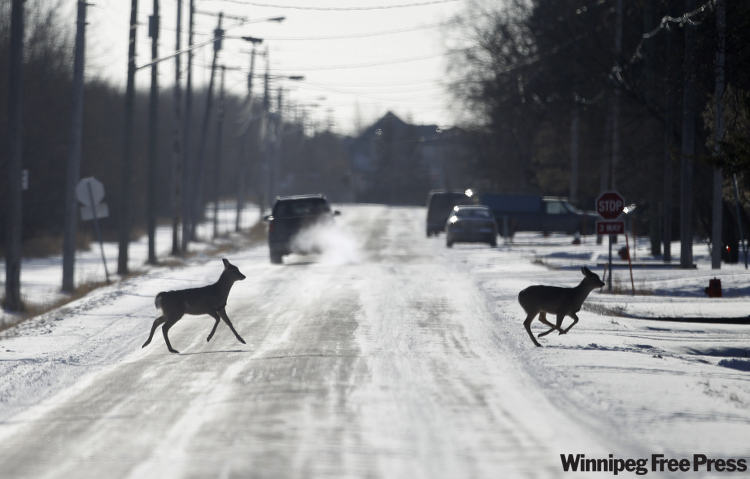
Unlike other collisions where driver behaviour — speed, alcohol and lack of seatbelt use — plays a major role in determining the severity of the crash, wildlife collisions are unpredictable. Smiley said drivers who see a deer on the road should stay in their lane and hit the brakes. Animals are most active at dusk and dawn, and Smiley said drivers and their passengers need to watch out for any signs of activity and be aware that if they spot one deer, two more could be right behind them.
Even then, Smiley said animals can dart out from nowhere. His Dodge Caravan was totalled when a buck ran into the passenger side of his van in Minnesota.
“Literally the animal can be standing idle on the shoulder of the road or a ditch and within the blink of a second, they’re jumping across the road in the path of a vehicle,” he said.
That’s been a problem on a stretch of Highway 59 near Birds Hill Park, where deer collisions cost MPI about $230,000 every year.
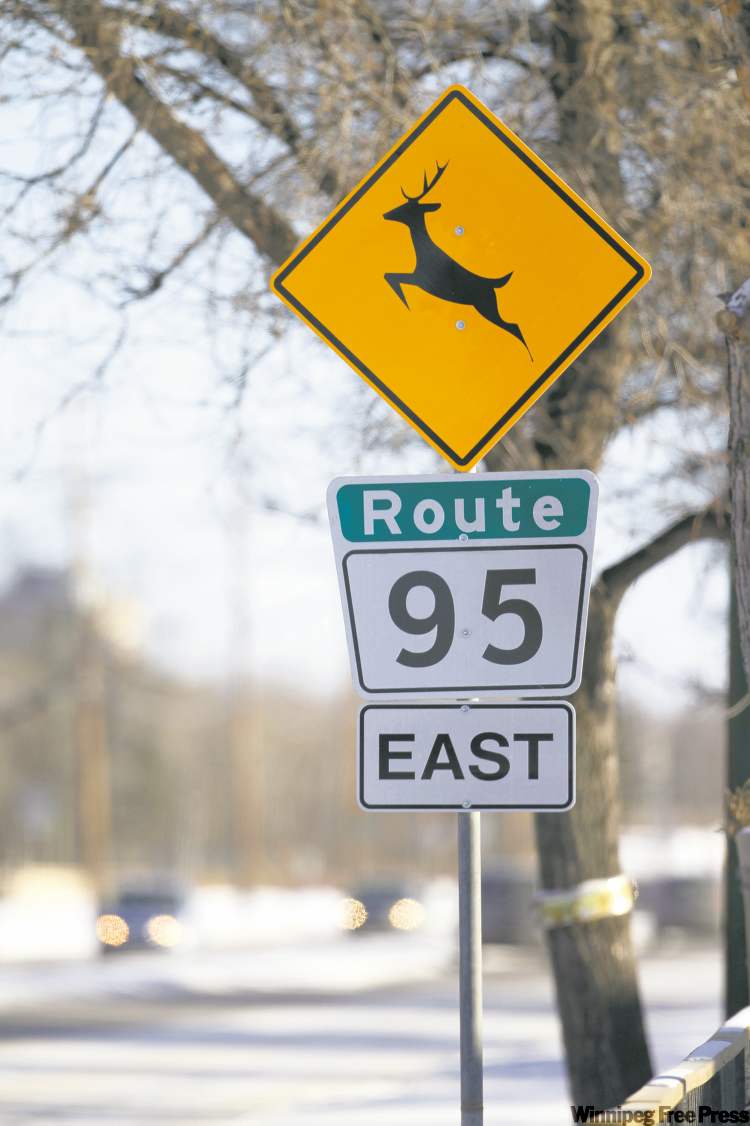
The public insurer examined whether a fence could be built to keep deer off the highway, but found it would cost $700,000 to build a 10-kilometre perimeter. Smiley said fencing would not prevent deer from crossing at another point along the road, and the idea was abandoned.
Instead, Manitoba Conservation launched a program to track the carcasses of deer killed by vehicles.
Brian Joynt, regional wildlife co-ordinator, said Birds Hill Park has recorded a large number of deer collisions over the years, and the province partnered with the municipality and park staff to map where they have been hit. Vehicles that respond to collect dead animals are now outfitted with GPS devices, Joynt said, so they can track where and see if this changes over time.
Between November 2009 and August 2011, the GPS system recorded 112 collisions in the Birds Hill Park area, including 15 along the park’s boundary on Highway 58 and another 11 near the turnoff for Highway 44.
The project is slated to continue to the end of 2012, and Joynt said he’s interested to see whether the number of collisions drops now that part of the floodway has been revegetated with plants deer don’t like to eat. At the same time, he said it’s difficult to tell whether the deer population has increased or decreased since the province has not done a recent wildlife survey in the area or in Winnipeg.
“We don’t have a real good handle on the deer population,” Joynt said. “If we had funds to do it, we would be very interested in monitoring a lot more of our populations, but we have a finite amount of resources.”
RM of Springfield Reeve Jim McCarthy has lived in the area since the mid-1970s and said there are definitely more deer. McCarthy said 30 years ago people did not need to fence off their gardens and watch out for the animals on area roadways as much. Today, he said most people he knows are concerned about the problem since they have either had close calls or hit a deer.
“There’s been a noticeable increase in the deer population. I see them in the field, in the yards; it’s really difficult to have a garden without the deer destroying your garden,” McCarthy said. “I think most residents, myself included, have hit deer.”
Winnipeg does not track the GPS co-ordinates of dead animals, but the city’s 311 hotline has seen a slight increase in the number of requests to pick up dead deer. Last year, there were 570 requests to pick up dead deer, up from 502 the previous year. Most calls came from residents in Charleswood, followed by Winnipeggers in St. Boniface and St. Vital.
So far in 2012, there have been 11 requests to pick up dead deer — almost one every day.
Data from 2009, the latest available, show 464 deer collisions were reported in Winnipeg, with the largest number in Charleswood.
Winnipeg police cracked down on speeders in Charleswood last October, the month when deer collisions are the most frequent.
Winnipeg police traffic unit Sgt. Mark Hodgson said the number of people caught driving over the speed limit dropped over the span of a few weeks. Police data show about 18 per cent of vehicles were clocked speeding on westbound Shaftesbury Boulevard at Corydon Avenue before enforcement began. Several weeks later, that figure dropped to 10 per cent. Police ticketed 130 drivers out of a total of 733 who were stopped.
Hodgson said reducing the speed helps to reduce the number of collisions and the severity of a potential crash. Police can’t measure whether the number of collisions dropped, Hodgson said, since that would depend on whether the deer population increased or decreased.
Havixbeck said she thinks the province should initiate a study to examine the deer population and its movements. She said researchers undertook similar studies in the 1970s and 1980s, and it would be good to have new guidelines on how the city and its residents could mitigate problems with the animals.

Havixbeck said she sometimes receives calls from residents who complain a dead deer hasn’t been picked up, noting this occurred last year next to a school. A resident went to cover the animal, she said, so children wouldn’t see.
“I think there needs to be some study and some tracking,” Havixbeck said. “The deer are posing some interesting challenges.”
jen.skerritt@freepress.mb.ca
By the numbers
- More than 10,000 wildlife collisions are reported in Manitoba every year, up from about 6,600 a decade ago. The bulk of these collisions involves deer.
- Last year, the City of Winnipeg received 570 requests to pick up dead deer, up from 502 the previous year. Most calls came from residents in Charleswood, followed by Winnipeggers in St. Boniface and St. Vital. So far in 2012, there have been 11 requests to pick up dead deer — almost one every day.
- Wildlife collisions cost Manitoba Public Insurance $31 million annually. By comparison, impaired driving costs $33 million in claims annually; speeding costs $40 million; non-use of seatbelts results in $23 million in claims.
- Provincial data found wildlife contributed to 37 per cent of all collisions on provincial highways between 1994 and 2007 — a significant number that includes instances where vehicles swerve off the road and into ditches to avoid an animal.
- Preliminary figures contained in a City of Winnipeg report released this week show the number of deer collisions has steadily risen in Manitoba in recent years — from 6,330 in 2005 to 7,475 in 2010.
— source: City of Winnipeg, Manitoba Public Insurance