Oosthuizen bags an albatross, makes some history at Masters
Advertisement
Read this article for free:
or
Already have an account? Log in here »
To continue reading, please subscribe:

Digital Subscription
One year of digital access for only $205*
- Enjoy unlimited reading on winnipegfreepress.com
- Read the E-Edition, our digital replica newspaper
- Access News Break, our award-winning app
- Play interactive puzzles
*First annual payment billed as $205.00 + GST for one year. This annual subscription will automatically renew at $233.00 + GST every 52 weeks (10% off the regular annual price of $259.35). Offer available to new and qualified returning subscribers only. Cancel any time.
To continue reading, please subscribe:
Add Free Press access to your Brandon Sun subscription for only an additional
$1 for the first 4 weeks*
- Enjoy unlimited reading on winnipegfreepress.com
- Read the E-Edition, our digital replica newspaper
- Access News Break, our award-winning app
- Play interactive puzzles
*Your next Brandon Sun subscription payment will increase by $1.00 and you will be charged $17.95 plus GST for four weeks. After four weeks, your payment will increase to $24.95 plus GST every four weeks.
Read unlimited articles for free today:
or
Already have an account? Log in here »
Hey there, time traveller!
This article was published 08/04/2012 (5246 days ago), so information in it may no longer be current.
AUGUSTA, Ga. – Even if he doesn’t have a place in the champion’s locker room at the Masters, Louis Oosthuizen can say he has a spot in the Albatross Club with Gene Sarazen.
Not a bad consolation prize: That shot by “The Squire” in 1935, after all, is widely credited with putting the Masters on the map.
Back then players weren’t routinely hitting the ball so far, but Sarazen had the pluck to pull out a 4-wood from 235 yards and blast the ball over the creek that guards the 15th green at Augusta National. He made double-eagle, otherwise known as an albatross. It erased a three-shot deficit to Craig Wood in one swing. The two went to a playoff that Sarazen won.
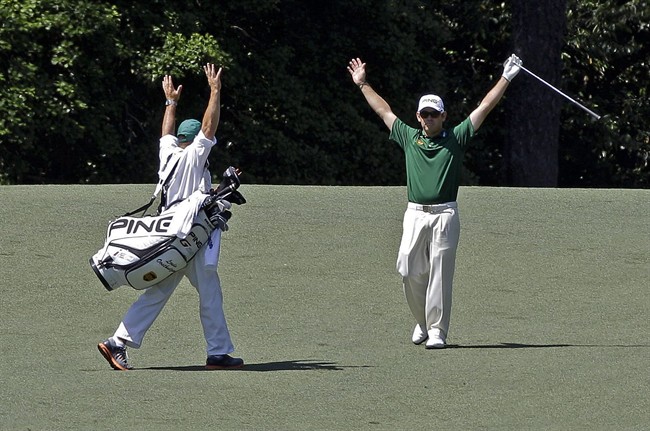
On Sunday, Oosthuizen also got to the playoff on the strength of his double-eagle but he didn’t make any more history.
Bubba Watson pulled off The Shot of the tournament — that twister from nowhere on the 10th hole in the playoff — and Oosthuizen walked home not with the green jacket, but with a good-looking ‘2’ on the scorecard. It was only the fourth double-eagle in the history of the Masters and the first ever on the par-5 second at Augusta National.
Yes, this is a rarity, and not only at Augusta.
There have been only 17 double-eagles compared to 130 holes-in-1 on the PGA Tour since 2008, according to STATS LLC.
It’s even more infrequent at your average muni, where the everyday player is nowhere near as skilled as the guys shooting at pins for a living.
On this crazy Sunday at Augusta National, Oosthuizen’s 2 was much more notable than a pair of 1s — the holes-in-1 by Adam Scott and Bo Van Pelt that wound up as mere footnotes.

“My first double-eagle ever,” Oosthuizen said.
The shot came from 253 yards out and Oousthuizen flushed a 4-iron that dropped on the front of the green, then travelled around 80 feet back and toward the right and straight into the hole.
Oosthuizen raised his hands, high-fived his caddie.
Watson, who was playing in the same group, told Oosthuizen he wanted to high-five him too, “but felt it might not have gone over too well,” Oosthuizen said.
Oosthuizen’s albatross now ranks No. 2 on the list of four that have come at Augusta National — ahead of Bruce Devlin’s in 1967 on No. 8 and Jeff Maggert’s in 1994 on No. 13, but still one notch behind Sarazen’s. Had The Squire not made that shot, the historians say there’s no telling where the Masters would be today.