

No high-tech bodysuit? No problem: Olympic swimming ends with 9 world records set in the pool
Advertisement
Read this article for free:
or
Already have an account? Log in here »
To continue reading, please subscribe:

Digital Subscription
One year of digital access for only $205*
- Enjoy unlimited reading on winnipegfreepress.com
- Read the E-Edition, our digital replica newspaper
- Access News Break, our award-winning app
- Play interactive puzzles
*First annual payment billed as $205.00 + GST for one year. This annual subscription will automatically renew at $233.00 + GST every 52 weeks (10% off the regular annual price of $259.35). Offer available to new and qualified returning subscribers only. Cancel any time.
To continue reading, please subscribe:
Add Free Press access to your Brandon Sun subscription for only an additional
$1 for the first 4 weeks*
- Enjoy unlimited reading on winnipegfreepress.com
- Read the E-Edition, our digital replica newspaper
- Access News Break, our award-winning app
- Play interactive puzzles
*Your next Brandon Sun subscription payment will increase by $1.00 and you will be charged $17.95 plus GST for four weeks. After four weeks, your payment will increase to $24.95 plus GST every four weeks.
Read unlimited articles for free today:
or
Already have an account? Log in here »
Hey there, time traveller!
This article was published 05/08/2012 (5169 days ago), so information in it may no longer be current.
LONDON – So much for all those dire predictions of it taking many years, even decades, to break the swimming records set in high-tech bodysuits.
Nine world records fell at the London Olympic pool, 2 1/2 years after the return to old-fashioned textile suits.
That was a vast improvement from last year’s world championships in Shanghai, when only two swimmers set world records — Ryan Lochte of the United States in the 200-meter individual medley and Sun Yang of China in the marathon-like 1,500 freestyle.
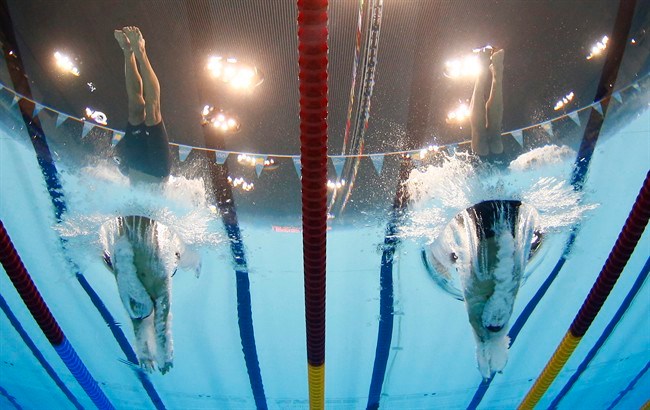
“When they changed the sport everyone started thinking that there won’t be another world record broken for a while,” Lochte said. “But I went out there and I changed that last year and Sun Yang changed it, too. So people started saying, ‘You know what? That’s possible. This can actually happen.’ And they started believing, and once you start believing, anything can happen.”
At the 2008 Beijing Games, 25 world records dropped — nearly all of them from swimmers wearing Speedo’s innovative LZR Racer bodysuit, which was designed with help from NASA. That was the most marks to fall at a single games.
Then at the 2009 world championships in Rome, an astounding 43 world records were established, as other companies like Arena and Jaked developed suits that were virtual flotation devices.
While those numbers may never be seen again, more marks fell in London than the six at the 2004 Athens Games, when bodysuits were allowed but rubberized outfits hadn’t yet been introduced.
On Day 1 of the London Games, 16-year-old Ye Shiwen of China improved the world record in the women’s 400 IM by more than a second. While that swim sparked rampant speculation of doping, more records followed, from a variety of nations.
Cameron van der Burgh of South Africa lowered the mark in the 100 breaststroke, Dana Vollmer of the United States did it in the 100 butterfly and Daniel Gyurta of Hungary established a new mark in the 200 breaststroke.
Rebecca Soni, another American, set records in both the semifinals and final of the 200 breast and teammate Missy Franklin got one in the 200 backstroke. On the final night of competition Saturday, Sun broke his own mark in the 1,500 freestyle and the American women won the medley relay in world record time.
“Many people in the past were saying you had to go back to scratch and start from zero,” FINA executive director Cornel Marculescu said. “This demonstrates that at the end of the day it’s the quality of the athletes and the preparation. These people are swimming 15-20 kilometres (9-12 miles) every day.”
However, some records still seem destined to last a while after FINA not only went back to textiles but also restricted men to suits covering only the waist down to the knees. Women’s suits cover shoulders to knees.
“The 50 free is going to be tough to beat at 20.9. That’s certainly a challenging one,” Swimming Canada CEO and head coach Pierre Lafontaine said, referring to Cesar Cielo’s mark from 2009 in the one-lap race — the shortest in the pool.
Florent Manaudou of France won the men’s 50 free in London in 21.34.
But there are still some swimming officials calling for yet another change. Manufacturers are not happy with the new men’s suits, which don’t allow sponsorship space on the chest.
Marculescu wouldn’t rule out a change to conform men’s suits with the women’s ones.
“There are some discussions that the men have less possibility to advertise than the women,” Marculescu said. “We should not have a closed mind. … For the moment, it is what it is. Everyone is happy. But sport is business.”

But hardly any swimmers are clamouring for another change.
“It’s like Formula One, changing rules every year, you just conform and do your best,” Van der Burgh said. “Keep it as is. You got to show off your physique and look good.”
Lochte said that if it were up to him he would have gone back to old-school briefs, so he certainly doesn’t want a change in the other direction.
Coaches are also content.
“I would be very disappointed if they did that,” Lafontaine said. “I think where we’re at is where we should stay. What we have now shows the sport. It shows the athleticism of the sport.”
Related Articles
For Olympians without million-dollar deals, it's teaching, changing oil - even a brothel



Advertisement Advertise With Us
Advertisement Advertise With Us