

Heels can be hell on the health of servers
Advertisement
Read this article for free:
or
Already have an account? Log in here »
To continue reading, please subscribe:

Digital Subscription
One year of digital access for only $205*
- Enjoy unlimited reading on winnipegfreepress.com
- Read the E-Edition, our digital replica newspaper
- Access News Break, our award-winning app
- Play interactive puzzles
*First annual payment billed as $205.00 + GST for one year. This annual subscription will automatically renew at $233.00 + GST every 52 weeks (10% off the regular annual price of $259.35). Offer available to new and qualified returning subscribers only. Cancel any time.
To continue reading, please subscribe:
Add Free Press access to your Brandon Sun subscription for only an additional
$1 for the first 4 weeks*
- Enjoy unlimited reading on winnipegfreepress.com
- Read the E-Edition, our digital replica newspaper
- Access News Break, our award-winning app
- Play interactive puzzles
*Your next Brandon Sun subscription payment will increase by $1.00 and you will be charged $17.95 plus GST for four weeks. After four weeks, your payment will increase to $24.95 plus GST every four weeks.
Read unlimited articles for free today:
or
Already have an account? Log in here »
Hey there, time traveller!
This article was published 02/03/2013 (4921 days ago), so information in it may no longer be current.
A Red River College student is calling on the Manitoba government to prevent restaurants from forcing waitresses to wear heels on the job.
Amy Tuckett, 31, is a licensed massage therapist, former server and graduating creative communications student. She spent the past year filming Hell on Heels, a documentary examining the damage done to women’s feet after wearing high heels. She wants Workplace Health and Safety to ban the mandatory wearing of heels.
“Because of my work as a massage therapist, I’ve seen a lot of back pain, low-back issues. You see degeneration in the lumbar,” Tuckett says. “A lot of these problems don’t surface until years later. If you make women wear heels to work, you’re contributing to the problem.”
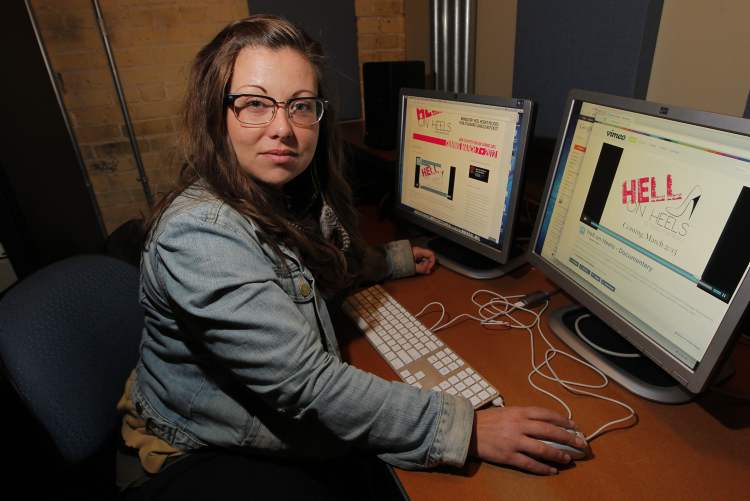
Tuckett says she interviewed fellow students who work as servers. Few were willing to appear on camera, fearing they’d be fired.
“A restaurant may say they have a one-inch minimum heel requirement but the girls say they know the higher, the better.”
Tuckett approached several Winnipeg restaurants for comment. Moxie’s didn’t call her back. She got an email response from Earls and Joey’s corporate offices.
“Earls does not require our staff to wear high heels while at work,” said Melissa Pulsifer. “The dress code at Earls allows for staff to dress (as they like) while keeping within strict parameters that include safety requirements. In the case of shoes, that includes a closed toe and heel, nonslip sole and a supportive heel equal to that of a good walking shoe (1″). If the shoe meets those guidelines staff are welcome to wear a heel height of their own choosing.”
Joey’s guest relations manager Keiko Read said they have guidelines for staff. Dress shoes should have a low heel, defined by the chain as between half an inch to three inches. The women can wear low-slip shoes if they want.
“Anyone with injuries that prevent them from wearing heels can wear flat dress shoes,” said Read in an email.
Hermano’s Restaurant has no heel policy. They cooperated with Tuckett on her project.
The creative communications student also reached out to Original Joe’s, having been told they had no heel requirement. The restaurant declined to participate in the documentary. Soon after, an employee emailed Tuckett a photo of a new posted policy, complete with photos. Waitresses must now wear at least a one-inch heel.
The chain did not respond to an interview request.
A 2010 study, the results of which were published on discovery.com, showed wearing high heels puts extra pressure on the inside of a woman’s knee and raises her risk of osteoarthritis later in life. Heels also alter muscle and tendon structure, the website said.
Tuckett interviewed two doctors for her film, both of whom say heels can lead to physical ailments down the road.
The provincial Labour Department sent Tuckett an emailed response to her question about Workplace Health and Safety’s policy on unsafe footwear in the workplace. She asked if they would consider revising their policy in light of medical evidence on the potential harm.
“It falls on all employers to identify hazards in the workplace and then implement the proper controls to address any hazards. For example, in addressing footwear, the employer should review any first-aid records at the workplace and any WCB claims that would indicate an issue with footwear, and then implement a footwear policy to address,” the response read.

Tuckett says that doesn’t answer her question. She wants Labour Minister Jennifer Howard to change the law to protect workers.
“I do feel they need to take a stance on restaurants,” she says. “When I was a server, I’d be on my feet eight hours. I got to wear comfortable shoes and my feet still hurt.”
In response to a request from the Free Press on Friday, the province issued a statement that said, in part: “While we are not aware of any jurisdiction that currently considers wearing high heels to be a health or safety concern in general, we expect employers to work with employees to resolve specific situations if they occur. If, for example, there were medical issues involved with a particular employee, the employer would have to take those issues into consideration. We understand that there is some new research in this area and we have asked the student you identified to provide her research to the minister’s office. We will ensure that it is considered in our review of the Workplace Safety and Health Act, which is currently underway.”
Hell on Heels will première Thursday, March 7 at 7 p.m. at the Free Press News Café.
lindor.reynolds@freepress.mb.ca
Related Articles
Amy Tuckett talks Hell on Heels at News Café today
Advertisement Advertise With Us
Advertisement Advertise With Us
History
Updated on Saturday, March 2, 2013 9:05 AM CST: adds video, replaces photo