

Outdoor exhibit reveals a flaneur’s view of Montreal in the 1920s, ’30s
Advertisement
Read this article for free:
or
Already have an account? Log in here »
To continue reading, please subscribe:

Digital Subscription
One year of digital access for only $205*
- Enjoy unlimited reading on winnipegfreepress.com
- Read the E-Edition, our digital replica newspaper
- Access News Break, our award-winning app
- Play interactive puzzles
*First annual payment billed as $205.00 + GST for one year. This annual subscription will automatically renew at $233.00 + GST every 52 weeks (10% off the regular annual price of $259.35). Offer available to new and qualified returning subscribers only. Cancel any time.
To continue reading, please subscribe:
Add Free Press access to your Brandon Sun subscription for only an additional
$1 for the first 4 weeks*
- Enjoy unlimited reading on winnipegfreepress.com
- Read the E-Edition, our digital replica newspaper
- Access News Break, our award-winning app
- Play interactive puzzles
*Your next Brandon Sun subscription payment will increase by $1.00 and you will be charged $17.95 plus GST for four weeks. After four weeks, your payment will increase to $24.95 plus GST every four weeks.
Read unlimited articles for free today:
or
Already have an account? Log in here »
Hey there, time traveller!
This article was published 13/06/2014 (4479 days ago), so information in it may no longer be current.
MONTREAL – A stroll this summer along McGill College Avenue in downtown Montreal may provide a sense of what it was like to be a “flaneur” in the city in times past.
The McCord Museum is displaying 25 works by the early 20th-century Canadian photographer Harry Sutcliffe along a one-block section of the route, between President Kennedy Avenue and Boulevard de Maisonneuve.
The photographs, enlarged from postcard size and mounted on panels, reveal something of the everyday atmosphere of Montreal’s parks and squares in the 1920s and ’30s.
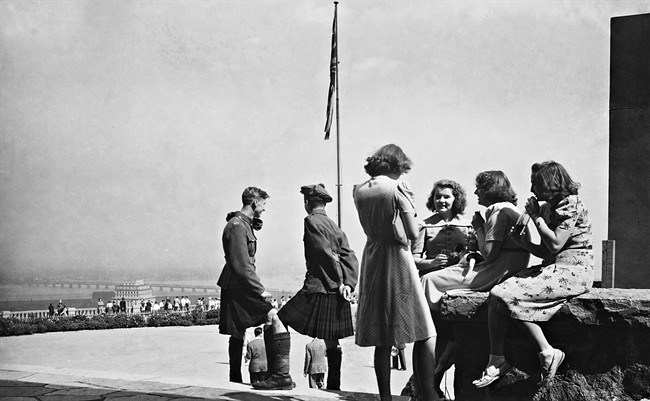
“In some photos you see people in the parks sitting on a bench, just looking, just being quiet,” says H�l�ne Samson, the show’s curator. There are also families in canoes and children on bicycles.
This is the first exhibition devoted to the little-known photographer, who died in 1942, says Samson.
The British-born Sutcliffe specialized in making postcards, says Samson. He was also a flaneur, she says — a fact highlighted in the show’s French title: “Harry Sutcliffe — Fl�neur dans Montr�al” (translated to English as “Sutcliffe — Strolling Through Montreal”).
“It’s the idea of taking time to walk in the city and just enjoy spontaneously what you can discover,” says Samson.
With the quicker pace of life today and people focused on their smartphones, this may be something of a lost activity, she suggests. “Do we still stroll in the city just for the sake of it?”
The works on display were selected from a recent donation of 2,000 of Sutcliffe’s photographs to the McCord by his great-grandson.
The exhibition, the McCord’s ninth annual outdoor summer photography show, runs until mid-October.