

Back to school, back to hunger: Foods bank use at post-secondary institutions going up
Advertisement
Read this article for free:
or
Already have an account? Log in here »
To continue reading, please subscribe:

Digital Subscription
One year of digital access for only $205*
- Enjoy unlimited reading on winnipegfreepress.com
- Read the E-Edition, our digital replica newspaper
- Access News Break, our award-winning app
- Play interactive puzzles
*First annual payment billed as $205.00 + GST for one year. This annual subscription will automatically renew at $233.00 + GST every 52 weeks (10% off the regular annual price of $259.35). Offer available to new and qualified returning subscribers only. Cancel any time.
To continue reading, please subscribe:
Add Free Press access to your Brandon Sun subscription for only an additional
$1 for the first 4 weeks*
- Enjoy unlimited reading on winnipegfreepress.com
- Read the E-Edition, our digital replica newspaper
- Access News Break, our award-winning app
- Play interactive puzzles
*Your next Brandon Sun subscription payment will increase by $1.00 and you will be charged $17.95 plus GST for four weeks. After four weeks, your payment will increase to $24.95 plus GST every four weeks.
Read unlimited articles for free today:
or
Already have an account? Log in here »
Hey there, time traveller!
This article was published 31/08/2015 (4064 days ago), so information in it may no longer be current.
A trip back to school may be exciting, but it can also mean a trip below the poverty line for some cash-strapped post-secondary students.
Juggling the rising costs of tuition, rent and living expenses can mean meal-planning isn’t top priority. A steadily increasing number of college and university students in Manitoba are relying on food banks to get by, according to data from Winnipeg Harvest.
Michael Barkman, the Manitoba chairman for the Canadian Federation of Students, said students’ reliance on food banks isn’t a new thing, although in the last five years, their needs have become more noticeable.
“Clearly as we’re seeing, this is a very alarming trend and it needs to receive attention from government and the public,” Barkman said.
Data compiled by Harvest shows the weight of food bank donations to the University of Winnipeg, Red River College and the Winnipeg Adult Education Centre has increased every year since 2010.
From 2010 to 2014, Winnipeg Harvest donated more than 626,000 pounds of food to these three schools.
Between 2013 and 2014, the weight of food donations at RRC alone increased by nearly 40 per cent — leaping to 31,278 pounds from 19,523 pounds.
For Rebecca Trudeau, a former RRC food bank co-ordinator who now works at Winnipeg Harvest, the reality of student poverty hits close to home.
She had to use food banks as a child, but worked full-time while in college so she wouldn’t have to depend on them.
“People make jokes about (students eating) ramen all the time, but that’s legit — that’s student life. Although it is funny, it’s not healthy,” Trudeau said. “That affects your mental health and your ability to do your work well enough.”
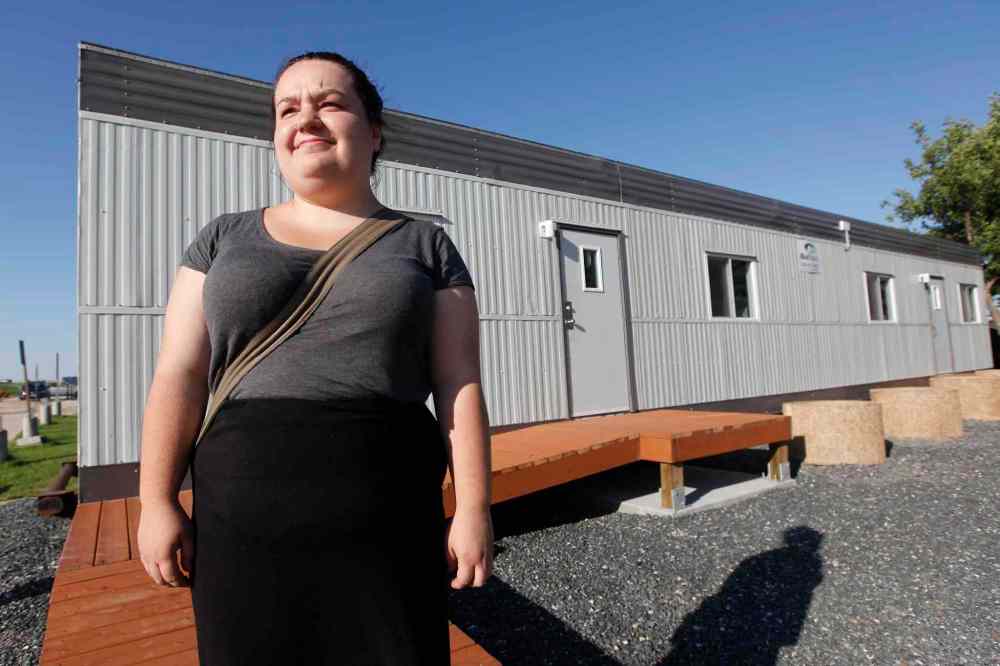
RRC is introducing a new food bank trailer this year, which is tucked in a parking lot behind the Notre Dame campus so as to provide privacy for students picking up food.
After its old trailer was found to be no longer up to fire code, the Red River College Students’ Association (RRCSA) had to raise more than $100,000 to get a new one.
On an interim basis, Trudeau operated the food bank out of a cramped basement hallway at the Notre Dame campus every second Friday. There’s also a food bank that operates out of the Exchange District campus every second Wednesday.
Students sign up in advance for care packages filled with perishable and non-perishable food items, which usually last them four to five days, Trudeau said.
She got to know some of the food bank regulars and said many of them were single parents with families to support, or newcomers to Canada, looking for help with food on a short-term basis.
She met one student who lived in a hotel while going to school.
“Some of the students that I saw didn’t even have the amenities to cook things and some of them would only take things they could cook in the microwave,” she said.
Trudeau said she thinks post-secondary institutions ought to contribute more financial support to their food banks.
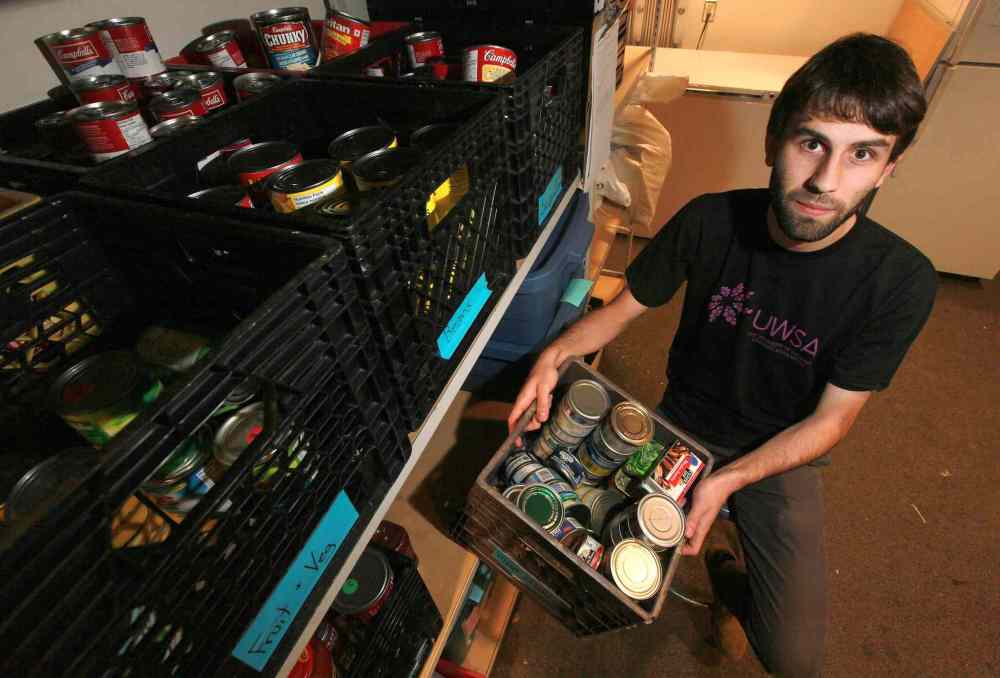
The RRCSA and the University of Winnipeg Students’ Association (UWSA) organize and fund the food banks on their own. In the spring, U of W students voted in favour of an increased food bank levy during a general election referendum.
The UWSA increased student fees by an extra $1.50 per person to be able to hire an assistant food bank coordinator and to better accommodate the needs of its clients, said UWSA president Peyton Veitch.
There are about 150 students and community members registered for the UWSA food bank and about 75 people who use the service on average per week, he said.
“We’re really proud of being able to offer this service to community members and students who require it. But I think that what we have to ask ourselves in 2015 is: why do we have to continue to operate a food bank?” he said. “Frankly the fact that we even need to operate a food bank showcases a great failure in terms of our society’s ability to provide for everyone.”
Veitch would like to see federal election candidates discuss the interconnected issues of student poverty, debt and rising tuition costs.

The average Manitoban student has to work twice as many hours as they did in 1975 to pay for their tuition in full, Veitch said, citing a 2014 study by the Canadian Centre for Policy Alternatives.
Addressing the root causes of students’ food bank usage needs to be done — and fast, said Barkman.
“It’s a Band-Aid solution — food banks are not a sustainable option. We need to work on making post-secondary education more accessible,” he said. “Students shouldn’t be making the decision between paying for tuition fees and paying for food.”
jessica.botelho-urbanski@freepress.mb.ca
Twitter: @_jessbu