

In Conversation with Pete Mahovlich and Pat Stapleton
Advertisement
Read this article for free:
or
Already have an account? Log in here »
To continue reading, please subscribe:
Digital Subscription
One year of digital access for only $1.44 a week*
- Enjoy unlimited reading on winnipegfreepress.com
- Read the E-Edition, our digital replica newspaper
- Access News Break, our award-winning app
- Play interactive puzzles
*Billed as $5.77 plus GST every four weeks. After 52 weeks, price increases to the regular rate of $19.95 plus GST every four weeks. Offer available to new and qualified returning subscribers only. Cancel any time.
To continue reading, please subscribe:
Add Free Press access to your Brandon Sun subscription for only an additional
$1 for the first 4 weeks*
- Enjoy unlimited reading on winnipegfreepress.com
- Read the E-Edition, our digital replica newspaper
- Access News Break, our award-winning app
- Play interactive puzzles
*Your next Brandon Sun subscription payment will increase by $1.00 and you will be charged $17.95 plus GST for four weeks. After four weeks, your payment will increase to $24.95 plus GST every four weeks.
Read unlimited articles for free today:
or
Already have an account? Log in here »
Hey there, time traveller!
This article was published 02/04/2016 (3720 days ago), so information in it may no longer be current.
When Pete Mahovlich and Pat Stapleton arrived at training camp prior to the 1972 Summit Series against the USSR national team, they didn’t know each other, certainly didn’t like each other and had no inkling of the role they would soon play in Canadian history.
After all, how many people can go anywhere in the country and be regaled with stories from complete strangers of where they were when Paul Henderson scored his famous goal with 34 seconds to go in Game 8 in Moscow on Sept. 28 that year?
The accolades have piled up for the 35 players on that squad ever since, culminating with being named the “team of the century” by The Canadian Press and Broadcast News in 1999.
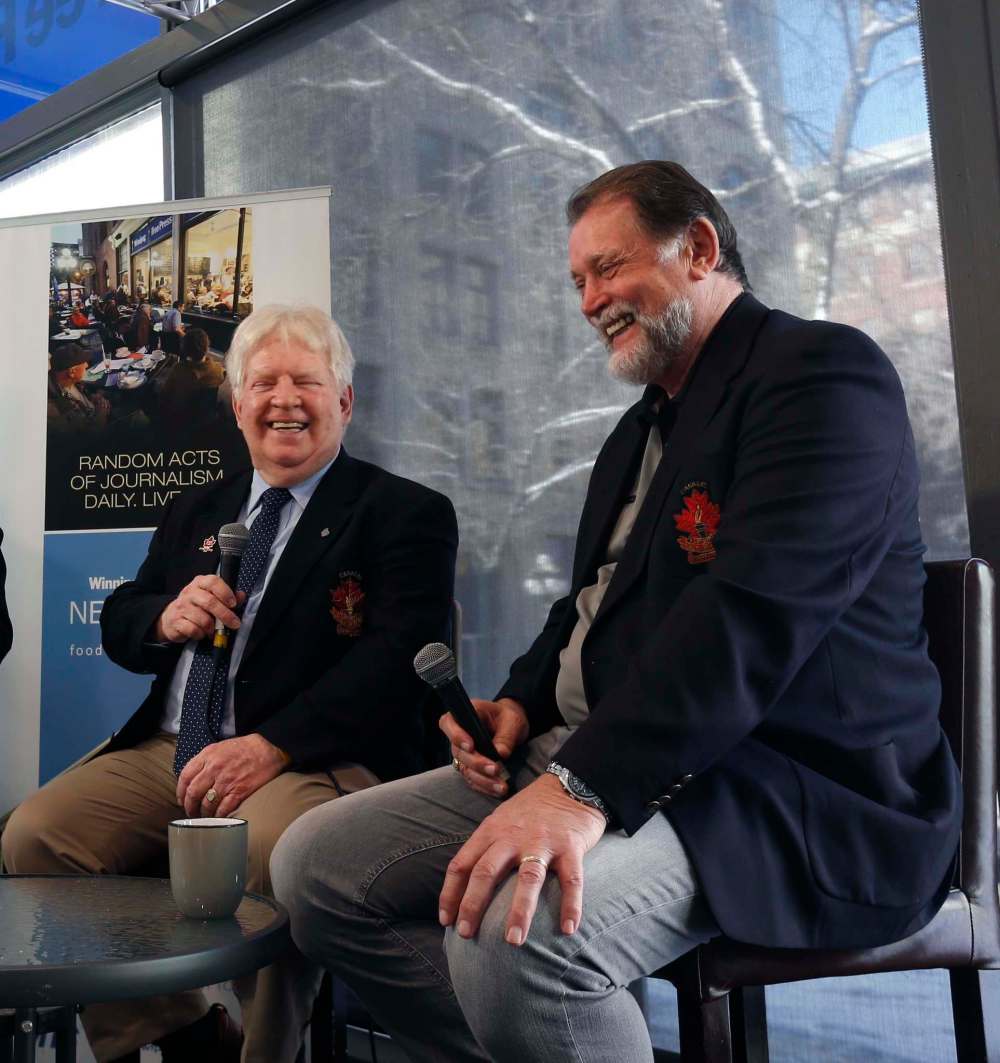
Now, they are proud to call each other “teammates for life.”
The two sat down for a wide-ranging discussion at the Winnipeg Free Press News Café recently and shared many stories, nearly as many laughs and even a few tears.
FP: You guys are going out on a speaking tour with some of your Team Canada teammates and coach, Harry Sinden, this fall to tell a few stories at the Centennial Concert Hall on Sept. 6.
Stapleton: They’re going to play video of some of the games, and the guys will relate to it. I think we’re going to go behind the scenes. A lot of the stuff from the dressing room has never been told before, other than to teammates and family. We had an event in St. Catharines recently where 17 of us got together onstage. We formed a corporation, and we have 37 shareholders (including Sinden and the family of late assistant coach John Ferguson). The project is called 28,800 Seconds — the Power of Teamwork. When we got together, it became hilarious.
Mahovlich: I’ve had to grow a moustache and goatee because I was so embarrassed about what was said on that stage. It’s the interaction of the players and some of the things that happened. Even the players themselves didn’t know what was going on sometimes, and the way I viewed the experience might have been different from how Pat viewed it. The people got involved by asking questions. We thought we’d be there for an hour and that would be it, but three hours later, we had to end it with Phil Esposito saying his prostate was full and he had to relieve himself. He said, ‘That’s it, I can’t do it anymore. I gotta go to the bathroom.’
FP: You guys came out for Game 1 in Montreal over-confident, playing a bunch of guys you had never heard of and whose equipment didn’t match. What was the chatter in the dressing room before the game?
Stapleton: The one guy I remember was Harry Sinden saying ‘They were good.’ We watched them the day before in a practice and they didn’t look that good. Whether they gave us the biggest con job ever, because they were falling down, they weren’t making their passes. We were set up. We realized later on they went on our time in Canada 18 days before they arrived. The eight-hour time change wasn’t there. What you should learn out of it is the other team has good players and can make good plays. Sometimes the other team can make better plays.
FP: When did you realize as a group that the Soviets were for real?
Mahovlich: During the first intermission of Game 1. You saw that skill factor, the ability to make plays, control the puck for 35 to 40 minutes and have 15 to 18 shots a game. Of those shots, 14 were great scoring chances. The puck-possession time was phenomenal.
FP: And how was the dressing room different before the third period of Game 8 when you were down 5-3 and in danger of losing the series?

Stapleton: We were talking about who has the next shot, and guys would speak up, ‘I’ve got it.’ I wonder what was going on in the other dressing room. I’ve often thought they played not to lose in the third period. You’ve got to play to win.
Mahovlich: For some reason, I never thought we were going to lose, and here we are, it’s 5-3 against a great team. The four games in Canada, because we weren’t dominating the Russians, everybody was embarrassed to be a Canadian or to be part of that team. That all changed after the Vancouver game (a 5-3 loss after which the Canadians were booed off the ice) and Phil talked on TV.
It still breaks me up. I’m envisioning these telegrams coming from all across Canada. Hundreds and hundreds of names. We started putting them up on the walls in our dressing room and down the hallway on the way out to the rink. All these towns across Canada… All of a sudden, (we felt) the pride of being a Canadian. That’s what it was all about.
geoff.kirbyson@freepress.mb.ca
History
Updated on Saturday, April 2, 2016 11:12 AM CDT: Video added.