

Bloody legacy of table 63
Drugs, bullets cross paths in series of incidents that started in the street, spilled into a restaurant and continued for years

Advertisement
Read this article for free:
or
Already have an account? Log in here »
To continue reading, please subscribe:
Digital Subscription
One year of digital access for only $1.44 a week*
- Enjoy unlimited reading on winnipegfreepress.com
- Read the E-Edition, our digital replica newspaper
- Access News Break, our award-winning app
- Play interactive puzzles
*Billed as $5.77 plus GST every four weeks. After 52 weeks, price increases to the regular rate of $19.95 plus GST every four weeks. Offer available to new and qualified returning subscribers only. Cancel any time.
To continue reading, please subscribe:
Add Free Press access to your Brandon Sun subscription for only an additional
$1 for the first 4 weeks*
- Enjoy unlimited reading on winnipegfreepress.com
- Read the E-Edition, our digital replica newspaper
- Access News Break, our award-winning app
- Play interactive puzzles
*Your next Brandon Sun subscription payment will increase by $1.00 and you will be charged $17.95 plus GST for four weeks. After four weeks, your payment will increase to $24.95 plus GST every four weeks.
Read unlimited articles for free today:
or
Already have an account? Log in here »
Hey there, time traveller!
This article was published 19/08/2016 (3568 days ago), so information in it may no longer be current.
It is a moment frozen in time: six friends sit down for a late-night bite after hours of club-hopping, drinking, dancing, and socializing.
They are sharing laughs and jokes, not only among themselves but with the good-natured waitress who’s just brought their plates of runny eggs, fluffy pancakes, and greasy sausage.
Except for the two elderly men paying their bills at the front counter, table 63 is the only one occupied inside the Salisbury House restaurant on Pembina Highway in the early morning hours of this mid-week shift.
These south-end Winnipeg boys, raised in middle-class suburbia, are living in the moment. They’ve got money, good looks, and plenty of charm and charisma.
Life is pretty damn good.
A door chime sounds and a masked man enters. He’s armed with a high-powered gun and deadly intentions.
The events that transpired Sept. 27, 2012, would shock the community. In just a few seconds, numerous lives were forever shattered.
A Winnipeg Free Press investigation shows the fallout from that bloody night continues, tying up extensive police resources in at least two provinces.
Multiple unsolved murders. An attempted execution in broad daylight. A never-before-heard apparent “confession” from a dead man. Allegations of a wrongful conviction. Links to old crimes and notorious cons.
“We’re left here with a bit of a mess,” Court of Queen’s Bench Justice Chris Martin said during a series of recent court hearings surrounding these matters. The hearings were under a publication ban at the time, but the Free Press can now report on them.
Amid a barrage of tragedy and lingering mystery, one thing has become clear: it all revolves around table 63.
▣ ▣ ▣

The line of people who wanted Jeffrey Lau dead might go out the door and around the corner. After all, you make enemies when you’re dealing high volumes of cocaine.
With no official organized crime affiliation, Lau, 23, was essentially an independent proprietor who rubbed plenty of people the wrong way.
The first attempt on his life came in June 2012, when Lau was struck by a vehicle. He had just left the Osborne Village Motor Inn — and the incident was clearly no accident.
Witnesses described several suspects getting out of the vehicle and repeatedly kicking and stomping Lau, rendering him unconscious. They stripped him of his clothes before fleeing.
Lau was rushed to hospital, where he spent a week recovering from extensive injuries, including a fractured skull. When the attack occurred, he was with a good friend, Jorden Fries, who was not injured in the incident.
Lau and Fries weren’t co-operative with police in providing descriptions of suspects or potential motive. That’s not surprising when you live this kind of lifestyle. No arrests have been made in the case.
A few months later, Lau and Fries were sitting inside the Salisbury House, at table 63, on that fateful night in September 2012.
Joining them that night were four other friends: Justin Latinecz, Rob McGirr, Khuong Nguyen and a man we’ll call John Doe because his identity is protected by a court order.
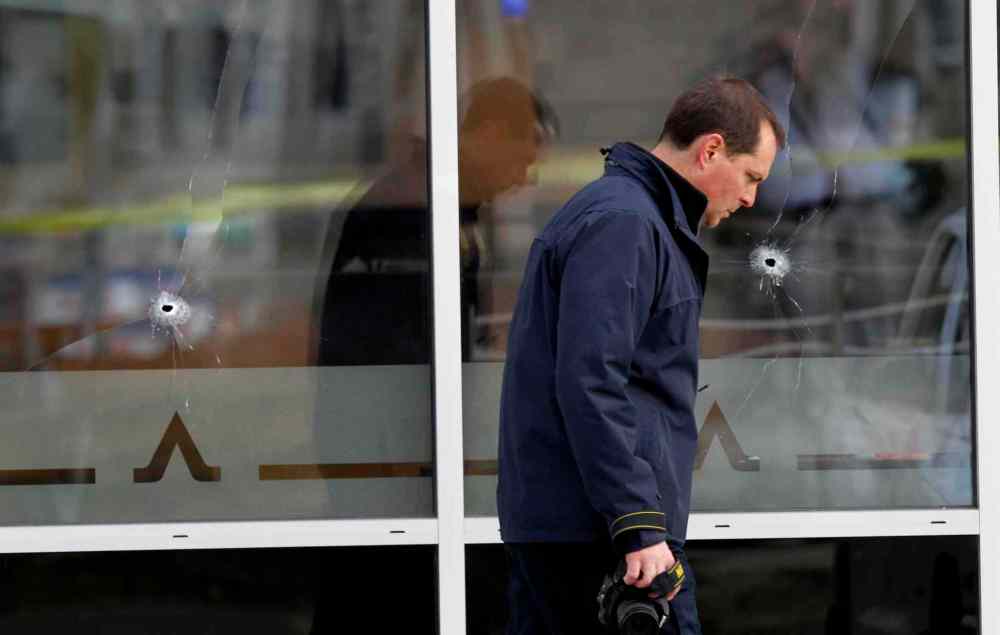
The masked man who came into the diner was targeting Lau. He went directly at him, firing upwards of 20 shots. Doe was struck twice in the arm and ankle by gunfire, only because he was sitting next to Lau. The other four at the table weren’t hurt.
“It’s not rocket science. It was a hit,” Doe told a Winnipeg jury in June 2016 while testifying for the Crown. “If he had wanted to kill the whole table, he would have shot everyone at the table.”
Although no one could provide much of a description of the shooter due to his covered face, Latinecz gave a key piece of evidence that helped police break the case.
Latinecz, 22, broke down in tears as he told police how he desperately tried to save Lau, using his shirt as a tourniquet and pleading for others in the diner to get help. He described watching the gunman flee from the restaurant and get into a waiting vehicle he believed was a Lincoln Zephyr or MKX. An unknown person then drove the killer away.
Police would find a trail of evidence nearby — including the gun used to kill Lau, a white T-shirt the killer is believed to have pulled over his face, and a pair of black gloves. DNA testing would ultimately provide a “mixed profile” on the shirt and gloves, with the primary contributor found to be a man named Devin Hall.
Police also searched car rental records and discovered a Lincoln MKZ — similar to the vehicle described by Latinecz — had been rented by a man named Matthew Lavergne, a friend of Hall. Hall’s name was also on the rental agreement, police discovered.
Police arrested Hall, 30, in February 2013. He was charged with first-degree murder. He refused to give a statement.
Lavergne was arrested in June 2013 under suspicion of being the getaway driver. But police ultimately released him without charge following 10 hours of questioning in which he wouldn’t talk.
“They got no case on him. They interviewed him for hours. They’ve got nothing on him. He refused to say anything to them,” Hall’s lawyer, Martin Glazer, told the Free Press.
An arrest usually signals the end of an investigation. It turned out the police work involving this group was only just beginning.
Surveillance footage from Sals shooting
▣ ▣ ▣
Jorden Fries was still reeling from watching his friend die. Now the 25-year-old Winnipeg man was in custody, having been charged with a killing at a St. Boniface house party.
Fries was arrested in June 2013 after attacking Kyle de Vasconcelos, 23. The two men had been socializing on Notre Dame Street when violence erupted.
De Vasconcelos stumbled from the scene, collapsed and died outside a home on the 200 block of Rue Dumoulin. The beating and stabbing were so severe, police initially thought the victim had been shot. One of the knife wounds pierced his heart.
Fries and de Vasconcelos were described as “associates,” although there’s no suggestion the killing had any connection to the Salisbury House incident.
At trial earlier this year, Fries denied involvement in the killing, suggesting someone else must have inflicted the deadly wounds. Jurors didn’t believe him, finding him guilty of second-degree murder.
He was given a life sentence with no chance of parole for at least 10 years. At the hearing, the victim’s family members questioned how he could “play God” by taking a life.

The Crown’s key witness was dead.
Justin Latinecz, who provided info about the getaway driver in Lau’s killing, was shot and killed less than 24 hours after the one-year anniversary of that crime. A 27-year-old friend was also wounded in the attack, which happened in a back lane outside Latinecz’s Essex Avenue home in St. Vital.
“It was an ambush. Probably set up as a drug transaction, then the gunman popped up and unloaded on them,” a justice source told the Free Press. (The source’s name is being protected because the person is not authorized to speak on the case.)
Although Latinecz was dead, police had videotaped his interview and would later play it in court for jurors at Hall’s trial.
In his statement, Latinecz admitted his group had connections to the drug trade in Winnipeg and Lau was a dealer.
“He said Jeff was independent and was the boss,” said Winnipeg police Sgt. Douglas Bailey.
On the night of the killing, Latinecz said several of them had gone to various clubs and bars before stopping at the Salisbury House for some food.
“He said he didn’t get any negative vibes (earlier in the night), it was all good times,“ said Bailey. “He said, ‘If I knew that (expletive) was going to happen, I wouldn’t have gone.’”
Latinecz got a tattoo on his neck commemorating the date of Lau’s death. And he was apparently honouring his friend in another way as well.
“He took over the selling of drugs for Lau after he was killed,” the justice source said.
So who killed Latinecz? One suspect could clearly be ruled out: Devin Hall. He was in custody at the time for Lau’s killing.
But a key figure would emerge when another attack, perhaps linked to table 63, occurred months later.
Jeffrey Lau had been executed. Jorden Fries was in prison for murder. Justin Latinecz was also dead. And now Rob McGirr was on the receiving end of an attempt on his life.
McGirr had to dodge bullets after two masked men opened fire in a crowded parking lot near the University of Manitoba, narrowly missing their target, in June 2014.
He had just emerged from the Mac’s Convenience Store in the area of Pembina Highway and Chancellor Drive when two shots were fired at him around 7 p.m. Both missed.

McGirr fled while the gunmen sped away. Several witnesses gave detailed information to police, including the suspects threw a gun out the car window on Bison Drive. Police located a loaded .45-calibre Colt handgun, which had the serial number removed.
Two men were arrested that evening during a traffic stop. Police found body armour and handcuffs in their vehicle.
One of the accused turned out to be a familiar face to police.
Matthew Lavergne — the suspected getaway driver in Lau’s killing who was never charged — was identified as the one who shot at McGirr. His friend, Bryan Devlin, was charged as well.
Lavergne, 31, and Devlin, 32, pleaded guilty earlier this year after striking a deal with the Crown. They received five-year prison terms.
Court heard McGirr was being watched by the two accused, who had put a GPS tracker on his vehicle days earlier. This suggested a level of planning rather than a spontaneous act.
“It’s quite an interesting case, to say the least,” prosecutor Jocelyn Ritchot told the court. However, no backdrop to the incident was provided, including a possible motive. Lawyers said it was a “true plea bargain” with both sides giving things up to come to a resolution.
“The actions of the accused were reckless and extremely dangerous to public safety,” said Queen’s Bench Justice Joan McKelvey. “Quite clearly there was a callous disregard for public safety.”
They had his DNA on items linked to the killing, along with a car rental agreement which bore his name.
Would it be enough to convince jurors he was guilty of murdering Jeffrey Lau?
As Devin Hall’s trial began in June 2016, defence lawyer Martin Glazer put his own expert on the stand to say the DNA evidence doesn’t prove Hall fired the gun. That’s because investigators found what’s known as a mixed profile on the items, with DNA traces from at least three people. The primary source was Hall, but Glazer’s expert told jurors it didn’t exclude the possibility unidentified DNA on the items belong to the killer.
Jurors were given several possible explanations as to how Hall’s DNA could have been on the items if he had nothing to do with the shooting: transferring his DNA through contact with the killer; innocently touching the items at some point; or even having the gloves and shirt come into contact with other items or locations where his DNA had been left behind.
Glazer also suggested there was no direct evidence the car rented by Lavergne, with Hall also listed on the documents, was the same one described by Latinecz at the scene. It looked similar, sure. But nobody could say it was the same vehicle.
In his most aggressive move, Glazer began pointing out similarities between the Lau killing and the unsolved Latinecz murder a year later, suggesting there could be a link.
Timeline of events
June 2012 – Jeffrey Lau attacked on Osborne Street by several men. He suffered a skull fracture. No arrests made, case is unsolved.
Sept. 27, 2012 – Jeffrey Lau shot and killed inside the Salisbury House restaurant on Pembina Highway. Devin Hall charged with first-degree murder.
June 2, 2013 – Jorden Fries charged with second-degree murder for stabbing, beating death at a St. Boniface house party. Fries was later convicted.
Sept. 28, 2013 – Justin Latinecz shot and killed outside his home in St. Vital. No arrests made, case is unsolved.
June 30, 2014 – Rob McGirr escapes injury after being shot at near the University of Manitoba. Matthew Lavergne and a second suspect arrested and later convicted.
Apr. 20, 2015 – Garry Godson shot and killed in Winnipeg. No arrests made, case is unsolved.
Oct. 7, 2015 – Joel Geddes shot and killed in Calgary. No arrests made, case is unsolved.
Glazer said both were seemingly targeted attacks where one victim was killed and a second injured. Nine-millimeter bullets were used in both shootings. And he was quick to point out his client, Hall, was in custody for the Lau homicide when Latinecz was killed. Meaning if the same killer was responsible for both, it couldn’t be Hall.
“The atmosphere going on between these groups of people was one of hostility, retaliation, another person comes out and shoots. This is all part of the dangerous lifestyle we say Lau was leading and the world he participated in. This is a group involved in bad things. They’ve got friends involved in bad things. This is all interconnected,” Glazer told the court. “There were people out to get him. There were people with motive to kill him.”
Sgt. Douglas Bailey of the homicide unit revealed Latinecz’s case remains a priority.
“It’s an open, ongoing investigation. Ultimately who is responsible for that has not been determined,” Bailey told jurors.
Crown attorney Brent Davidson went even further, telling court Matthew Lavergne was considered a “person of interest” in the Latinecz killing during legal submissions the jury was not privy to.
It had already been proven Lavergne went after Rob McGirr by shooting at him in 2014. Is it possible he also took aim at Latinecz in 2013, the main witness whose testimony about the getaway vehicle led police to both him and Hall for the 2012 killing of Lau?
Glazer also suggested the people who tried to kill Lau on Osborne in June 2012 were the ones responsible. Davidson noted it didn’t automatically help Glazer’s client since there’s no proof Hall wasn’t involved in that attack.
One thing Glazer couldn’t do is suggest Lavergne was the one who shot Lau. That’s because Lavergne is a beefy 260 pounds and stands 5-5. Surveillance video that captured part of the restaurant shooting shows a much taller, skinnier suspect.
“We admit Mr. Lavergne is not the slender shooter because of his appearance,” Glazer told the court.
However, Glazer did raise eyebrows when he suggested another person entirely may be responsible for not only killing Lau but also gunning down Latinecz. He told Court of Queen’s Bench Justice Chris Martin he planned to bring a motion suggesting a “third party” was responsible.
And it was a blast from the past.
▣ ▣ ▣
Joel Geddes was as violent as they come.The former member of the Zig Zag Crew, a puppet club of the Hells Angels, was convicted of manslaughter for the 2003 baseball-bat beating death of 18-year-old Morgan Trudeau outside a Pembina Highway bar. He would serve just 15-months in custody.
Following his release from jail, he and three other men were charged in a violent 2006 gangland kidnapping and beating. The victim was allegedly taken from a Pembina Highway restaurant, tied to a post in a basement for more than 10 hours and hit with brass knuckles and the butt end of a gun, suffering a variety of injuries.

One of his co-accused was none other than his good friend and former neighbour, Devin Hall.
Hall would have his charges dismissed at a preliminary hearing. Geddes and his other two co-accused — Garry Godson and Jared Billings — were ordered to stand trial, only to have the Crown enter a stay of proceedings in 2008 when the victim couldn’t be located.
Geddes and Godson would cross paths with police again in 2011. Geddes was arrested and charged with dangerous driving after allegedly fleeing a police attempt at a spot check. Officers identified him as the driver. But his charge was dropped when Godson stepped forward and claimed he was the one behind the wheel, making the admission at one of Geddes’ court hearings. The Crown asked the police to investigate further, and this was confirmed.
Godson, who was also a friend of Hall, ultimately pleaded guilty and was given a six-month jail term.
In April 2015, Godson was found shot dead after police were called to the area of Highfield Street and Chandos Avenue in Norwood Flats. Neighbours reported hearing as many as five shots.
No arrests have been made and no motive for his killing has been disclosed by police.
Six months later, Geddes met a similar fate. He was gunned down outside a home in a Calgary suburb in what police called a “targeted murder.” It happened on his eight-year-old son’s birthday. The boy witnessed the deadly attack. The killing is also unsolved.
At Hall’s trial in June, Glazer revealed he had a witness willing to come forward to say Geddes was the real killer of not only Lau but also Latinecz.

Jurors never heard of this, because it was argued outside their presence. The Free Press can now report on it because the trial is completed.
Glazer ultimately abandoned the “third-party suspect” motion, saying he didn’t think he could tender the evidence because it would be considered self-serving, hadn’t been given to any authorities, hadn’t been recorded and couldn’t be tested through cross-examination since Geddes couldn’t be produced in court.
The Crown likely would have argued it’s convenient to try and blame a dead person — especially once who was good friends with Hall — in an attempt to exonerate him. And they were planning to fire back on all cylinders by shredding the credibility of people such as Geddes and Lavergne.
“For a first-degree murder trial, there’s been a lot of twists and turns,” Justice Chris Martin said during the course of legal arguments on these issues. “Things have gone quite differently in this trial than I anticipated they would.”
The Crown claimed Glazer had also done damage by not-so-subtly raising the possibility Lavergne or someone else could be responsible while cross-examining certain witnesses in front of the jury.
“We’re left with, as my children would say, a take-backsie,” said Davidson. “No words can be used to put the genie back in the bottle.”
Martin ultimately warned jurors to disregard any evidence they heard during the trial about the issue.
“You are to give it no weight and draw no inferences from it,” he said.
So who was the mystery witness that was going to point the finger of blame at Joel Geddes?
None other than his own mother.
Glazer recently revealed to the Free Press Joanne Geddes claims her son was responsible for killing both Lau and Latinecz prior to his own violent demise. She said it was part of an ongoing drug turf war.
“I’ve got very strong reason to believe it was Joel who walked into that Salisbury House, and not Devin,” Geddes told the Free Press. “And I’ve got very strong reason to believe Joel went and took care of the guy in St. Vital, too.”
Geddes said “it was common knowledge on the street” her son was robbed by Lau and others of an expensive gold chain months prior to the Salisbury House murder. And she said the June 2012 attack on Lau outside the Osborne Village Motor Inn was carried out by her son in retaliation to Lau trying to steal his “crack phone.”
As well, she claims Lau, McGirr, and others in that group had put a “$250,000 contract” out on him, leaving her son with no choice but to essentially kill or be killed.
“They were coming after him and his family. Joel was cornered,” said Geddes. Although her son never explicitly told her he carried out any killings, Geddes said she has no doubts.
“Joel wouldn’t say that to me. What Joel says to me is things like, ‘OK, that settles it, I know what I got to do, that’s going to be taken care of.’ After the Salisbury shooting he told me, ‘I gotta disappear, I gotta disappear, you’re not going to see me for a while.’”
As well, she said her prediction about her son’s fate ultimately came true.
“I understand Joel was in that life and there were consequences to that lifestyle,” she said. “Ten days before (he was killed) I told Joel, ‘They’re coming for you, you know you’re going to die. What am I going to do?’”
During mid-trial arguments which the jury was excluded from hearing, Glazer wanted to ask police if they had considered Geddes a suspect in Lau’s murder. The Crown inquired and answered by simply repeating only Hall and Lavergne were arrested, with only Hall being charged.
The Free Press requested comment from the Winnipeg police homicide unit about Joanne Geddes’ claims. Police declined to speak, citing ongoing investigations.
Despite the circumstantial evidence — including the DNA link and the car rental — Glazer said he believes the woman’s story to be truthful.
“I think it’s pretty compelling. What this person has to say makes this a wrongful conviction. Definitely,” said Glazer. “I don’t think (Hall) was involved in this. I think Geddes was involved in both.”
Hall was convicted of Lau’s murder, with jurors only needing a few hours to deliberate following a three-week trial.
“I’m telling you, they put an innocent guy away,” said Joanne Geddes.
There were six people seated at table 63 that night in September 2012.
Two are now dead. One is in prison for murder. One survived an attempt on his life. The other two have kept a low profile while remaining in the community.
Lavergne remains behind bars for a few more years as a result of his involvement in the shots fired at McGirr. He could still be charged as the suspected getaway driver in Lau’s killing should police and the Crown feel their evidence is strong enough at some point. There is no statute of limitations.
As well, Latinecz’s murder remains under investigation — with Lavergne identified as a “person of interest.”
Meanwhile, the man found by jurors to be behind the mask inside the Salisbury House has started his mandatory life sentence with no chance of parole for at least 25 years. Hall has since filed an appeal. His two former friends — Geddes and Godson — are dead.
Joanne Geddes believes both of those attacks are linked to what started on the street, spilled into the Salisbury House and has now carried on for years.
“That’s 100 per cent. 100 per cent,” she said. “I would like everyone to know I forgive whoever. I don’t care who it was. I don’t care if they ever get picked up. I’m telling you, this should end. I’d like the other families to know I’m really sorry.
“It’s not just our kids. It’s the people above the kids that get them involved, turn both sides against them. They don’t care as long as they get their money. That’s the way that world works.”
mike.mcintyre@freepress.mb.ca
Mike McIntyre is a sports reporter whose primary role is covering the Winnipeg Jets. After graduating from the Creative Communications program at Red River College in 1995, he spent two years gaining experience at the Winnipeg Sun before joining the Free Press in 1997, where he served on the crime and justice beat until 2016. Read more about Mike.
Every piece of reporting Mike produces is reviewed by an editing team before it is posted online or published in print — part of the Free Press‘s tradition, since 1872, of producing reliable independent journalism. Read more about Free Press’s history and mandate, and learn how our newsroom operates.
Our newsroom depends on a growing audience of readers to power our journalism. If you are not a paid reader, please consider becoming a subscriber.
Our newsroom depends on its audience of readers to power our journalism. Thank you for your support.
Mike McIntyre is a sports reporter whose primary role is covering the Winnipeg Jets. After graduating from the Creative Communications program at Red River College in 1995, he spent two years gaining experience at the Winnipeg Sun before joining the Free Press in 1997, where he served on the crime and justice beat until 2016. Read more about Mike.
Every piece of reporting Mike produces is reviewed by an editing team before it is posted online or published in print — part of the Free Press‘s tradition, since 1872, of producing reliable independent journalism. Read more about Free Press’s history and mandate, and learn how our newsroom operates.
Our newsroom depends on a growing audience of readers to power our journalism. If you are not a paid reader, please consider becoming a subscriber.
Our newsroom depends on its audience of readers to power our journalism. Thank you for your support.
Advertisement Advertise With Us
Advertisement Advertise With Us
History
Updated on Friday, August 19, 2016 9:58 AM CDT: Removes photo