

The quintessential civil servant
Eldridge to become fourth Manitoban to receive Vanier Medal, Canada's highest honour for public service
Advertisement
Read this article for free:
or
Already have an account? Log in here »
To continue reading, please subscribe:
Monthly Digital Subscription
$1 per week for 24 weeks*
- Enjoy unlimited reading on winnipegfreepress.com
- Read the E-Edition, our digital replica newspaper
- Access News Break, our award-winning app
- Play interactive puzzles
*Billed as $4.00 plus GST every four weeks. After 24 weeks, price increases to the regular rate of $19.95 plus GST every four weeks. Offer available to new and qualified returning subscribers only. Cancel any time.
Monthly Digital Subscription
$4.99/week*
- Enjoy unlimited reading on winnipegfreepress.com
- Read the E-Edition, our digital replica newspaper
- Access News Break, our award-winning app
- Play interactive puzzles
*Billed as $19.95 plus GST every four weeks. Cancel any time.
To continue reading, please subscribe:
Add Free Press access to your Brandon Sun subscription for only an additional
$1 for the first 4 weeks*
*Your next subscription payment will increase by $1.00 and you will be charged $16.99 plus GST for four weeks. After four weeks, your payment will increase to $23.99 plus GST every four weeks.
Read unlimited articles for free today:
or
Already have an account? Log in here »
Hey there, time traveller!
This article was published 21/01/2017 (3362 days ago), so information in it may no longer be current.
OTTAWA — It was Feb. 5, 1968.
A 23-year-old man, fresh from university, arrived at Room 42, a basement office in the Manitoba Legislature, which then housed the research department of the Manitoba Treasury Department.
It was his first full-time job — an analyst in the federal-provincial division.
Manitoba political expert Paul Thomas remembers him well, “with a Beatles’ haircut and Jimi Hendrix on his music player.”
“I thought to myself ‘this guy has no future’,” says Thomas, who was working in the office. “It turns out, I was wrong.”
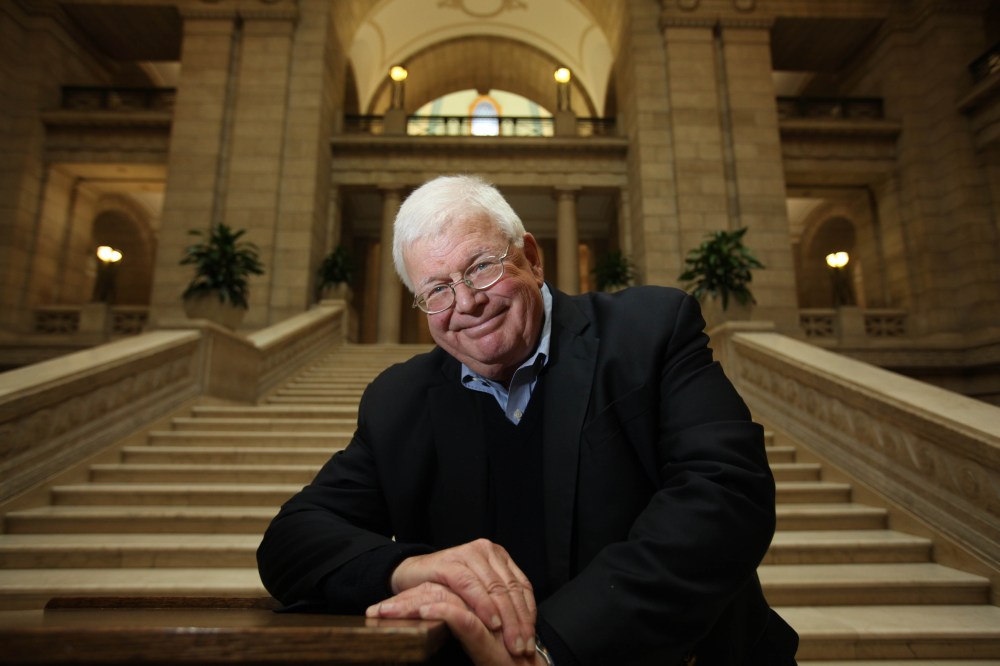
That man was Jim Eldridge, who on Monday at a ceremony at Rideau Hall in Ottawa, will be the 2017 recipient of the Vanier Medal, the highest award in Canada for public service. He is just the fourth Manitoban to receive the medal since its inception in 1962.
CentrePort Canada President Diane Gray worked by his side for almost 15 years as the deputy minister of finance and intergovernmental relations in Manitoba and wrote a letter in support of his nomination for the award.
“I would call him the quintessential civil servant.”
Eldridge, 72, retired Dec. 31, having advised the last eight Manitoba premiers and played witness to and influence on most of the great national political debates of the last half century. The constitution debates in the early 1980s? Eldridge was not only part of it, he helped pen the section on equalization.
He was part of the Meech Lake debates, the Charlottetown Accord conversations, and every national and western premiers meeting since at least 1980.
He recalls Manitoba Premier Sterling Lyon, Quebec Premier René Lévesque and Quebec Finance Minister Jacques Parizeau together in the cabinet room in the Manitoba Legislature trying to draft a communique during the 1980 premiers meeting, which Manitoba hosted. There were no computers, everything was being done with typewriters.
“I walked into the room and Premier Lyon was in there holding the scissors, Rene Levesque was holding the scotch tape and Jacques Parizeau was holding this piece of typescript,” he says, chuckling.
Eldridge never planned on this career. Born in Winnipeg in May 1944, he grew up on Oxford Street in River Heights and graduated from Kelvin High School, before going on to the University of Manitoba. He studied economics and politics, and was in the midst of working on a masters in economics when his father’s sudden death left him needing to make some money.
“In the first couple of years I was unsure if I was cut out for it but I had a lot of fantastic bosses,” he said. “By Year 5, I was hooked.”
In 1968, cabinet ministers did not have political staff in Manitoba. Rather the rookie in the department was assigned to staff the minister while the legislature was sitting. Eldridge was assigned that task almost from the moment he walked in the door, helping Finance Minister Gurney Evans.
“I got a crash course in how everything worked,” he says, noting he sat in on all of Evans high-level meetings with Manitoba Hydro or local interest groups during budget planning.
Eldridge became the director of the federal-provincial relations division of the treasury branch just a few years after starting. In 1973, he was appointed assistant deputy minister for fiscal and economic policy and federal provincial relations, during which time he was asked to set up a stand-alone federal-provincial relations unit. He became deputy minister in 1986.
In 1999, when Gary Doer was sworn in as premier, he appointed Eldridge as the clerk of the executive council, the senior civil servant in the province, a position he held until his first retirement in 2004. His departure didn’t last long.
For the next five years, he worked part time as an advisor to Doer on intergovernmental affairs. In 2009, when Greg Selinger took over as premier, he appointed Eldridge as the deputy minister for federal-provincial and interprovincial relations. Last spring, when Premier Brian Pallister was elected, he asked Eldridge to be a senior advisor to the executive council for the transition period.
In December, Pallister awarded him the Order of the Buffalo Hunt, saying Eldridge’s counsel was a lifesaver.
“I must reference, Madam Speaker, being a new Premier and in my first week in the job, going to the western Canadian premiers’ meetings and not having Jim there would have been a serious, serious challenge for that rookie Premier,” Pallister said.
Don Leitch, who was the clerk of the executive council during Gary Filmon’s premiership between 1988 and 1999, and is one of Eldridge’s closest friends, says he told Pallister later that day, Eldridge had played that role for more than one premier. Filmon was also elected just days before the western premiers’ meeting and Eldridge was at his side then, too.
Doer hadn’t been to a single national premiers’ meeting when he had to host one in 2000, and Eldridge was there.
Doer remembers Alberta Premier Ralph Klein and Saskatchewan Premier Roy Romanow were at odds around the table over health care and he was worried the meeting wasn’t going well.
So Eldridge calmed his fears.
“He said ‘this is the best meeting! You should have been there when (Manitoba Premier Ed) Schreyer and (Alberta Premier Peter) Lougheed got into an argument about clean energy’!”
Every person the Free Press interviewed about Eldridge said they really hope he will write a book.
“His institutional knowledge and memory of everything from 1967 to now, it’s just a virtual walking library of information,” says Gray.
Advising eight premiers across the political spectrum might be difficult for some, but Eldridge was described by all as a consummate professional.
“He was the kind of person you could confide in and know he would keep it in confidence,” Doer says.
Eldridge himself looks back on his career, noting how technology has changed much of how intergovernmental relations works. He said in the days before email and teleconferences, people had to meet in person. During the constitutional talks in 1980, he spent every week one summer with his colleagues from other provinces and federal justice minister Jean Chretien, flying to a different city each week for talks.
Those personal interactions made for stronger relationships than he thinks often exist now, when meetings have given way to technology, and politicians seem less trustful of public servants.
“The result is a less collegial process,” he says.
Away from the office, Eldridge is a sports fan and family man. His two children are now grown and working as lawyers in Toronto, a city he visits many times a year to see his first grandson.

Leitch says Eldridge is just a kind, affable person who had enthusiasm for everything. He remembers after a meeting in downtown Calgary to prepare for a western premiers’ conference, he and Eldridge were killing time before their flight home at The Bay, when they came upon staff tearing apart a Disney display.
“He is a huge Disney fan,” says Leitch. “He has taken his kids to Disney lots. There were these four-foot high characters of Mickey Mouse and Donald and Minnie and Goofy, and he asked ‘hey, can we have those.’ They were just going to throw them out.”
Leitch laughs as he remembers the two of them, dressed in suits, lugging these four enormous cutouts of Disney characters onto the plane, where Eldridge’s excitement won over the flights attendants who found safe homes for them for the flight to Winnipeg.
“This is just a perfect example of Jim’s outright zest for life,” Leitch says.
mia.rabson@freepress.mb.ca
The honour

The Vanier Medal was created in 1962 in honour of Canada’s then Gov.-Gen. Georges P. Vanier. It is the Institute of Public Administration of Canada’s highest form of recognition. It is awarded to an individual who has shown distinctive and indefatigable leadership and made significant contributions in public administration and to the public service in Canada.
Past Manitoba winners:
1967: Manitoba Hydro President Donald Stephens
2003: Paul Thomas, Duff Roblin Professor of political science, University of Manitoba
2008: Margaret Bloodworth, national security advisor to Prime Minister Stephen Harper, former deputy minister of transport who oversaw Canada’s Y2K transition. Born and raised in Winnipeg.
Advertisement Advertise With Us
Advertisement Advertise With Us