

Early 1900s flu was a global pandemic
Advertisement
Read this article for free:
or
Already have an account? Log in here »
To continue reading, please subscribe:
Monthly Digital Subscription
$1 per week for 24 weeks*
- Enjoy unlimited reading on winnipegfreepress.com
- Read the E-Edition, our digital replica newspaper
- Access News Break, our award-winning app
- Play interactive puzzles
*Billed as $4.00 plus GST every four weeks. After 24 weeks, price increases to the regular rate of $19.95 plus GST every four weeks. Offer available to new and qualified returning subscribers only. Cancel any time.
Monthly Digital Subscription
$4.99/week*
- Enjoy unlimited reading on winnipegfreepress.com
- Read the E-Edition, our digital replica newspaper
- Access News Break, our award-winning app
- Play interactive puzzles
*Billed as $19.95 plus GST every four weeks. Cancel any time.
To continue reading, please subscribe:
Add Free Press access to your Brandon Sun subscription for only an additional
$1 for the first 4 weeks*
*Your next subscription payment will increase by $1.00 and you will be charged $16.99 plus GST for four weeks. After four weeks, your payment will increase to $23.99 plus GST every four weeks.
Read unlimited articles for free today:
or
Already have an account? Log in here »
Hey there, time traveller!
This article was published 05/03/2018 (2968 days ago), so information in it may no longer be current.
The flu has been causing havoc over the last five months. The available flu vaccine is said to be about 25 per cent effective against the virulent H3N2 strain, which continues to spread across North America. From September to mid-January, there were more than 80 flu-related deaths in Canada, and at least eight of them were children. In the United States, more than 80 children have died from the virus.
As tragic as this is, in the past 100 years modern medicine has come a long way since the influenza pandemic of 1918, which was responsible for the deaths of at least 50 million people across the world — and possibly as many as 100 million. An estimated 500 million, at the time about one-third of the world’s population, were infected.
More than two million Canadians contracted the disease and approximately 50,000 died. It was the worst plague since the medieval Black Death, which had lasted for more than a century. In contrast, in 1918 the worst phase of the flu pandemic raged for only six months. Yet anyone who can trace back their ancestry and who had relatives living in Canada in 1918 almost certainly had a family member who died in the pandemic.
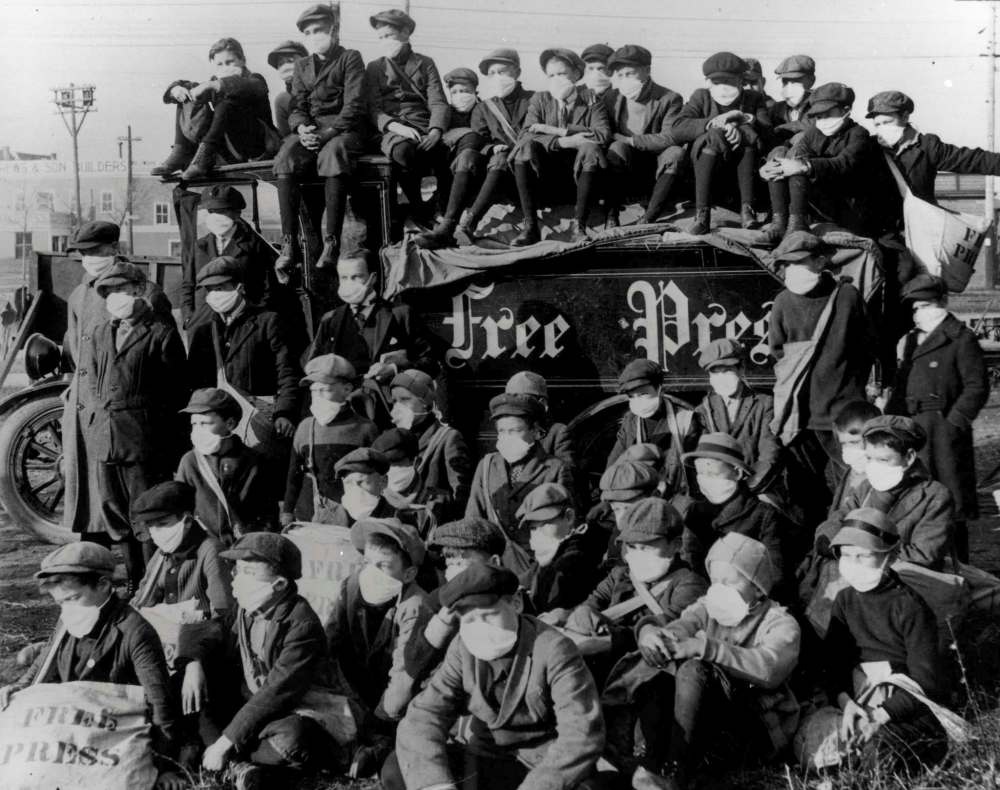
“Nothing else — no infection, no war, no famine — has ever killed so many in as short a period,” wrote U.S. historian Alfred Crosby. Medical officials were helpless to stop it in Canada and elsewhere. In 1918, pandemic planning for influenza outbreaks was virtually nonexistent.
Canada’s average death rate during the pandemic was 6.1 per 1,000 — though the rate in Winnipeg was 6.6, and among the Indigenous population of Norway House in northern Manitoba it was 183. This Canadian rate was much better than Cameroon’s at 445 per 1,000, yet worse than Australia’s of 2.7.
The United States’ rate was 6.5 per 1,000, and the average death rate in Europe in 1918 was 4.8. More curiously, the majority of those who succumbed were between the ages of 18 and 40. (It is possible that individuals who were older than 40 may have been exposed to an earlier strain of the virus, which tempered its effect on them.)
There were three bouts of influenza in 1918: the first in late February-early March, which was relatively mild in comparison to what followed; the second, starting in late August and early September — the first civilian outbreak in Canada was reported in Victoriaville, Que., on Sept. 8 — which lasted for several months and was responsible for the majority of the deaths; and the third, which lingered into 1919-1920. A century later, medical experts and historians are still debating how the flu reached North America.
For a long time, it was thought that soldiers arriving back in Canada beginning in August 1918 brought the disease with them. There had been flu outbreaks in European military camps starting in 1916. Physicians who treated the soldiers at barracks in northern France and in England reported in 1917 that many of their patients who had died from the illness had symptoms later observed in civilian sufferers who perished in 1918: bloody mucus, a faster-than-normal heart rate at rest, a nasty fever and a bluish colouration of the skin. But the timeline for the returning soldiers was off, since a lot of them arrived back in Canada after Nov. 11, when the war ended.

Another theory focused on an outbreak of the flu in U.S. military camps, especially in Kansas. It was possible that civilians who came in contact with the soldiers were infected and the disease then spread quickly across the continent and to Europe, where it might have mutated. But again, the timeline did not precisely fit the pattern, suggesting that the military camp outbreak was not the “primary site,” though it contributed to the spread of the flu among civilians in North America.
A third and more probable hypothesis, according to the latest research, is that the deadly influenza virus of 1918 originated in China and was spread in North America and Europe by the Chinese Labour Corps. In the spring of 1918, thousands of Chinese conscripts — who had lived for a time in crowded barracks ripe for the spread of influenza — journeyed from the then-British-controlled port of Weihaiwei in northeast China to Europe. In early 1918, about 25,000 members of the labour corps, the majority (if not all) of whom had been exposed to pneumonia or flu in China, arrived in Vancouver and were transported across the country by train.
British officials in Weihaiwei had been careless or ignored the reality of the situation because many of the Chinese men were too ill to travel and more than 3,000 needed medical attention. As such, there was plenty of opportunity for influenza to spread from the men in Canada and also to soldiers in Britain and France, once the labour corps arrived in Europe.
Indeed, British, French, and Canadian soldiers started becoming ill by February 1918, long before they journeyed home, carrying the virus with them. Within months, the labour corps was also in Britain. By then, however, the influenza pandemic was unstoppable.
Now & Then is a column in which historian Allan Levine puts the events of today in a historical context.