

It doesn’t have to be last stop for Via Rail
Advertisement
Read this article for free:
or
Already have an account? Log in here »
To continue reading, please subscribe:

Digital Subscription
One year of digital access for only $205*
- Enjoy unlimited reading on winnipegfreepress.com
- Read the E-Edition, our digital replica newspaper
- Access News Break, our award-winning app
- Play interactive puzzles
*First annual payment billed as $205.00 + GST for one year. This annual subscription will automatically renew at $233.00 + GST every 52 weeks (10% off the regular annual price of $259.35). Offer available to new and qualified returning subscribers only. Cancel any time.
To continue reading, please subscribe:
Add Free Press access to your Brandon Sun subscription for only an additional
$1 for the first 4 weeks*
- Enjoy unlimited reading on winnipegfreepress.com
- Read the E-Edition, our digital replica newspaper
- Access News Break, our award-winning app
- Play interactive puzzles
*Your next Brandon Sun subscription payment will increase by $1.00 and you will be charged $17.95 plus GST for four weeks. After four weeks, your payment will increase to $24.95 plus GST every four weeks.
Read unlimited articles for free today:
or
Already have an account? Log in here »
Hey there, time traveller!
This article was published 28/12/2020 (2037 days ago), so information in it may no longer be current.
The recent performance by Via Rail’s Canadian between Vancouver and Winnipeg — but not between Toronto and Winnipeg via northern Ontario — on its first trip in nine months is the death rattle of Canada’s passenger trains. It needn’t be.
Working on my book on this long and sad Canadian saga, I frequently look south at Amtrak. There, a few miles from the border, a solution operates reliably, affordably and effectively. It is the Chicago-St. Paul-Seattle/Portland Empire Builder. It is named for Ontario-born James J. Hill, who built the original railway plied by Amtrak’s double-deck train today using many Bombardier-built, Ottawa-financed passenger cars.
Amtrak and Via Rail started out at much the same place and with the same objective: respond to public demands that the government save what remained of each country’s once-massive rail passenger systems. That happened in the U.S. in 1971 and it fuelled public demands that Pierre Trudeau’s government do the same here, which it reluctantly did in 1977.
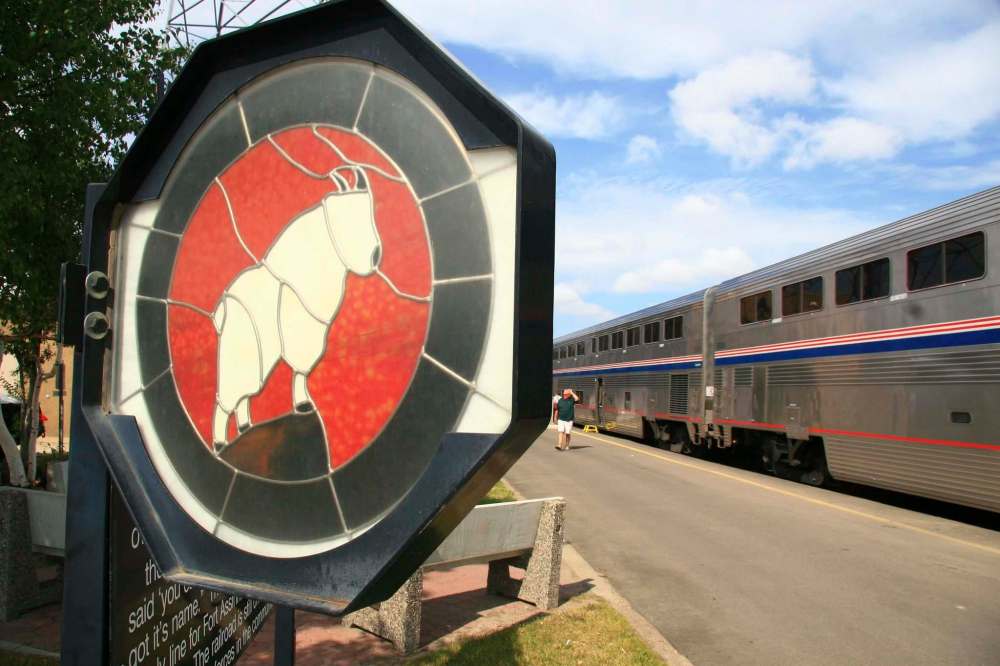
But the similarities pretty much end right there. Amtrak faced rough political sledding through its 50 years of publicly-funded operation, but nothing like Via Rail. That’s because its founders armed it with enabling legislation that makes it almost impossible for any administration to kill it, though many have tried. That legislation allows Amtrak to adapt to changing conditions and adopt new concepts.
One key provision gives any state wanting more service the right to it, if they pay part of the cost. That contrasts with Canada, where the provinces whine and contribute nothing to Via Rail while throwing billions at highways. The feds undermine their own Via Rail by propping up our overblown and expensive air system.
Amtrak’s 17 state partnerships fund 28 regional corridors in addition to its basic national network, which includes the high-density northeast corridor and 15 long-distance trains that make Via Rail look like a rolling museum.
Modern equipment has always been near the top of Amtrak’s agenda since its 1971 launch. Democratic and Republican legislators have made that happen. One was president-elect Joe Biden, whose efforts in support of and daily use of Amtrak earned him the nicknames “Amtrak Joe” and the “Senator from Amtrak.”
Because of Biden and many other rail-savvy federal and state representatives before, during and after his first tour on Capitol Hill, Amtrak rolls — and rolls with modern equipment that has slashed costs and boosted ridership and revenue.
The Empire Builder is typical of today’s coast-to-coast Amtrak network. In 2016, I compared it with Via’s Canadian. Updating that analysis is virtually impossible because Via Rail frequently changes its data reporting methods. One might suspect Via Rail and its Ottawa leash-pullers are trying to hide something.
In 2013, Amtrak’s Empire Builder — equipped with double-deck Superliner cars, many built by Bombardier with Export Development Canada financing — carried more than five times as many passengers and ran more than twice as frequently for less than a third of the per-passenger subsidy of the Canadian, which operates with rebuilt 1950s rolling stock.
South of the Empire Builder’s route on the former Great Northern Railway — built by Ontario-born James J. Hill and the two Scottish cousins who also built the CPR — citizens and politicians are advocating the relaunch of the North Coast Limited on another line through Fargo, Bismarck, Billings, Helena and Spokane. It would run in conjunction with the Empire Builder to link this aptly-named flyover territory with the Pacific Northwest and the Midwest.

There’s no reason Canada can’t do the same. Ah, but the politics of it all. That’s why Via Rail has been a disaster since its inception and is now clearly headed for that big roundhouse in the sky. We don’t have the equivalents of president-elect Biden and the many other Democrats and Republicans who have seen the vital need for a modern rail passenger system to keep their nation economically, socially and environmentally vibrant and competitive. It’s political will as much as public bucks that makes the trains roll — or not.
Until that happens, Canada’s rail passenger service is doomed. It all makes me think of the words on that inspiring plaque beside the CPR main line at Craigellachie, British Columbia:
“A nebulous dream was a reality: an iron ribbon crossed Canada from sea to sea. Often following the footsteps of early explorers, nearly 3,000 miles of steel rail pushed across vast prairies, cleft lofty mountain passes, twisted through canyons, and bridged a thousand streams.
“Here on November 7, 1885, a plain iron spike welded East to West.”
Greg Gormick is a nationally-known rail analyst and policy adviser, whose clients have included Via, CP, CN and elected officials of four political parties. He is the author of the forthcoming book, A National Dream Reborn? – The Life, Near-Death and Future of Canada’s Passenger Trains.
Related Articles
Via Rail on a track to nowhere
Advertisement Advertise With Us
Advertisement Advertise With Us