Fossil fuel fouls clean-grid future Manitoba Hydro can’t escape its emergency reliance on natural gas as demand ramps up for electric power
Read this article for free:
or
Already have an account? Log in here »
To continue reading, please subscribe:

Digital Subscription
One year of digital access for only $205*
- Enjoy unlimited reading on winnipegfreepress.com
- Read the E-Edition, our digital replica newspaper
- Access News Break, our award-winning app
- Play interactive puzzles
*First annual payment billed as $205.00 + GST for one year. This annual subscription will automatically renew at $233.00 + GST every 52 weeks (10% off the regular annual price of $259.35). Offer available to new and qualified returning subscribers only. Cancel any time.
To continue reading, please subscribe:
Add Free Press access to your Brandon Sun subscription for only an additional
$1 for the first 4 weeks*
- Enjoy unlimited reading on winnipegfreepress.com
- Read the E-Edition, our digital replica newspaper
- Access News Break, our award-winning app
- Play interactive puzzles
*Your next Brandon Sun subscription payment will increase by $1.00 and you will be charged $17.95 plus GST for four weeks. After four weeks, your payment will increase to $24.95 plus GST every four weeks.
Read unlimited articles for free today:
or
Already have an account? Log in here »
Hey there, time traveller!
This article was published 28/03/2024 (929 days ago), so information in it may no longer be current.
Despite its reputation as one of Canada’s cleanest electric grids, Manitoba Hydro used more natural gas-fuelled electricity in the last 12 months than it has in a decade.
A perfect storm of drought conditions and high electricity import costs resulted in the province firing up its backup natural gas power earlier and significantly more often to keep up with demand.
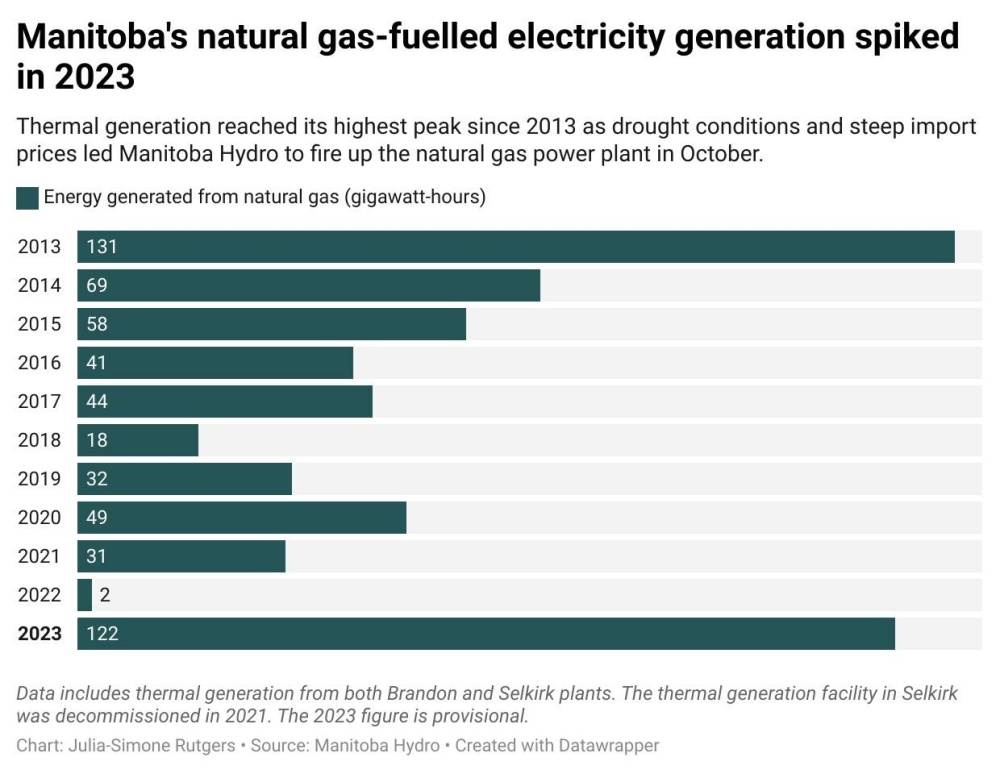
From 2013 to 2023, the utility has run its natural gas generators for an average 54 gigawatt-hours of power; this year, the province has used 122 GWh, according to data provided by Manitoba Hydro.
The drought conditions took a toll on the province’s hydroelectric reserves this year, prompting the utility to import electricity as well as running its backup thermal generators.
It’s a foreshadowing of the uncertain future Manitoba Hydro faces as national efforts to shift away from fossil fuel energy sources in sectors like transportation and heating add strain to the province’s capacity-strapped grid. At the same time, the federal government is targeting a net-zero electricity grid by 2035, meaning any new power needs to be low in carbon emissions.
Hydro’s long-term projections show it will need to at least double its current power supply to keep up with the increased demands from electric vehicles and heating systems and to meet net-zero targets over the next 20 years. In the short term, the utility has admitted it doesn’t have enough power to add new, large consumers to the grid and will need new power sources by the end of the decade.
RUTH BONNEVILLE / FREE PRESS
In the midst of the growing power crunch, Manitoba Hydro, which boasts one of the cleanest grids in the country, is banking on fossil fuels long into the future — and it lacks a clear path toward building an arsenal of renewable sources.
The scope of the power problems
Even before the ongoing drought, Hydro had been sounding the alarm about a shortage of surplus power.
In a September briefing note to the province, obtained by The Narwhal/Free Press, Hydro revealed the surplus capacity used to mitigate fluctuating water levels and shore up revenue from power sales had become “very limited” as demand across all sectors had grown. A queue exists of more than 50 prospective “energy-intensive” customers requiring over 2,700 megawatts of capacity — more than double the existing surplus — and that pressure will only continue to mount.
“A single energy intensive connection may consume all remaining electrical capacity,” the note read.
“New economic development, new and existing customer expansion, decarbonization and vehicle electrification will continue increasing prospective electric interconnection … further constraining electricity supply.”
All told, Manitoba’s 16 hydroelectric dams produce 5,768 megawatts of electricity at any one time. The natural gas peaking plant in Brandon can add an extra 280 megawatts in a pinch, and the two small, independently owned wind farms in southern Manitoba contribute another 250 megawatts of capacity.
TIM SMITH / THE BRANDON SUN The Manitoba Hydro Brandon Generating Station
That’s enough to meet local demand and fulfil the utility’s export commitments (some 1,600 megawatts it’s contracted to provide to power companies in Saskatchewan, Minnesota and other jurisdictions), with an average 970 megawatts of surplus, according to a Free Press/Narwhal analysis of capacity and demand data over the last 10 years. Most years, Manitoba can sell that surplus to the mid-continent independent system operator — the cross-border power market — for an average of $190 million in opportunity revenues.
As Hydro outlined in its note to the province, that surplus is starting to run out, cutting into both revenue opportunities and the utility’s future dependability.
Speaking to the Manitoba Chambers of Commerce in January, then-Hydro CEO Jay Grewal explained dry conditions over the past year had already left the utility with $160 million in net negative income by the end of the third quarter, as hydraulic generation dropped 25 per cent below projected levels and the utility was forced to import energy.
Drought isn’t the only factor straining Manitoba’s grid; national efforts to decarbonize the economy and reach net-zero carbon emissions by 2050 are creating a growing demand on electricity systems from coast to coast.
The Canada Energy Regulator’s 2023 energy futures report projects electricity use will more than double by 2050, becoming the country’s “dominant energy source” and the “backbone of our net-zero scenarios.”
Even after connecting the latest (and likely last) new hydroelectric dam, the $8.7-billion Keeyask project, in 2022, Manitoba’s projections show the province will need 13,000 MW of capacity — more than double current supply — in order to meet 2050 targets.
MANITOBA HYDRO Keeyask Generating Station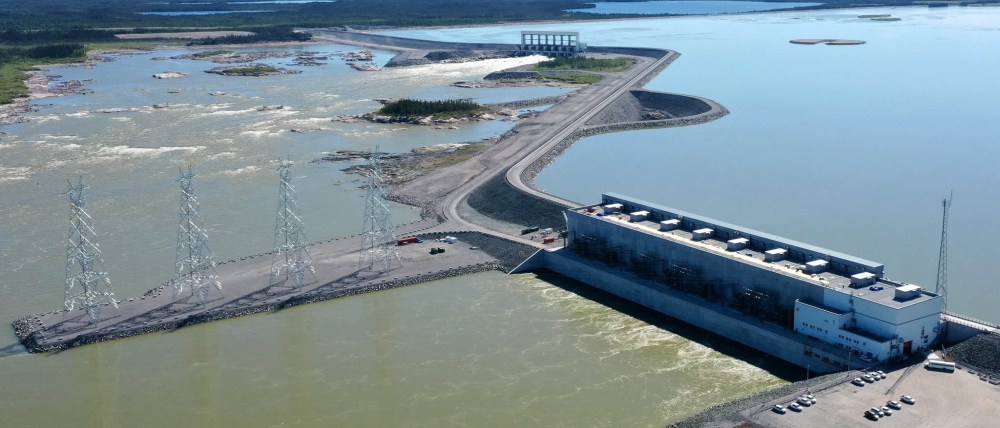
“The province no longer has surplus power to draw on,” the projections state.
In face of these pressures, Grewal told the Manitoba Chambers of Commerce the utility had accelerated its timeline for new power generation.
“When we built Keeyask, we didn’t think we’d need that new power until 2045. We may need it by 2029 or 2030,” she said.
Why look to natural gas?
In the near term, according to Manitoba Hydro spokesperson Bruce Owen, the utility has a contingency plan no matter how low water levels get.
“Our service to domestic customers is never in danger thanks to our transmission interconnections to neighbouring wholesale markets, which allow us to import energy as required during periods of drought,” Owen said in an emailed statement.
The utility refused to provide data on the amount of energy imported this winter, citing its “ability to compete in the electricity market this summer.” The latest quarterly report shows Hydro purchased 1,955 GWh of energy between April 1 and Dec. 31 last year — a sevenfold increase from the 289 GWh imported over the same time period in 2022 (a high-water year) and about 30 per cent less than it imported in the first three quarters of 2021, a drought year.
This year’s imports were curtailed by high electricity prices in the mid-continent power market as drought impacted neighbouring U.S. states, according to the quarterly report.
To mitigate costs, Hydro turned to its failsafe: the natural gas peaking plant in Brandon.
“We’ve run a natural gas turbine at the Brandon Generating Station periodically since late October to meet our customers’ energy needs during the winter months when electricity use is at its highest and when it makes economic sense — for example, if it’s cheaper to run Brandon to provide Manitobans with energy than import electricity from neighbouring utilities,” Owen said.
TIM SMITH / THE BRANDON SUN FILES The stacks at the Manitoba Hydro Thermal Electric Generation Station east of Brandon on Victoria Ave. East poke out from a shroud of fog.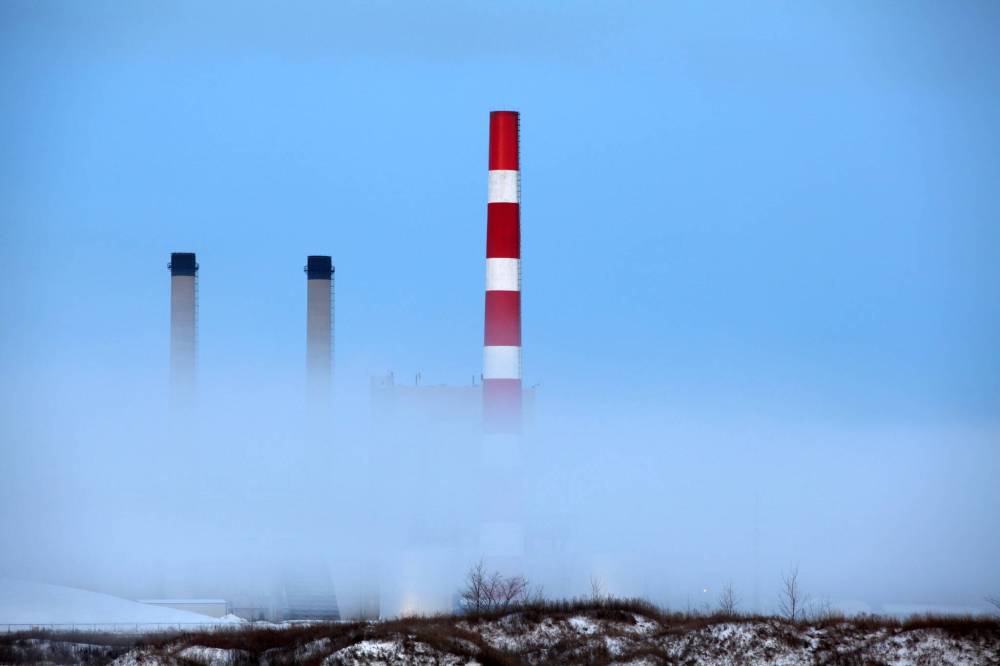
From 2013 to 2023, Manitoba Hydro has generated an average 54 GWh of electricity from its natural gas turbines (including the Selkirk natural gas plant decommissioned in 2021) each year.
Manitoba used 57 GWh of thermal electricity from last October to December alone. According to data provided by Manitoba Hydro, that figure had climbed to 122 GWh by March — the most it’s used since 2013.
Even during drought conditions in 2021, the province used just 31 GWh of natural gas-fuelled electricity. Last year, when water levels were high, it used 2 GWh.
According to the Canada Energy Regulator, 18 per cent of all electricity in the country came from fossil fuels as of 2021. All provinces and territories use some fossil fuel generation in their power systems. But on the path toward national net-zero emissions, Canada has begun implementing regulations aimed at reaching net zero in the electricity sector by 2035. To get there, the federal government recommends phasing out unabated use of fossil fuels for power, except for a small share of natural gas with carbon capture and storage technologies to balance grids that need flexible power options.
In November, Manitoba Premier Wab Kinew and Deputy Prime Minister Chrystia Freeland announced a joint $476-million investment to upgrade some existing hydroelectric infrastructure. The province said the upgrades would reduce emissions from the thermal generating plant by 37 per cent.
But according to Manitoba Hydro’s integrated resource plan and the previous provincial government’s energy road map, natural gas-fuelled electricity will rise over the coming decades.
Hydro said it needs “dispatchable” power sources that will work regardless of weather conditions, can be scaled up quickly, and won’t put too much financial strain on the utility or consumers.
Renewable energy sources like wind turbines and solar panels are considered variable power sources, meaning they’re only dependable when the wind blows and sun shines. Hydroelectric reservoirs have historically had an element of predictability by comparison, but have become more susceptible to weather impacts like precipitation levels and snow melt owing to the impacts of climate change.
“We need to pair these variable renewable resources with a dispatchable resource,” Hydro wrote in the integrated resource plan.
RUTH BONNEVILLE / FREE PRESS FILES Manitoba Hydro is cool to solar power, calling it a costly and ultimately inefficient source of power.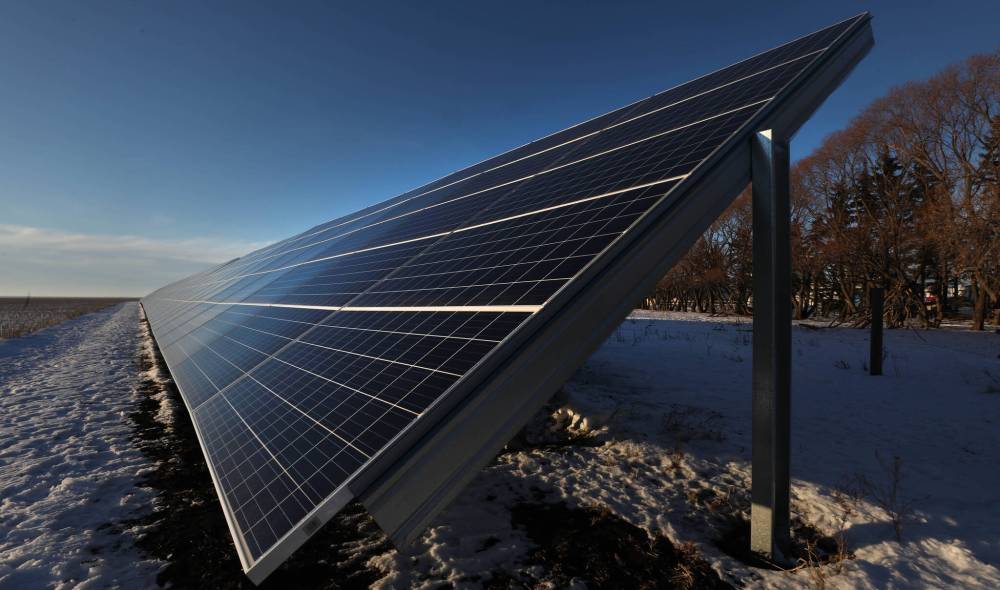
“Our results favour thermal generation, fuelled by natural gas, for this role because it is one of the lowest-cost resources for providing capacity.”
The integrated resource plan analyzed four potential scenarios to scale up power supply over the next two decades, none of which considered a trajectory to achieving net-zero by 2050 targets. In all scenarios, Hydro has banked on an increase in natural gas generation to meet rising demand, projecting the increase in carbon emissions from electricity generation would be offset by the drop in emissions from other sources, like car engines and home furnaces.
An area farmer seeds his crop on fields betweem Manitou and St Leon.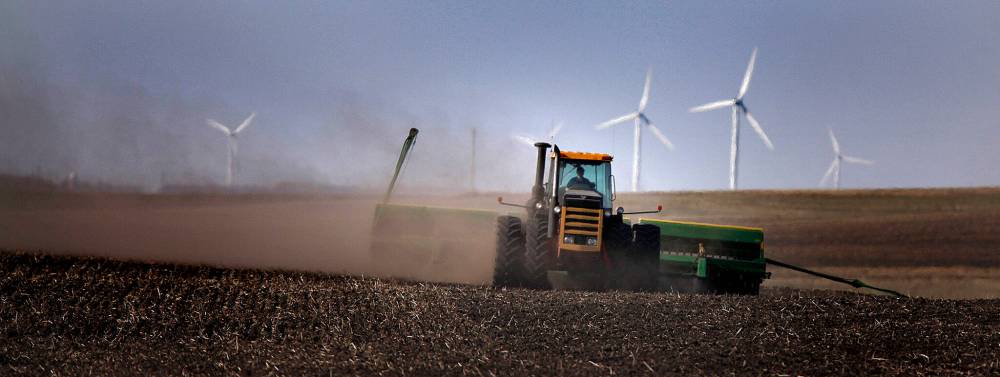
Experts believe natural gas a ‘dead end’
In a 2022 report on building net-zero electricity grids, experts at the Pembina Institute, a Canadian think tank with a focus on energy transition, cautioned “growth in fossil fuel generation must be avoided and all emissions from electricity generation brought close to zero” in order for Canada to meet its Paris agreement targets.
Although natural gas is considered less expensive in the short term, the cost of gas is rising and “any new investment in emitting technologies listed runs the risk of committing to ‘dead ends’ that will ultimately become uneconomical and not support a net-zero grid in the long term,” the report reads.
Instead, experts believe it’s time for utilities to bite the bullet and invest in renewable technologies, despite the upfront infrastructure costs.
“Your best option in Manitoba, I would say, is to maximize productivity first, then renewables, particularly wind and to a lesser extent solar, backed by the Hydro infrastructure,” Mark Winfield, a professor of environmental and urban change at York University, said in an interview.
“What do you do when the wind doesn’t blow and the sun doesn’t shine? You run the Hydro dams. When the wind is blowing and the sun is shining you close the Hydro dams.”
Manitoba has decided against new hydroelectric dams, in large part because the utility is already severely leveraged by debt, Grewal told the Chambers of Commerce. The utility’s planning documents also dismiss solar power as a costly and ultimately inefficient source of electricity for the province.
As far as proven renewable technologies, that leaves just wind power, which the Canada Energy Regulator projects will be the largest source of new electricity generation by 2050.
TREVOR HAGAN / FREE PRESS FILES The Canada Energy Regulator believes wind power will be the largest source of new electricity generation by 2050. Manitoba currently has two small wind farms.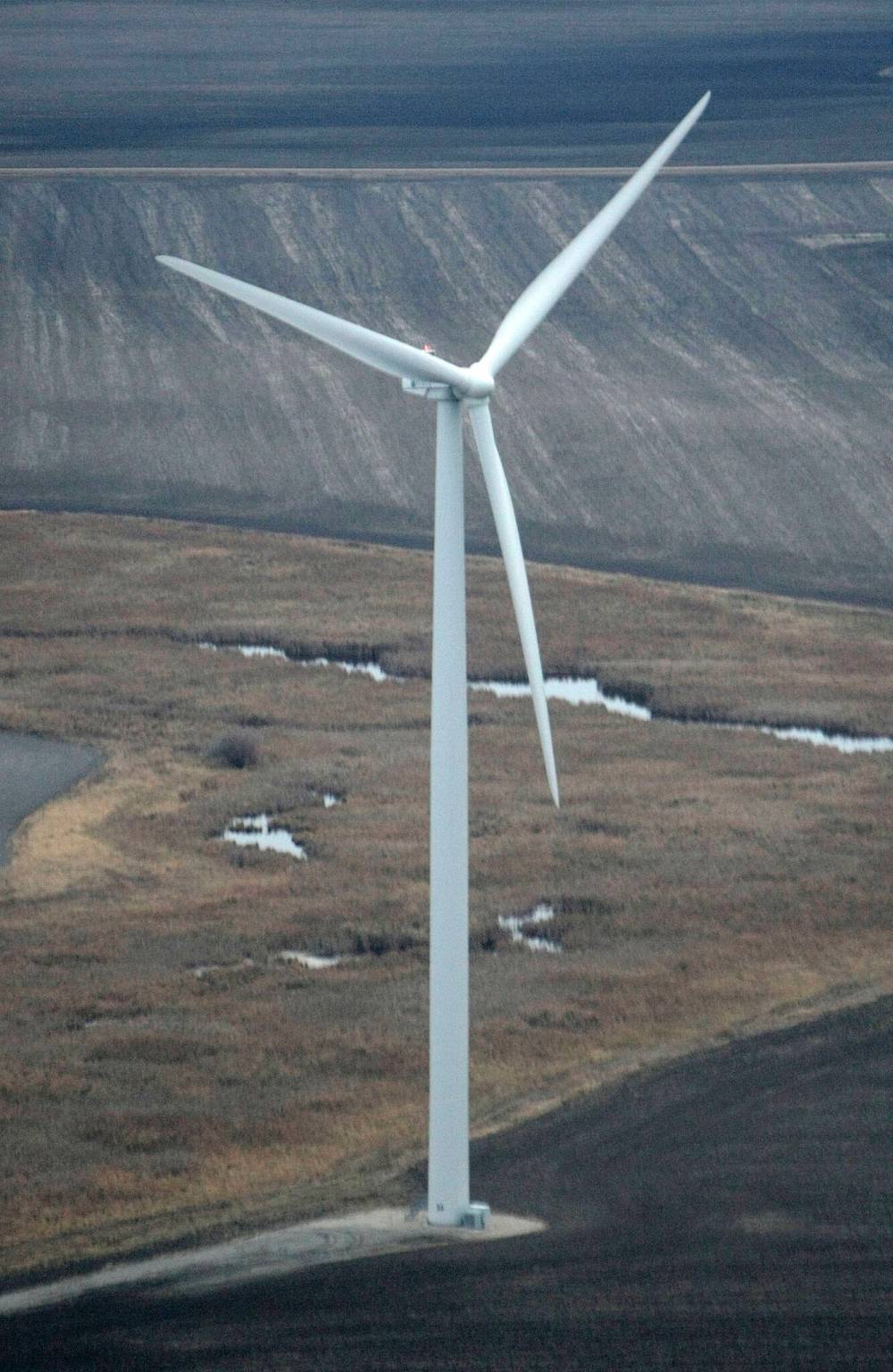
The problem is that building wind infrastructure is expensive.
Manitoba’s leaders have touted its low electricity rates — second only to Quebec — as critical to the province’s economic growth. But new infrastructure will require “significant investment,” according to Manitoba Hydro’s plans, and that will necessitate rising rates.
To mitigate costs, Grewal said in January Manitoba Hydro would issue a call for proposals to build out its generation infrastructure, particularly more wind farms, through partnerships with more independent producers.
That’s in line with expert advice Hydro has received from Dunsky Energy and Climate, and it’s a strategy other utilities across the country have already put into action.
British Columbia’s hydro utility pledged to issue a “call for power” this spring after demand projections found new power resources would be needed “sooner than expected.” The utility plans to develop clean-electricity projects as early as 2028. Hydro-Québec issued a call for tenders in March 2023 to add 1,500 MW of wind power to its grid by the end of the decade, which the utility said would be needed to “help meet Quebec’s growing demand for electricity.” In January, it announced it had approved eight wind farm projects that would add 1,550 MW to the grid.
“You need to have a very serious conversation about gas versus the alternatives, in terms of what comes out as most cost-effective — and I think renewables would probably come out highly competitive,” Winfield said.
The day after Grewal’s speech, Manitoba Finance Minister Adrien Sala publicly rebutted her comments and said the province would look to add capacity to the grid without external partners.
PHIL HOSSACK / FREE PRESS FILES Manitoba Hydro’s Limestone Dam and Power gearing Station near Gillam. 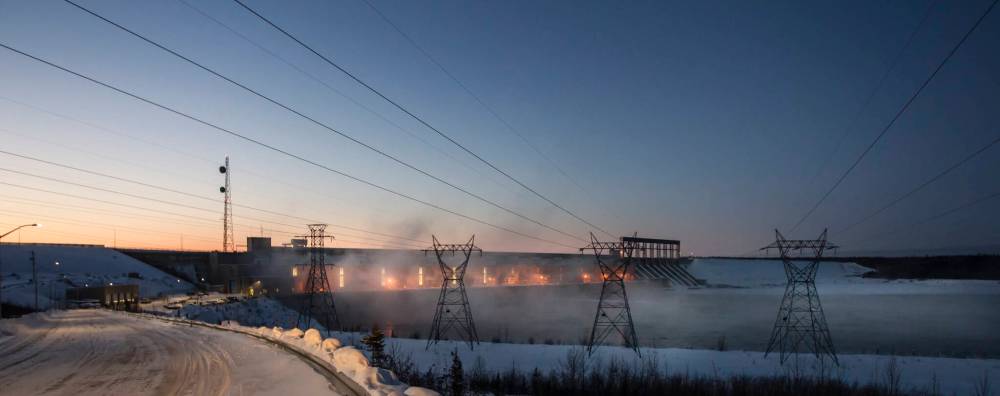
“There’s no question that we need to find ways of building new capacity here in Manitoba, and we do have energy needs that need to be met, but our position is that new generation should be publicly owned,” Sala said.
Grewal was dismissed from her role as CEO two weeks later.
Following the New Democratic Party’s election win last fall, the government directed Hydro to plan for a net-zero electricity grid by 2035 (something Grewal had previously called “unfeasible”) and to eliminate any reliance on natural gas, while doubling down on a promise to “keep Hydro public” by avoiding private partnerships. That deviates from expert advice Hydro has received, and the government hasn’t presented an alternative path.
julia-simone.rutgers@freepress.mb.ca

Julia-Simone Rutgers is an investigative reporter who joined the Free Press in 2020. Read more about Julia-Simone.
Every piece of reporting Julia-Simone produces is reviewed by an editing team before it is posted online or published in print — part of the Free Press‘s tradition, since 1872, of producing reliable independent journalism. Read more about Free Press’s history and mandate, and learn how our newsroom operates.
Our newsroom depends on a growing audience of readers to power our journalism. If you are not a paid reader, please consider becoming a subscriber.
Our newsroom depends on its audience of readers to power our journalism. Thank you for your support.
Related Articles
Manitoba slams door on Hydro subsidiary privatization