Police, auto repair shops credit new legislation for almost total end to catalytic converter thefts
Read this article for free:
or
Already have an account? Log in here »
To continue reading, please subscribe:

Digital Subscription
One year of digital access for only $205*
- Enjoy unlimited reading on winnipegfreepress.com
- Read the E-Edition, our digital replica newspaper
- Access News Break, our award-winning app
- Play interactive puzzles
*First annual payment billed as $205.00 + GST for one year. This annual subscription will automatically renew at $233.00 + GST every 52 weeks (10% off the regular annual price of $259.35). Offer available to new and qualified returning subscribers only. Cancel any time.
To continue reading, please subscribe:
Add Free Press access to your Brandon Sun subscription for only an additional
$1 for the first 4 weeks*
- Enjoy unlimited reading on winnipegfreepress.com
- Read the E-Edition, our digital replica newspaper
- Access News Break, our award-winning app
- Play interactive puzzles
*Your next Brandon Sun subscription payment will increase by $1.00 and you will be charged $17.95 plus GST for four weeks. After four weeks, your payment will increase to $24.95 plus GST every four weeks.
Read unlimited articles for free today:
or
Already have an account? Log in here »
Hey there, time traveller!
This article was published 22/04/2024 (881 days ago), so information in it may no longer be current.
Efforts to curb the theft of catalytic converters in Winnipeg have proven successful, with provincial legislation and police enforcement slamming the brakes on the once-rampant crime.
Data from the Winnipeg Police Service shows the number of reported catalytic converter thefts dropped to 12 cases citywide so far in 2024, down from 236 in roughly the same period last year.
The reduction came in the wake of the Scrap Metal Act and a concerted police effort to crack down on the crime.
“The Scrap Metal Act made major changes that really stymied who could buy and sell these items.… There are not a lot of dealers now who are willing to take a chance and take these products in because it’s illegal to do so,” WPS spokesperson Const. Dani McKinnon said Monday.
The former Progressive Conservative government reined in scrap-metal sales in July 2022, legislating Manitoba metal recyclers to document and photograph all converters purchased, and hand over their records to local authorities weekly.
ETHAN CAIRNS / FREE PRESS FILES
Scrap dealers must also obtain detailed information from all prospective metal sellers, including their government ID, a photograph of their face, a physical description and a written explanation of how they acquired the materials.
Converters are part of a vehicle’s exhaust system, converting pollutants to less toxic material. They’re valuable because they contain trace amounts of precious metals such as platinum, palladium and rhodium.
WPS previously described their theft and sale as fetching a “lucrative” sum, saying scrap yards would pay between $100 and $500 per unit.
Under the Scrap Metal Act, recyclers are no longer allowed to pay cash for converters or any sales worth more than $50.
“This was excellent legislation and it actually put the onus on scrap-metal recyclers to make sure they weren’t taking in the proceeds of crime,” Tory justice critic Wayne Balcaen said of the latest WPS statistics.
“The fact is, the people who were doing this are aware now that they can’t just do the theft and bring it forward to a scrap recycler without the ramifications of having to identify themselves.”
“The fact is, the people who were doing this are aware now that they can’t just do the theft and bring it forward to a scrap recycler without the ramifications of having to identify themselves.”–Wayne Balcaen
Balcaen, a former chief of police in Brandon, was part of the stakeholder group that helped draft the legislation. He said its success is an example of government, organizations and police services working in concert.
Winnipeg Crime Stoppers conducted multiple public awareness campaigns after the Scrap Metal Act was enacted, which also motivated people to take precautions to protect their vehicles, McKinnon said.
“There’s a number of factors we can talk about that have likely contributed to these great fluctuations, but really I think the No. 1 is education to the public,” she said.
WPS logged a total of 344 reported catalytic converter thefts in Winnipeg last year, down from 1,801 in 2022.
The crime spiked across the province in 2022 when it rose to 2,230 from 1,969 the previous year, data from Manitoba Public Insurance shows.
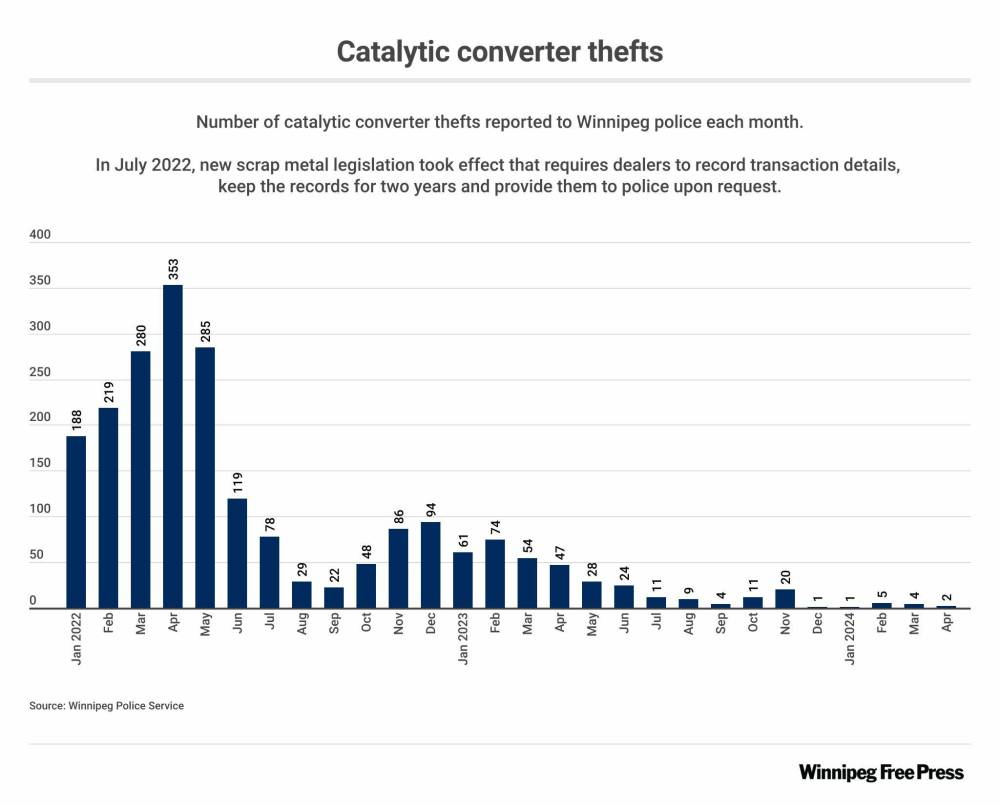
Last year, the crime was reported 550 times in Manitoba. As of April 14, the numbers were at 31, MPI said.
Melissa Button, a staff member at Penner Auto Body Ltd., said automotive dealers have seen the legislation’s impact first-hand.
“Right when they started it, we started getting way less people coming in,” she said. “It used to be really frequent, but now I haven’t had a call from anybody regarding (a stolen catalytic converter) in a very long time.… We are glad to hear it. It’s such a pain in the butt for people.”
The enforcement has made it difficult for people to sell the automotive part, even through legitimate means, Button added, saying her boyfriend recently removed the catalytic converter from his vehicle and struggled to find a purchaser.
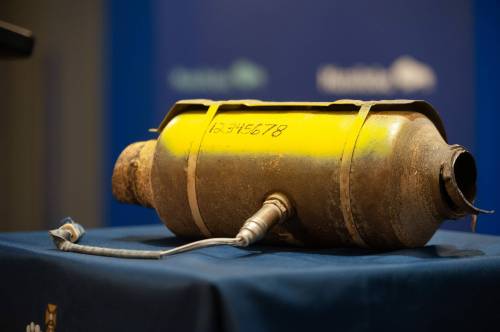
Penner Auto Body is one of more than 80 automotive shops in Manitoba that participate in the Crime Stoppers “Save Your Cat” program, which allows drivers to have their catalytic converter engraved with the vehicle serial number and painted with high visibility paint free of charge.
Similar legislation to the Scrap Metal Act exists elsewhere in Canada, including in Alberta, Nova Scotia and B.C.
A ruling in the Alberta Court of Justice from last December found the Scrap Metal Dealers and Recyclers Identification Act — Alberta’s legislative equivalent — is unconstitutional.
Like in Manitoba, the provincial legislation requires scrap-metal purchasers to record seller’s information and provide it to police.
“The legislation does not truly regulate trade and does not address property and civil rights or administration of justice in a public manner,” Justice Heather Lamoureaux said in her written decision.
Lamoureaux concluded that the act deals solely with criminal law, which is in the federal domain, and therefore should hold “no force and effect” in the province of Alberta.
JORDAN ROSS / THE CARILLON FILE Harvest Honda mechanic Jerry Mitchell engraves a catalytic converter using one of 50 tool kits purchased by the province for garages in the Steinbach area.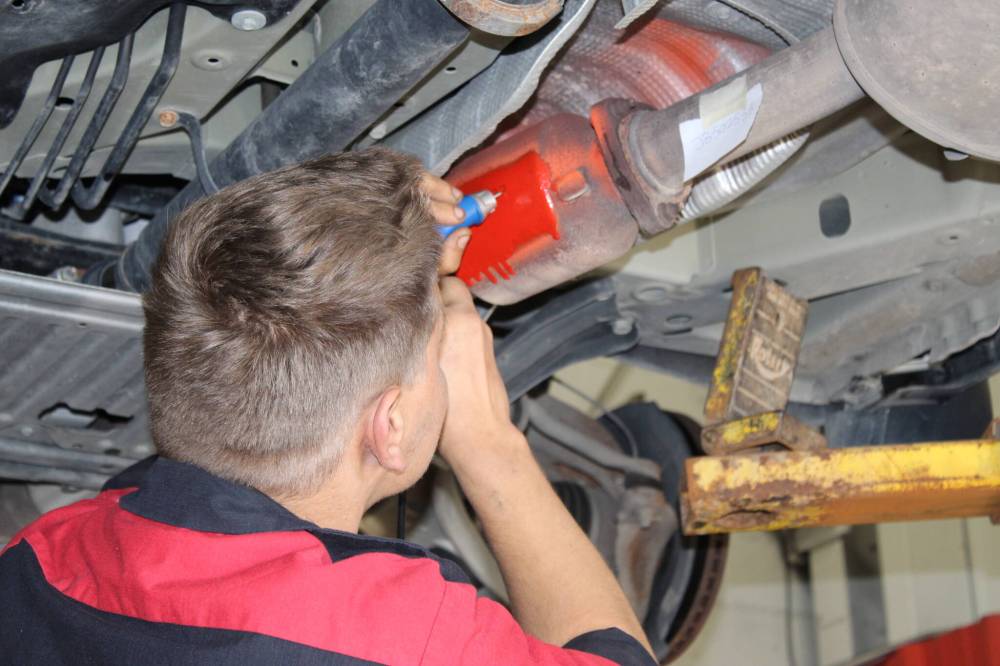
A Winnipeg scrap dealer who spoke to the Free Press anonymously agreed with the decision from Alberta, saying it is unfair to ask recyclers to collect personal information from metal sellers.
“They brought in the act here in Manitoba especially to deal with the catalytic converters, but it’s one of these situations where it almost seemed they were trying to hit flies with a baseball bat.”–Winnipeg scrap dealer
“The dealers don’t need this sort of thing,” he said by phone. “They brought in the act here in Manitoba especially to deal with the catalytic converters, but it’s one of these situations where it almost seemed they were trying to hit flies with a baseball bat.”
The man said reputable metal dealers already had safeguards in place.
tyler.searle@freepress.mb.ca

Tyler Searle is a multimedia producer who writes for the Free Press’s city desk. A graduate of Red River College Polytechnic’s creative communications program, he wrote for the Stonewall Teulon Tribune, Selkirk Record and Express Weekly News before joining the paper in 2022. Read more about Tyler.
Every piece of reporting Tyler produces is reviewed by an editing team before it is posted online or published in print — part of the Free Press‘s tradition, since 1872, of producing reliable independent journalism. Read more about Free Press’s history and mandate, and learn how our newsroom operates.
Our newsroom depends on a growing audience of readers to power our journalism. If you are not a paid reader, please consider becoming a subscriber.
Our newsroom depends on its audience of readers to power our journalism. Thank you for your support.
Related Articles
Efforts to curb catalytic converter theft stay in motion