

Gentle giant ‘gave of himself totally’
Elite shot putter remembered for committment to coaching, dedication to athletes
Advertisement
Read this article for free:
or
Already have an account? Log in here »
To continue reading, please subscribe:
Digital Subscription
One year of digital access for only $1.44 a week*
- Enjoy unlimited reading on winnipegfreepress.com
- Read the E-Edition, our digital replica newspaper
- Access News Break, our award-winning app
- Play interactive puzzles
*Billed as $5.77 plus GST every four weeks. After 52 weeks, price increases to the regular rate of $19.95 plus GST every four weeks. Offer available to new and qualified returning subscribers only. Cancel any time.
To continue reading, please subscribe:
Add Free Press access to your Brandon Sun subscription for only an additional
$1 for the first 4 weeks*
- Enjoy unlimited reading on winnipegfreepress.com
- Read the E-Edition, our digital replica newspaper
- Access News Break, our award-winning app
- Play interactive puzzles
*Your next Brandon Sun subscription payment will increase by $1.00 and you will be charged $17.95 plus GST for four weeks. After four weeks, your payment will increase to $24.95 plus GST every four weeks.
Read unlimited articles for free today:
or
Already have an account? Log in here »
Hey there, time traveller!
This article was published 14/08/2024 (801 days ago), so information in it may no longer be current.
In life, Bruce Pirnie was a big man with a personality to match.
An elite shot putter for Canada during a decorated career in the 1970s and ’80s, it could argued the transplanted American made an even bigger impact as a coach and administrator in his adopted country when his competitive throwing days were over.
He died on Aug. 8 after a battle with cancer.
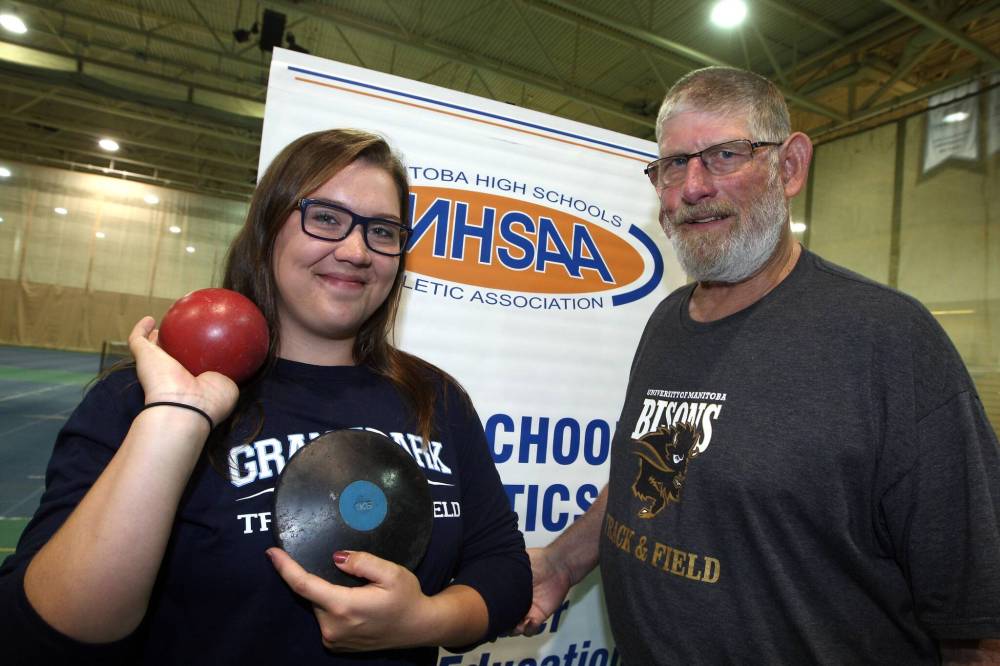
BORIS MINKEVICH/FREE PRESS FILES
Bruce Pirnie (right) with Taylor Heald in 2015.
Pirnie, who was survived by his daughters Jae, Elizabeth and Catherine, was 81.
“I think of Bruce and smile,” said Susanne Dandenault, who became an elite thrower in high school under Pirnie’s tutelage before transitioning to an international weightlifting career.
“I only have positive memories and things to say about Bruce… He was very consistent in how he treated me and I felt that he just believed in me. I’ve always succeeded under coaches that I felt believed in me and he was the first one.”
Pirnie could fill a room with his personal style.
“I just find it really hard to believe that the world has lost such a great person.,” said Marilyn (Mouse) Fraser, who first met Pirnie while she was a high school student attending the Legion Athletic Camp and worked for many years in the province as an sports administrator. “He was always super friendly to everyone. He always had a smile. He was known as a gentle giant. Oh, my God, I could say so many things about him.
“He was the type of person that would do anything and support everybody and everyone. He was a coach who was fair and who really cared about his athletes. He didn’t just become a coach to his athletes, he became a friend as well.”
The Boston-born Pirnie attended Yankton College in South Dakota, starring in football and track and field, before migrating north to Manitoba in the late 1960s.
In the midst of his athletics career, he also taught and coached at Grant Park High School and Nelson McIntyre Collegiate before a lengthy coaching career at the University of Manitoba, where among other noteworthy accomplishments, he guided the Bisons men’s team to seven Canada West titles and seven national championships in nine years between 1988-96.
The secret to his success? An unrelenting energy and commitment to his athletes.
“Bruce was patient and very generous with his time,” said Nicholas Pauletto, who relocated to Winnipeg from Sept-Iles, Que., in 1994 to be coached by Pirnie while attending the national training centre and the University of Manitoba where he became a five-time all-Canadian. “Anytime that I’ve seen it, he did absolutely everything.
“Even when he was head coaching at U of M, he did absolutely everything he could to give the athletes their opportunity to do their best… He had some connections down in the States, and every year our team at U of M would go two or three times down to compete — and I think that was a lot of help for developing top talent.”
In the fall of 1984, Dandenault met Pirnie and he immediately recognized her potential.
“He was fantastic,” said Dandenault. “I started with him knowing next to nothing and within a year and the following summer, I went to the national junior championships — I was younger than a junior — and that was to his credit. And then in the summer of ‘85 I also made the Canada Games team.”
Pirnie, who carried more than 300 pounds on his 6-7 frame, was hard to man to miss.
“Bruce was affectionate and warm and just a lovely human,” said Dandenault. “He wasn’t loud but he was incredibly knowledgeable, had a ton of experience in the sport and a big guy. So by virtue of those three characteristics, you tend to be a presence. Bruce always had a smile and he always had a hug. And I know that that is inappropriate in today’s society, but Bruce’s hugs were comfort and they were congratulatory or they were consoling — and they were wonderful.”
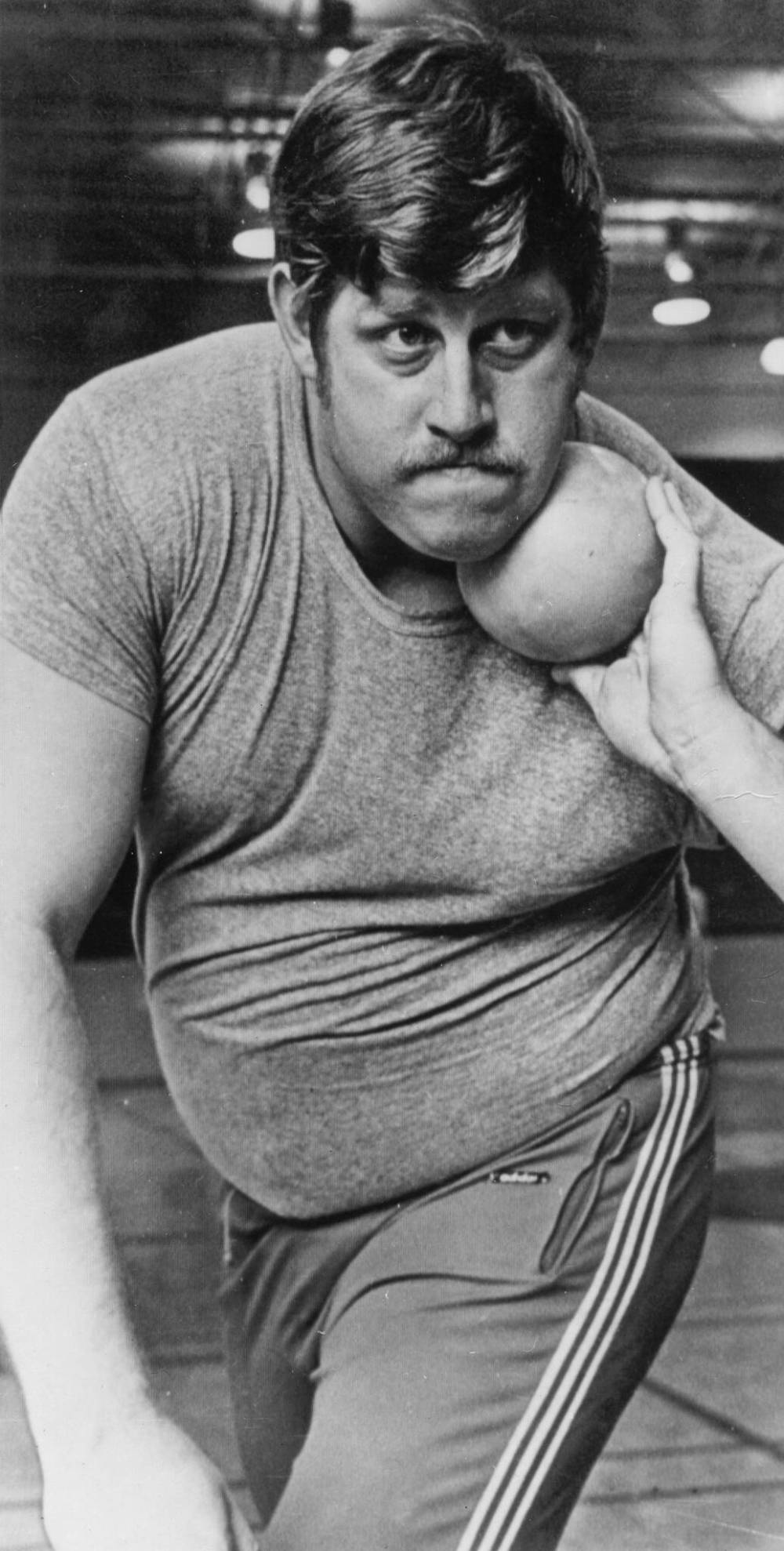
FREE PRESS FILES
Bruce Pirnie represented Canada as a shot-putter in the 1972 and 1976 Summer Olympics.
In fact, coaching was a side project for Pirnie throughout his competitive years. He would put on throwing clinics and was routinely generous with his time and expertise.
“He’s the kind of man that would show up at high school meets — outdoors, indoors — any track meet that was going on and he would sit and watch the throwers and he would offer assistance after the competition,” said Maureen Dowds, who was mentored by Pirnie and went on to to finish third in the women’s shot put at the 1967 Pan Am Games in her hometown and fourth in ‘75 Pan Ams.
“Or if they were from Winnipeg, he would offer assistance in coaching. And not just able bodied, but paralympic athletes, and some of my throwers in Special Olympics when I worked for Special Olympics, too. He just gave of himself totally.”
Longtime University of Manitoba coach Wayne McMahon worked with Pirnie for years but was first exposed to the big man’s athletic talents at the Legion Athletic Camp in 1964.
Pirnie represented Canada at the 1972 and ‘76 Olympics, finishing 17th and 20th, respectively, but he made his major competitive breakthroughs with a bronze at the 1974 Commonwealth Games and at the 1975 Pan Am Games in Mexico City, where he walked away with the gold medal.
“He beat them in ‘75 and he was still clean and then all of a sudden, the world records went through the roof,” said McMahon, recalling how Pirnie admitted to using performance-enhancing drugs to keep up with the artificially enhanced American throwers of the era. “Suddenly, everyone’s throwing 20, 21 metres and he’s at 19-something…
“It wasn’t banned (at the time) but I think he always regretted the kind of ethical choice.”

Added Dandenault: “I certainly didn’t ever get any pressure from Bruce to take anything to improve my performance. In my career, he was not in favour of drug use and I don’t even know that we talked about his experience with drugs and I think that was on purpose, because it wasn’t how he wanted people to succeed.
“I think, during his time, it was different. But I never got that sense or that kind of any kind of pressure when I was training with him.”
Above all, Pirnie had a rare gift for teaching.
“He was able to watch athletes and check and see the errors that they were making and deal with them in a really good way,” added Dowds. “Not being overly critical, but just say, ‘Well, let’s try this or let’s try this.’”
mike.sawatzky@freepress.mb.ca