Reading, writing, punching, kicking Incidents of violence are surging in Manitoba schools, with educational assistants bearing the brunt of student-on-staff attacks
Read this article for free:
or
Already have an account? Log in here »
To continue reading, please subscribe:
Digital Subscription
One year of digital access for only $1.44 a week*
- Enjoy unlimited reading on winnipegfreepress.com
- Read the E-Edition, our digital replica newspaper
- Access News Break, our award-winning app
- Play interactive puzzles
*Billed as $5.77 plus GST every four weeks. After 52 weeks, price increases to the regular rate of $19.95 plus GST every four weeks. Offer available to new and qualified returning subscribers only. Cancel any time.
To continue reading, please subscribe:
Add Free Press access to your Brandon Sun subscription for only an additional
$1 for the first 4 weeks*
- Enjoy unlimited reading on winnipegfreepress.com
- Read the E-Edition, our digital replica newspaper
- Access News Break, our award-winning app
- Play interactive puzzles
*Your next Brandon Sun subscription payment will increase by $1.00 and you will be charged $17.95 plus GST for four weeks. After four weeks, your payment will increase to $24.95 plus GST every four weeks.
Read unlimited articles for free today:
or
Already have an account? Log in here »
Hey there, time traveller!
This article was published 18/07/2025 (458 days ago), so information in it may no longer be current.
Julie Braaksma, better known as Ms. Braaksma inside her Brandon elementary school, was called for back-up help when a Grade 1 student burst into a temper tantrum in January.
More than 15 years into her career as a resource teacher, the request was not out of the ordinary; in fact, she often tells colleagues to reach out if they need assistance to de-escalate a situation.

“Objects were flying out of the classroom — school supplies, pencils, toys,” Braaksma recalled about the scene in January.
The distressed boy grew increasingly frustrated as his classmates evacuated the room.
Moments later, the six-year-old picked up a chair to throw at Braaksma. In an attempt to retreat, she tripped over a desk and fell to the ground.
That’s when the child jumped on her and started punching her with a building block, she said, adding that his scratches drew blood and she suffered bruised ribs.
“It’s not out of the norm for what’s happening in this province, but it’s definitely one of the more serious incidents,” said Braaksma, a PhD student who has devoted the better part of the last four years to researching violence in Manitoba schools.
“Usually, I’ve just been punched or kicked or spit on.”
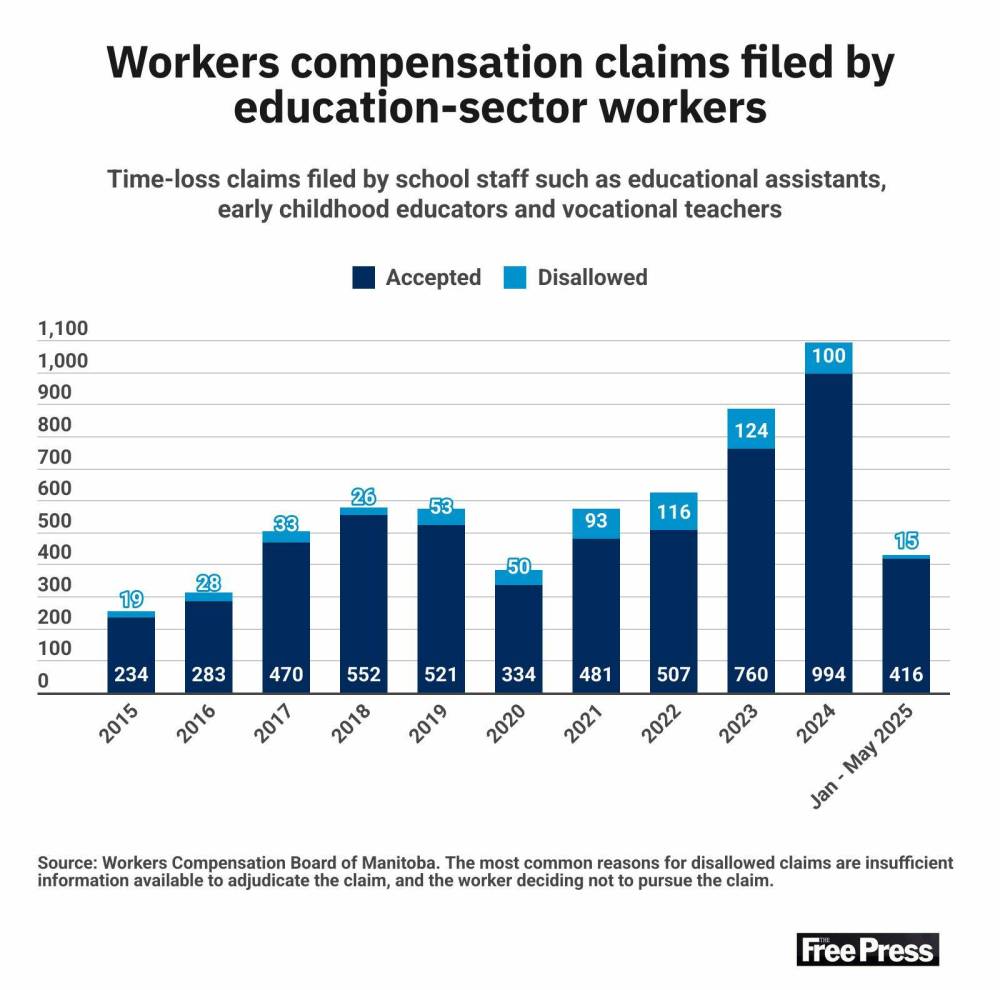
Documents obtained by the Free Press from the Workers Compensation Board of Manitoba shows injury claims have surged in the education sector.
In a freedom of information request, the Free Press sought a breakdown of time-loss claims filed by school staff, including educational assistants (EAs), early childhood educators and vocational teachers, between 2015 and 2025.
(The Manitoba Teachers’ Society membership is not included as its 16,600 educators report workplace injuries to their local and employer. Principals and teachers can use sick time or access disability coverage through MTS to recover, if need be.)
There were 844 more reports made to the workers compensation board last year compared to a decade ago — a 332 per cent increase.
Annual reports of surface wounds and bruises quadrupled during that period. Open wound incidents grew ninefold.
The number of “other traumatic injuries and disorders” also spiked, owing to steady year-over-year growth in that WCB category encompassing concussions, back pain and general soreness.
In 2015, there were 34 such incident reports — a fraction of the 164 that have already been reported mid-way through the current calendar year. Last year’s count was 434.
Those figures are unsurprising to the handful of Canadian researchers who have made it their mission to uncover the extent of student violence on teachers and school staff.
“There should be moral panic, but there isn’t,” said Chris Bruckert, chair of the department of criminology at the University of Ottawa.
Bruckert and clinical psychologist Darcy Santor founded the Violence and Harassment Against Educators Project in 2018. Their research team has since surveyed more than 10,500 teachers, EAs and clerical staff.
What they’ve found is that more workers are being injured — it’s a near-universal experience for EAs — and the frequency of incidents has risen following the COVID-19 pandemic.
And yet, there is little public awareness or concern because it’s become so normalized that students are not relaying what they’ve witnessed to their parents, Bruckert said.
“People think teachers are a bunch of whiny, privileged people who have the summers off and should just suck it up,” she added.

Darby Mallory, a PhD student involved in the project, said they’ve debated whether “violence” is an appropriate descriptor for what’s happening.
Ultimately, whether or not a student is intentionally targeting an adult or acting out because their needs are not being met, employees are experiencing these incidents as violence, she said.
Mallory said it’s important not to minimize that, especially given many educators they surveyed have reported violence to administration and been met with minimization, trivialization “or even blame.”
Manitoba EAs were asked about whether they had personally experienced violence in their workplace in a spring survey conducted by the Canadian Union of Public Employees.
Seven in 10 respondents said they had. Half of that group indicated they were experiencing violence at work on a daily or weekly basis.
“Nobody should be going to school fearing for their safety — not the kids and not the staff,” said union leader Gina McKay, who represents more than 6,000 support staff in kindergarten-to-Grade 12 buildings.
A total of 753 EAs completed the CUPE Manitoba workforce survey in April.
McKay said what strikes her as particularly troubling is how few workers are receiving paid annual training to prevent workplace violence.
Only 30 per cent of EAs reported they were receiving it. That figure remains unchanged in reviewing the results of all 1,136 K-12 employees who participated in the poll.
When taking into consideration bus drivers, clerical staff and custodians, 60 per cent of non-teaching school division staff in Manitoba have experienced violence on the job.
Inclusive education teacher Luanne Karn and a handful of EA colleagues began tracking injuries they suffered at a Winnipeg middle school in 2021-22.
The group documented 150 incidents in six weeks. Among them: bruises; sprains; scratches; a fracture; and a concussion.
“Students were hyper-alert, dysregulated, punching, pinching, grabbing hair, stabbing, yelling, swearing. That was my daily experience,” Karn said, recalling the lead-up to an earlier-than-planned retirement in 2024.
Karn took multiple leaves before making that decision; she was diagnosed with post-traumatic stress disorder in connection to the constant violence she witnessed and experienced in Manitoba’s public schools.
For the most part, her students acted out to communicate their needs were not being met, she said, noting many of them were functioning below grade level and required specialized support for a physical or cognitive disability.
Karn said the standardized education model — or, “factory approach” — was not providing the built-in flexibility many of her students needed to regulate their emotions. There was also not enough one-on-one instructional time to help them master skills, she said.
“As the mainstreaming of students with special needs or exceptionalities has occurred, the level of violence in schools has also increased because, I think, a lot of them are not getting their needs met,” Karn said.
“Students were hyper-alert, dysregulated, punching, pinching, grabbing hair, stabbing, yelling, swearing. That was my daily experience,”–Inclusive education teacher Luanne Karn
She noted the shift to integrate students from low-enrolment programs into regular classrooms has not been met with adequate resources to allow for true inclusion.
It became increasingly difficult to watch resources dwindle over time, Karn said, reflecting on her 25-year career in teaching and raising a teenager who’s enrolled in a public school.
Research out of University of Ottawa suggests school violence is on the rise in Ontario for an array of reasons linked to decades of government austerity and societal changes.
Larger class sizes, too few EAs and children not getting their learning or behavioural needs met due to limited assessment resources are all contributing factors, Bruckert said.
The criminology professor cited a shift in parenting styles and the proliferation of iPads as other influences.
Children are spending more time in front of a screen and they are not learning to share or master other social skills the same way they did 15 years ago, she said.
Mallory, lead author of the recently released report, Running on Fumes: Violence, Austerity, and Institutional Neglect in Ontario Schools, also noted students are showing up to school during a stressful time.
Running on Fumes: Violence, Austerity, and Institutional Neglect in Ontario Schools
The PhD student listed the mental health crisis, affordable housing shortage and the fallout of the COVID-19 pandemic, among other stressors.
The research team’s analysis shows the rate of Ontario elementary teachers experiencing student-initiated violence grew by more than 30 per cent between 2017-18 and 2022-23.
The average frequency of reported incidents more than doubled during that period, from 8.8 unique incidents over a school year to 18.4.
The University of Ottawa initiative also exposed that women experience “dramatically higher” rates of violence from students than men.
“Violence is often accompanied by gendered slurs, sexualized behaviours, and derogatory put-downs,” the Running on Fumes report states.
Ninety per cent of female respondents in the 2022-23 survey experienced violence versus 72 per cent of male participants. On average, women experienced twice as many incidents as men.
Related Articles
Sturgeon Heights student facing charges after school staffer attacked, windows smashed Sword attack at Brandon school racially motivated, police confirm



The Elementary Teachers’ Federation of Ontario has been a key partner in the Violence and Harassment Against Educators Project.
The federation, which represents 83,000 teachers and EAs, has been lobbying the Ontario government and school boards to ramp up compliance with health and safety legislation and improve reporting on violence in K-12 classrooms.
Lillian Klausen, president of the Manitoba Teachers’ Society, said her 16,600 members share the same concerns as their Canadian counterparts.
MTS did not have any data to release on the subject, but Klausen said it has created an internal committee to address workers’ physical and psychological health in response to recent anecdotes about violence.
There have been multiple high-profile incidents in Manitoba in recent months.
Winnipeg’s Sturgeon Heights Collegiate initiated a lockdown in May when a teenage boy attacked a school employee and vandalized the campus.
Last month, a 16-year-old student showed up at Neelin High School in Brandon with a sword to carry out a plot to target people of colour and immigrants.
The academic year that just ended was Braaksma’s last with the Brandon School Division.
She is moving to Saskatchewan, saying her now-former employer’s handling of the January incident was a motivating factor.
Braaksma said her professional judgment and training was called into question and there was no opportunity to debrief with the student or the family. Notably, she had nonviolent crisis intervention training.
What made matters worse is that she never heard from anyone on the superintendent’s team to acknowledge the incident, she said.
No one was available at the division to answer questions this week due to “summer schedules and limited availability,” said communications co-ordinator Terri Curtis.

Braaksma said her experience and early PhD findings suggest student-on-school-staff violence often goes underreported and does not lead to even a brief leave of absence.
She carried out her shift as usual after the altercation in January and only sought medical attention following several days of worsening pain in her chest.
This spring, as part of her online PhD program at Adler University, she surveyed nearly 200 local teachers on workplace violence and harassment and its toll on their physical and mental health. She is in the process of analyzing that data.
“I’m not here to lay blame,” Braaksma said. ”I’m here to say, ‘It’s happening. We have a problem. Let’s fix it.’”
— with files by Katie May
maggie.macintosh@freepress.mb.ca

Maggie Macintosh
Education reporter
Maggie Macintosh reports on education for the Free Press. Originally from Hamilton, Ont., she first reported for the Free Press in 2017. Read more about Maggie.
Funding for the Free Press education reporter comes from the Government of Canada through the Local Journalism Initiative.
Every piece of reporting Maggie produces is reviewed by an editing team before it is posted online or published in print — part of the Free Press‘s tradition, since 1872, of producing reliable independent journalism. Read more about Free Press’s history and mandate, and learn how our newsroom operates.
Our newsroom depends on a growing audience of readers to power our journalism. If you are not a paid reader, please consider becoming a subscriber.
Our newsroom depends on its audience of readers to power our journalism. Thank you for your support.