‘Built on love, hope, patience’ In the city of Kitchener, a tiny-home initiative has had an outsized positive impact on the homeless community
Read this article for free:
or
Already have an account? Log in here »
To continue reading, please subscribe:

Digital Subscription
One year of digital access for only $205*
- Enjoy unlimited reading on winnipegfreepress.com
- Read the E-Edition, our digital replica newspaper
- Access News Break, our award-winning app
- Play interactive puzzles
*First annual payment billed as $205.00 + GST for one year. This annual subscription will automatically renew at $233.00 + GST every 52 weeks (10% off the regular annual price of $259.35). Offer available to new and qualified returning subscribers only. Cancel any time.
To continue reading, please subscribe:
Add Free Press access to your Brandon Sun subscription for only an additional
$1 for the first 4 weeks*
- Enjoy unlimited reading on winnipegfreepress.com
- Read the E-Edition, our digital replica newspaper
- Access News Break, our award-winning app
- Play interactive puzzles
*Your next Brandon Sun subscription payment will increase by $1.00 and you will be charged $17.95 plus GST for four weeks. After four weeks, your payment will increase to $24.95 plus GST every four weeks.
Read unlimited articles for free today:
or
Already have an account? Log in here »
Hey there, time traveller!
This article was published 20/02/2026 (222 days ago), so information in it may no longer be current.
KITCHENER, Ont. — Like most Canadians, Mari dreams about having a bigger home for her boyfriend Rob and their dog, Trouble, a mutt of undefined origins.
The trio currently resides in an eight-by-10-foot dwelling at A Better Tent City, Kitchener’s tiny-home community for homeless people. But Trouble, who is 18 months old and earns his name each and every day, is a big reason why Mari would like more space.
Having said that, Mari, 42, is in no hurry to leave ABTC, which has provided her with a safe and stable place to live for the last five years.
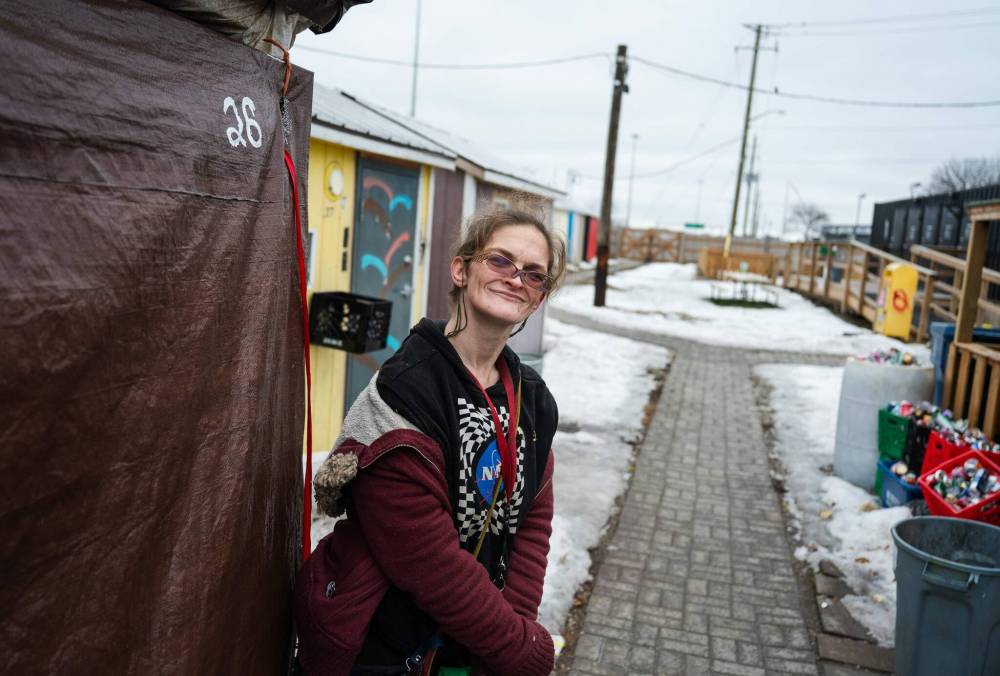
LAURA PROCTOR / FREE PRESS
Mari says A Better Tent City offers a sense of security and community.
“Before I lived here, I was living in a tent anywhere I could,” Mari said. “The last place I had been was the parking lot at the soup kitchen. Before that, I lived in a field across from the U-Haul.”
Previously, Mari had been living in a low-rent apartment in the southern Ontario city but was evicted when the landlord became upset with the number of friends she had staying with her. Once evicted, she said, she was “blacklisted” by other landlords and finding a job without a phone or permanent address proved fruitless.
While living in a tent, Mari said she often dreamed of a day when a benefactor would find an empty lot or field where all the homeless people she knew could pitch a tent and live as a community. And then, ABTC came along.
“Something like my cabin was beyond my dreams,” Mari said. “There’s a bit of drama here in the community now and then, but the people here are also supportive. And we have security and safety, which I never had before. Some people see this place as permanent; some think of it more as transitional. I think it’s transitional for us but … it’s nice to have a warm place to go.”
Communities like ABTC are gaining in popularity in Canadian municipalities seeking an effective way of reducing the number of homeless people living rough on the streets. In Winnipeg, most housing options have involved more traditional low-rise apartments. There is one “tiny-home village” operating in the city, Astum Api Niikinaahk, a 22-unit complex of bachelor-style apartments on Austin Street east of Main Street and managed by Mawi Wi Chi Itata Centre.
Currently, Winnipeg city council is doing a feasibility study for a temporary “managed encampment” for this upcoming spring and summer but has stopped short of investigating the permanent, tiny-home model that has been embraced by Kitchener and about a dozen other cities across Canada.
The architects of ABTC believe a community of smaller, free-standing structures has a number of advantages over traditional emergency shelters, or apartment-style dwellings that are often proposed as a solution for homelessness.
Firstly, a tiny-home community — once a location and zoning are decided — can be established quickly and cost-effectively.
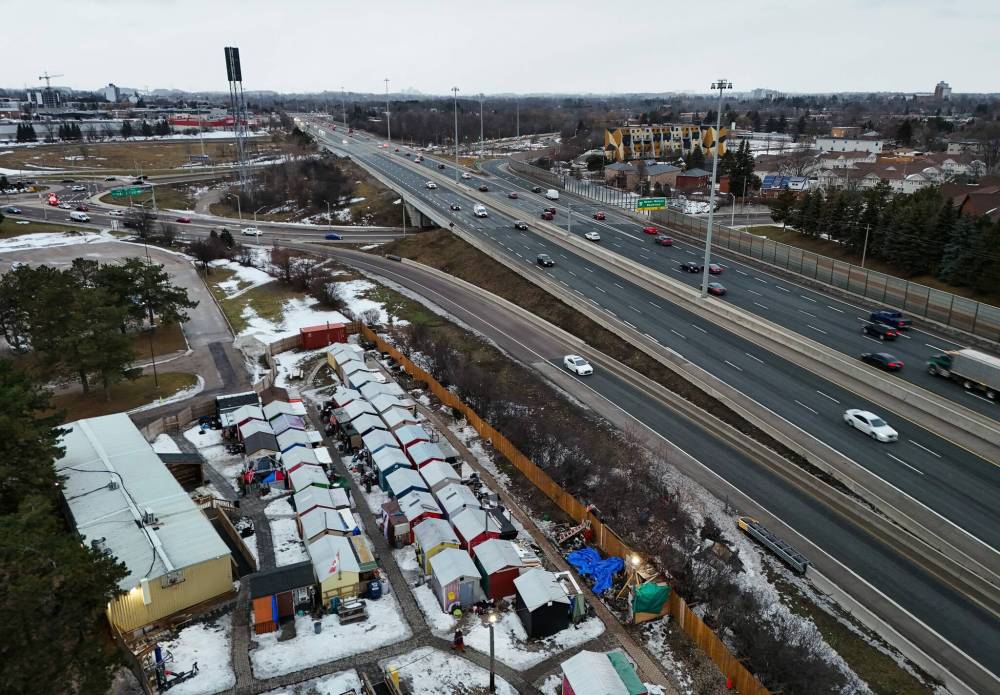
LAURA PROCTOR / FREE PRESS
A Better Tent City features 42 individual cabins, along with larger complexes with a community kitchen, laundry facilities, washrooms, showers and common areas.
At ABTC, the 42 cabins start out as run-of-the-mill garden sheds made by a company just outside Kitchener. ABTC then adds to the structure flooring, panelling, insulation, a radiator and a bed. It is retrofitted with a metal door and frame for extra security. Many residents choose to add tarping to create a vestibule on the front side of the cabins. All-in, it costs about $6,000 to buy and outfit each dwelling and annual operating expenses for the community are about $1.1 million. Those expenses are covered through a combination of gifts from benefactors, a $240,000 grant from the city of Kitchener, and a portion of resident government income and housing supports.
“Some people see this place as permanent; some think of it more as transitional. I think it’s transitional for us but … it’s nice to have a warm place to go.”
The entire village is encompassed by a high wooden fence and features a community garden and a dog park. ABTC is anchored by an extra-large construction trailer that contains a commercial kitchen, washing machines and common areas for residents to eat, watch television, take part in group activities or simply socialize with their fellow residents. A separate bank of modified shipping containers has been outfitted as community showers and bathrooms.
The cabins are all deliberately painted in vibrant colours to give them a warmer, more welcoming appearance. And while there is some hoarding and graffiti evident, for the most part the community shows signs residents are providing tender loving care for their homes and respecting their neighbours.
The community provides regular access to health services, including psychological care, along with support from mobile drug harm-reduction vehicles and addictions therapy for residents trying to ween themselves off opioids. Some of this treatment is extended to other homeless people who live in nearby tents.
Although ABTC does not prohibit drugs or alcohol, none of its residents have overdosed in the five-plus years it has operated.
Jeff Wilmer, one of ABTC’s co-founders and a former chief administrative officer for Kitchener, said nobody involved knew exactly how the village was going to function when it was established in 2020.
Once the decision was made to pursue a tiny-homes model, there were significant expectations it would be a transitional experience for the homeless — a place to go that was much more secure than emergency shelters until a permanent housing solution could be found. And while some of the residents have graduated to apartments, Wilmer said he’s discovered that for many of the residents of ABTC, the tiny-home community is more desirable than conventional housing.
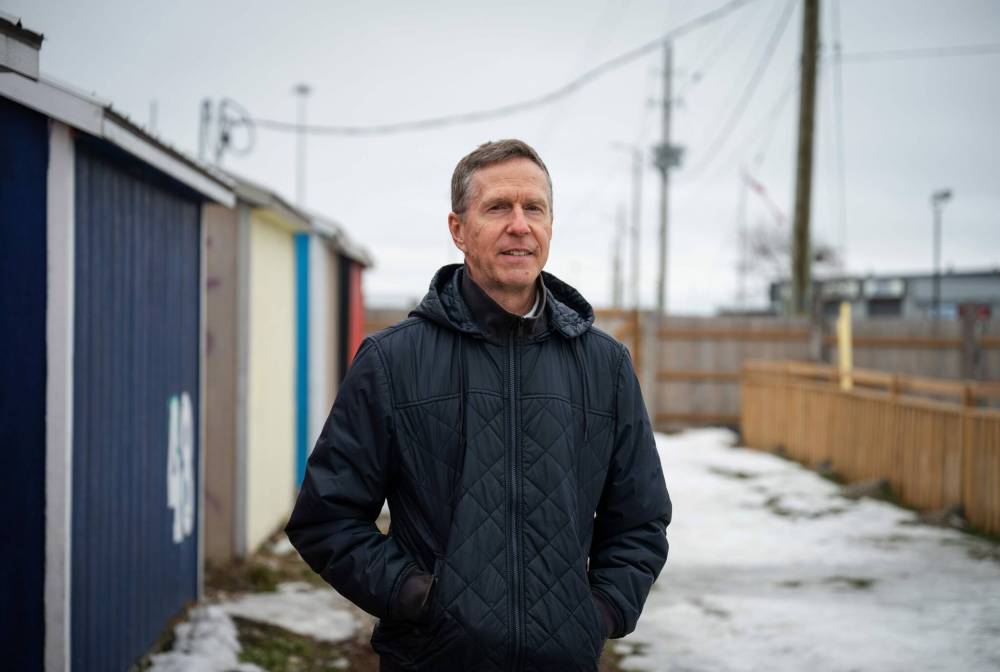
LAURA PROCTOR / FREE PRESS
Co-founder Jeff Wilmer says he was pleasantly surprised to learn many residents prefer the tiny homes to conventional housing.
That means vacancies are rare, which can pose a problem for the Waterloo Region, which encompasses Kitchener, where more than 2,300 people experienced homelessness in 2024.
“I think we saw ourselves as helping people transition from living on the street to something more stable, with the goal being an apartment of your own or a place of your own,” Wilmer said. “But I’ve had lots of conversations with the residents here who have told me, ‘I wouldn’t want a place of my own. I fear the isolation that could trigger a downward spiral.’”
Wilmer said residents also reacted positively to the fact ABTC was more generally tolerant of “disruptive behaviour” that wouldn’t be allowed in a larger, multi-unit apartment block.
“People here are good neighbours for each other in terms of the accommodating and forgiving part, but also the protecting and helping. When there’s trouble, they come to each other’s aid.”
“The folks here are remarkably forgiving to neighbours that are being really disruptive,” he said. “They all understand we all have our moments. People here are good neighbours for each other in terms of the accommodating and forgiving part, but also the protecting and helping. When there’s trouble, they come to each other’s aid.”
In the final analysis, stable housing for the homeless has to be defined, to some extent, by homeless people themselves, Wilmer said, adding there’s no point in moving the homeless into housing they do not want to be in long-term.
He’s heard from the homeless and their families about how much they appreciate ABTC’s approach.
“The mom of a guy who lives here came to see me and she said, ‘My son has been living rough on the streets for about 20 years. My other son and I never really knew where he was at any one moment. And sometimes we would find him and then come back the next day with clothing or food or stuff for him, and he wasn’t there anymore. He was always on the move.

LAURA PROCTOR / FREE PRESS
The entire village is encompassed by a high wooden fence and features a community garden and a dog park.
“She said, ‘now he’s been at ABTC for the last three years and he’s never been better. I know where he is, and I know that he’s safe, and I can go and visit him, and I feel safe.’ I hadn’t really thought of it from the perspective of a mom, but her life is way better now that he’s not living rough on the streets.”
The origin story of permanent communities for the homeless requires a deep dive into history, in particular our shared experience with economic turmoil and income disparity.
Although some trace encampments back to the migrant-worker camps of the 19th century, the more relevant lineage dates back to the Great Depression of the 1930s, and the proliferation of government-created encampments for people who had lost their homes and who wandered from city to city, town to town, looking for any kind of work.
In the U.S., these camps were called “Hoovervilles,” as a swipe at president Herbert Hoover, who was criticized for failing to act more quickly to address the economic distress triggered by the 1929 stock market crash. Hoovervilles sprung up organically, in parks and empty lots. The shacks were often built from scavenged lumber, metal sheeting and other discarded construction materials. By the end of the Great Depression, hundreds of Hoovervilles were established across the country, housing thousands of displaced Americans.
State and local governments often provided services to the Hoovervilles, including food, clothing, sanitation and even primary-level education. In some of these camps, mayors and local councils were elected.
A similar approach was taken in Canada where “shacktowns” and “hobo jungles” sprung up all over the country. Recognizing the growth of a transient homeless population, then-prime minister R.B. Bennett established camps where unemployed men were housed in military-style bunkhouses and were paid 20 cents per day to build roads, clear bush and construct public amenities. The modest daily pay prompted the nickname “Royal 20 Centres.”
By 1936, when the last of the Royal 20 Centres were disbanded, more than 170,000 men had found shelter and work in these camps.
For much of the rest of the 20th century, the homeless found shelter wherever they could in temporary encampments that were unsafe, unclean and often vulnerable of being bulldozed by local governments. Efforts were made to shift the homeless into traditional housing, but demand always seemed to outstrip supply.
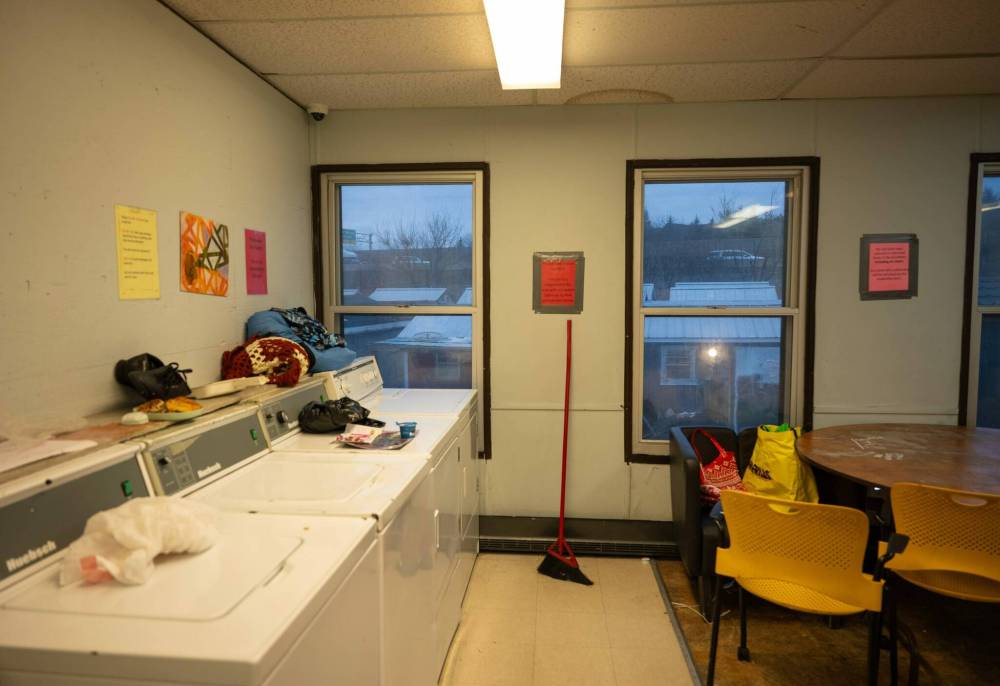
LAURA PROCTOR / FREE PRESS
The laundry facilities inside the main office building of A Better Tent City.
However, around the turn of the 21st century, a new approach began to come into view.
In 2000, Dignity Village, a tent city in Portland, Ore., was transitioned into a more permanent encampment with the support of local and state government. Relocated from under a highway overpass, government officials provided tiny homes, sanitation and support services. It currently houses about 60 people.
Its success spawned a handful of other permanent U.S. communities for the homeless, many with radically different missions.
One of the most ambitious projects in North America is the Community First! Village in Austin, Tex. The community is the brainchild of businessman and philanthropist Alan Graham, who raised US$18 million in 2014 to establish the site.
Community First! looks more like a subdivision of tiny homes, most averaging about 200-sq.-ft., with paved streets and sidewalks. Residents pay an average of US$300 per month for rent and can earn money by doing maintenance in the community.
What distinguishes Community First! and similar initiatives is a re-framing of expectations. While many programs to combat homelessness portray themselves as launching pads for employment and mental health and addictions treatment, Community First! seeks to first solve the shelter issue without burdening people with expectations around other challenges.
In a January 2024 interview with the New York Times, Graham said far too many people believe “if you stick people into housing … it’s going to solve all their problems.”
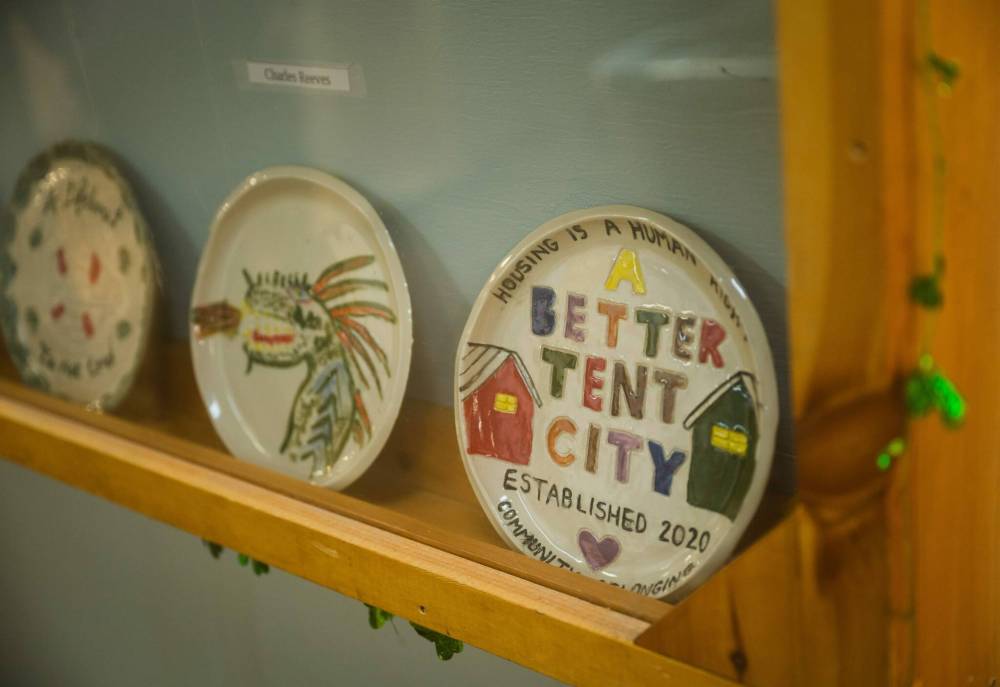
LAURA PROCTOR / FREE PRESS
Hand-painted plates inside the main office building of A Better Tent City.
Rather than focusing on reforming or curing people of the problems that helped make them homeless — mental health issues and addictions in particular — Graham said his goal was to provide “palliative” care to deal with the suffering that comes from being homeless.
“This isn’t ever going to be a model that’s a fix-and-repair model, that’s going to come in and retrain people to be a computer technician or something and then pop them out into the real world … This is a very complex group of people with a myriad of very, very complex issues. They will have to be subsidized for the rest of their lives, and we just have to come to grips with that as a society.”
There have been quantum leaps in homelessness strategy through the years, most notably the “housing-first” model that was devised in the 1990s by Canadian-born psychiatrist Sam Tsemberis.
At the time, homelessness strategy followed what social architects called “the staircase model,” where you treat mental health and addictions problems first, then transition those people into stable housing. The promise of shelter was the carrot to encourage people to focus on treatment. Housing-fiirst flipped the equation, prioritizing shelter before wrap-around supports.
This is largely the approach adopted in Manitoba, where Premier Wab Kinew’s NDP government is implementing the “Your Way Home” plan to end chronic homelessness: moving homeless people into housing — mostly traditional, apartment-style units — and then providing health and social supports.
While there is little doubt housing-first strategies reduce homelessness — at least while these programs are robustly funded — there are concerns about whether it does anything for long-term physical and mental health.
A June 2020 report published in The Lancet medical journal, based on the examination of more than a dozen different studies of housing-first programs, found the approach “significantly improved housing stability” but found “no measurable effect” on mental health and addictions. That echoed an earlier study published in the U.S. by the National Academies of Sciences, Medicine and Engineering, which found “no substantial evidence” that mental health or general health improved among those in housing-first programs.
More importantly, the research suggests housing-first programs do not necessarily allow the homeless to live longer. A 2025 analysis of data from housing programs in five Canadian cities found no statistically significant difference in the mortality rate between those in housing-first versus those in “treatment as usual” programs.
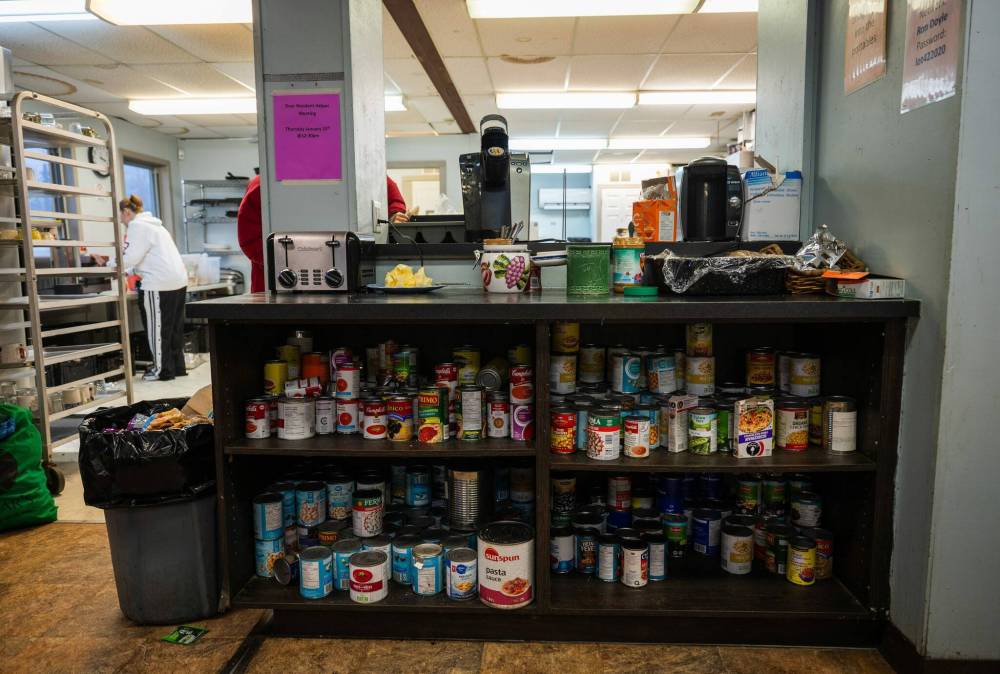
LAURA PROCTOR / FREE PRESS
A well-stocked Kitchen pantry in the main office building.
ABTC’s Wilmer said the research results strike deep at the heart of concerns he and other sponsors of the Kitchener site have about whether permanent homeless communities are doing enough to address the underlying causes of homelessness, particularly addiction.
“I think our donors, our volunteers, everybody understands that addiction is what led people to become homeless. So that’s the starting point. I don’t think I knew that in the early days, because I remember in the early days talking to someone on site and asking, like, how many of the residents are living with addiction? She said, all of them, that’s why they’re homeless.
“I think what some of us, including myself, kind of struggle with from time to time is, are we enabling them to stay living with their addiction? Are we doing as much as we can to encourage people to seek treatment?”
Ultimately, Wilmer said although housing and treatment programs can be undertaken separately, there needs to be a high level of co-ordination. In Ontario, there are a small but growing number of residential detox programs for homeless people that are showing promise. The greater concern is once a homeless person graduates from detox, they may not necessarily have a place to live for the long-term.
Wilmer also said homelessness programs cannot offer a one-size-fits-all model.
“In the end, what we’ve learned is that there’s different solutions needed for different people,” he said. “Even within this one model, there’s different paths that people take. Some people will transition to a place of their own and live a pretty normal life. Others don’t ever want to leave here. They’re there. They appreciate the community, and they’re fearful of life without it.”
Clad in a bright-white housecoat, a bright red tuque and Crocs-style sandals, Nadine Green is doing her best to make her way through the January cold from her tiny cabin to a nearby bank of showers located in the modified shipping containers. But no matter how quickly she tries to get to her destination, she cannot escape the people who want to talk with her.
Some just want to say hello, others want to carve out time to talk with her later in the day. And there are questions. So many questions.
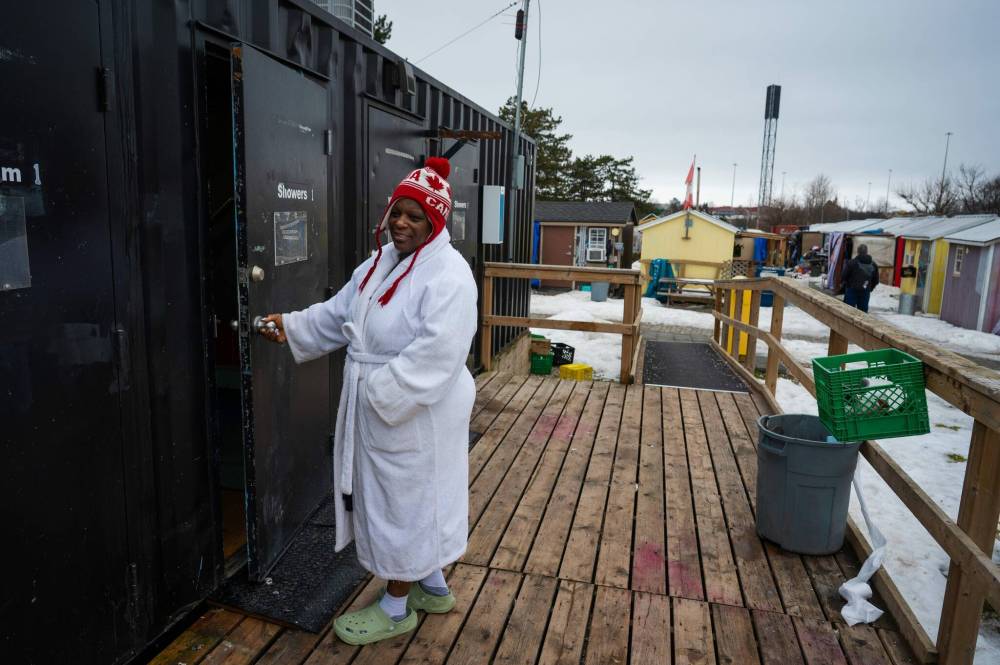
LAURA PROCTOR / FREE PRESS
On-site manager Nadine Green is part social worker, part life coach at A Better Tent City. She says the village offers one thing governments can never provide — love and understanding.
Officially, Green is the site manager for ABTC, but it’s hard to find anyone here who doesn’t consider her the community’s talisman. She is part social worker, part life coach and the single greatest reason why ABTC is so unique among programs for the homeless.
For Green, ABTC is not about social services. It’s about providing homeless people with the one thing government on its own cannot provide: love and understanding.
“And you know it’s this beautiful thing to get up knowing that we’re all on this homeless journey and they see the love, and it gives them hope,” she said.
Green was never homeless, but she has become legendary for her support for the homeless.
A former convenience-store owner, Green had begun to offer food and then shelter to the homeless in her neighbourhood. Eventually, the landlord who owned the building where her store was located evicted her after deciding providing shelter services was not appropriate.
She tried opening in another location, but the same thing happened. As Green’s story attracted increasing local media attention, she was eventually contacted by Wilmer and Ron Doyle, a successful businessman and philanthropist, who approached her with an unusual proposal.
It was April 2020, right in the teeth of the COVID-19 pandemic, and Doyle was trying to come up with a safe place for the homeless to take shelter. He owned a warehouse in an industrial park and suggested Green move in and manage what would be in essence an indoor tent city. Although she was apprehensive at first, she eventually agreed.

As time went on, and the population grew, Doyle began bringing in wooden garden sheds he found at a lumber yard. When the sheds proved popular with the homeless, work began on a move to a new location where everyone would be housed in these tiny cabins.
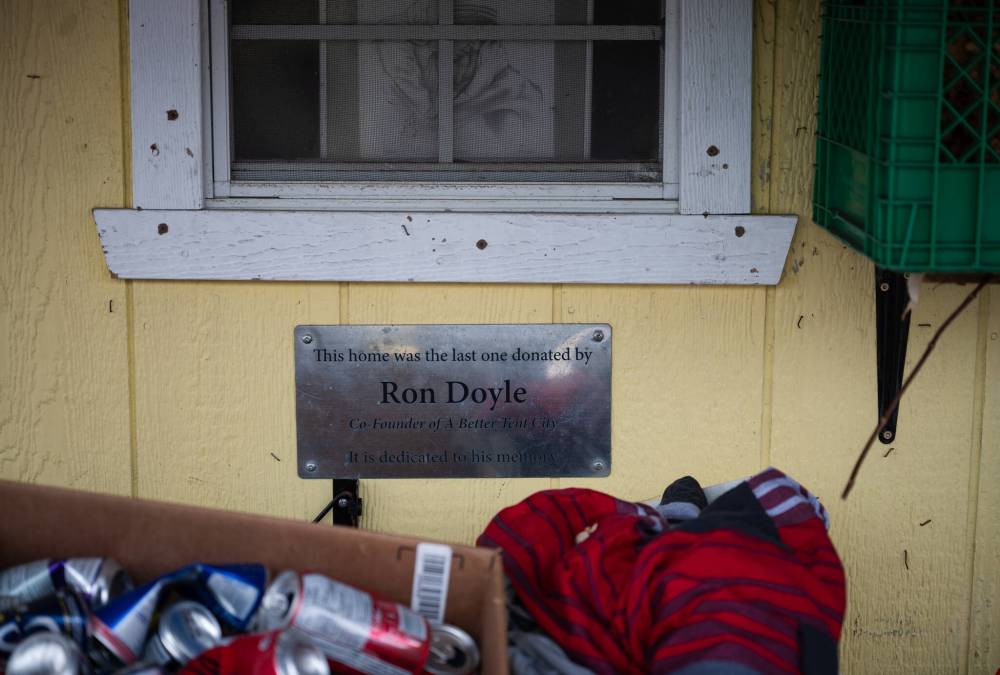
LAURA PROCTOR / FREE PRESS
A plaque pays tribute to co-founder Ron Doyle.
Green, who came from a broken family where violence was a constant presence, immediately decided she would live in one of the tiny homes, and dedicate herself to building a real community. Green said she has spent a lot of her life listening to her friends in the homeless community about the lack of dignity and dangers that accompany living rough.
Although she does not need to live on site, Green said she could no longer imagine not sharing her life with those who have grown to call the community home.
“ABTC is this beautiful, beautiful community that was built on love, on hope, on patience, on showing up for people. They have a family here. Everybody here is searching for something, including me.”
dan.lett@freepress.mb.ca

Dan Lett is a columnist for the Free Press, providing opinion and commentary on politics in Winnipeg and beyond. Born and raised in Toronto, Dan joined the Free Press in 1986. Read more about Dan.
Dan’s columns are built on facts and reactions, but offer his personal views through arguments and analysis. The Free Press’ editing team reviews Dan’s columns before they are posted online or published in print — part of the our tradition, since 1872, of producing reliable independent journalism. Read more about Free Press’s history and mandate, and learn how our newsroom operates.
Our newsroom depends on a growing audience of readers to power our journalism. If you are not a paid reader, please consider becoming a subscriber.
Our newsroom depends on its audience of readers to power our journalism. Thank you for your support.
Related Articles
New Siloam CEO takes charge amid growing need, tight budgets