

Remnants of river trail encampment an ‘eyesore’

Advertisement
Read this article for free:
or
Already have an account? Log in here »
To continue reading, please subscribe:

Digital Subscription
One year of digital access for only $205*
- Enjoy unlimited reading on winnipegfreepress.com
- Read the E-Edition, our digital replica newspaper
- Access News Break, our award-winning app
- Play interactive puzzles
*First annual payment billed as $205.00 + GST for one year. This annual subscription will automatically renew at $233.00 + GST every 52 weeks (10% off the regular annual price of $259.35). Offer available to new and qualified returning subscribers only. Cancel any time.
To continue reading, please subscribe:
Add Free Press access to your Brandon Sun subscription for only an additional
$1 for the first 4 weeks*
- Enjoy unlimited reading on winnipegfreepress.com
- Read the E-Edition, our digital replica newspaper
- Access News Break, our award-winning app
- Play interactive puzzles
*Your next Brandon Sun subscription payment will increase by $1.00 and you will be charged $17.95 plus GST for four weeks. After four weeks, your payment will increase to $24.95 plus GST every four weeks.
Read unlimited articles for free today:
or
Already have an account? Log in here »
Hey there, time traveller!
This article was published 14/02/2026 (229 days ago), so information in it may no longer be current.
Under a slowly dissipating blanket of fog on Saturday morning, as the Nestaweya River Trail curved quietly along the banks of the Assiniboine River, Tomasz Swacha slowed down and looked up.
What met his eyes was not the picturesque winter postcard of hoarfrost-kissed trees, but a jagged mound of castoffs — mattresses slumped into mud, overturned recycling bins, and shopping carts tangled in tarps.
He wasn’t the first to stop short at the sight. And he would not be the last.
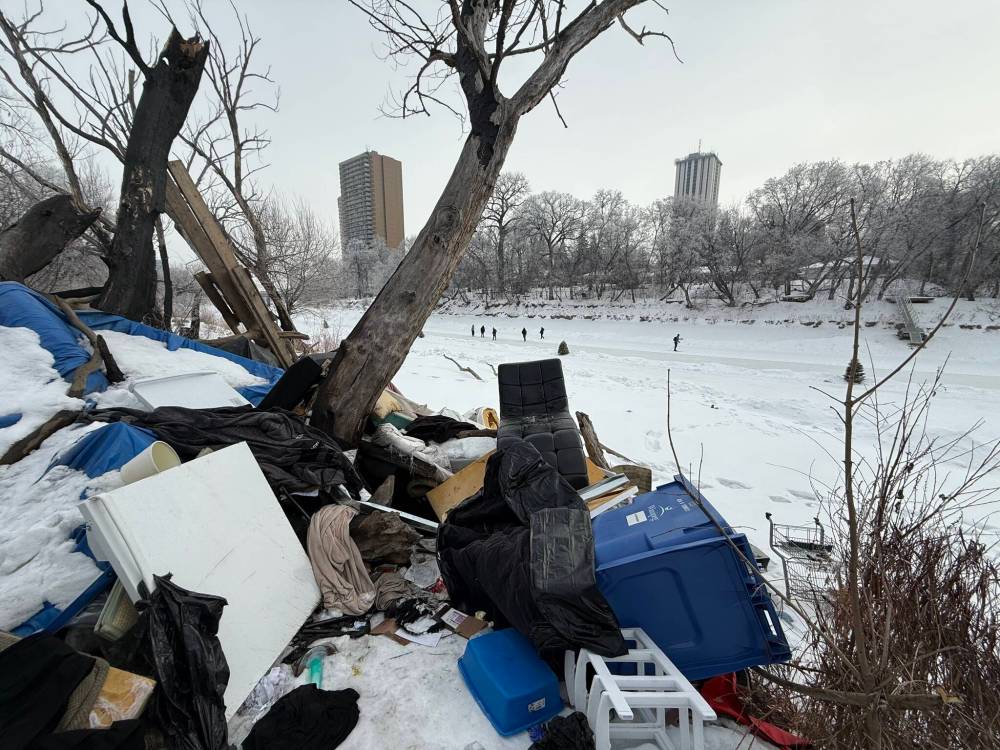
SCOTT BILLECK / FREE PRESS
An encampment along the riverbank of the Assiniboine River looms large as people enjoy the Nestaweya River Trail on Valentine’s Day.
“It’s bad and good, right?” Swacha said. “Some people might just think it’s people that shouldn’t be here, or that they have drug problems or other issues.
“But maybe they’ve had trauma, they have other things, and they can’t cope with, so they don’t know what to do and they find the streets as the safest possible way to survive, to connect with people that don’t judge them, like their family, or like us, the people walking and skating by.”
Nearly everyone who passed by Saturday glanced at least once at the site, marked by the familiar blue of City of Winnipeg recycling bins and what has become the encampment’s hallmark: a towering tree, its blackened trunk scarred by years of fires.
Similar scenes stretch east and west along the riverbank — the remnants of former sites, many touched by flames. Fires at encampments have become a common occurrence over the past several years.
“Is that an art installation?” one skater said as he passed.
As couples and families carved new lines along the trail on Valentine’s Day, an outreach van from Main Street Project pulled up near the southern end of Spence Street and turned on its hazard lights. Two workers stepped out and made their way toward the pile of debris, checking whether anyone was still calling the mound of rubble home.
No one appeared to respond.
“Instead of just looking it as a negative thing and all the bums on the street or whatever, I think you should see the person as a human and try to, maybe find out why they’re out here,” Swacha said. “It bothers me. I wish we could help them, because there’s so much wealth.”
A West Broadway resident, walking her dog along the path adjacent to the manicured skating trail, stopped to peer at the heap.
“It’s an eyesore,” she said, asking not to be named, adding she’s helped in the past with area residents for their annual cleanup.
“It’s getting to the point where it’s unsafe. It’s unsafe under the snow, you can’t come down any of the normal paths because there’s so much stuff underneath, like metal and sharp stuff.”
She said she plans to call 311 to see what can be done. City crews, she added, should have continued farther down the riverbank after clearing encampments near Mostyn Park and behind the Granite Curling Club in the fall, following the city’s encampment ban.
“Why not just finish it off?” she said. “It’s the last one along here. And it’s considerable. Once the snow and all the ice melts, is it just going to end up in the river?”
Another nearby resident, who lives south of the skating trail overlooking the river, told the Free Press he emailed the city asking what is being done about the rubble.
In a reply viewed by the Free Press, the city directed the man — who also asked not to be named — to contact Manitoba Housing or the Residential Tenancy Branch to report his concern.
The Free Press contacted the city Saturday. Officials acknowledged the request for comment but said a response would likely come Tuesday, when civic offices reopen.
Where the former encampment sits is considered private property and doesn’t fall under the city’s encampment ban.
“While the city and province have emphasized a coordinated approach to encampments, the response (to my concern) suggests a lack of alignment on the ground,” the man said. “It raises the question of how quickly this would be addressed if the garbage and/or encampment were located on a more prominent site, such as near the Manitoba Legislature or The Forks.”
The woman said she isn’t sure whose responsibility it is and added she feels conflicted.
“That was somebody’s home,” she said.
Swacha said he has watched the problem worsen since his high school days, a personal timestamp, he said, for the city’s deepening homelessness crisis.

He remembers a Danish exchange student in his class who had come to Winnipeg to learn English. Students were assigned an open essay on any topic they chose. Swacha wrote about hockey fights.
The Danish student wrote about Main Street and Higgins Avenue.
“I remember him saying, ‘I’ve been to a lot of major cities all over the world. I’ve come to Winnipeg to learn English. Main and Higgins, the problem, it’s right in front of you,’” he said. “He said that in other cities it’s in the back of the city, out of site and out of mind. But (in Winnipeg), it was right there for everyone to see. This was back in 1994.
“And things have just slowly gotten worse and worse.”
scott.billeck@freepress.mb.ca
Scott Billeck is a general assignment reporter for the Free Press. A Creative Communications graduate from Red River College, Scott has more than a decade’s worth of experience covering hockey, football and global pandemics. He joined the Free Press in 2024. Read more about Scott.
Every piece of reporting Scott produces is reviewed by an editing team before it is posted online or published in print — part of the Free Press‘s tradition, since 1872, of producing reliable independent journalism. Read more about Free Press’s history and mandate, and learn how our newsroom operates.
Our newsroom depends on a growing audience of readers to power our journalism. If you are not a paid reader, please consider becoming a subscriber.
Our newsroom depends on its audience of readers to power our journalism. Thank you for your support.
Scott Billeck is a general assignment reporter for the Free Press. A Creative Communications graduate from Red River College, Scott has more than a decade’s worth of experience covering hockey, football and global pandemics. He joined the Free Press in 2024. Read more about Scott.
Every piece of reporting Scott produces is reviewed by an editing team before it is posted online or published in print — part of the Free Press‘s tradition, since 1872, of producing reliable independent journalism. Read more about Free Press’s history and mandate, and learn how our newsroom operates.
Our newsroom depends on a growing audience of readers to power our journalism. If you are not a paid reader, please consider becoming a subscriber.
Our newsroom depends on its audience of readers to power our journalism. Thank you for your support.
Related Articles
Encampment residents defiant as new policy takes effect






Advertisement Advertise With Us
Advertisement Advertise With Us