

Homelessness a humanitarian crisis, Rattray says
‘We need to do more’: new executive director of End Homelessness Winnipeg hopes to use extensive resumé to fight for disadvantaged

Advertisement
Read this article for free:
or
Already have an account? Log in here »
To continue reading, please subscribe:

Digital Subscription
One year of digital access for only $205*
- Enjoy unlimited reading on winnipegfreepress.com
- Read the E-Edition, our digital replica newspaper
- Access News Break, our award-winning app
- Play interactive puzzles
*First annual payment billed as $205.00 + GST for one year. This annual subscription will automatically renew at $233.00 + GST every 52 weeks (10% off the regular annual price of $259.35). Offer available to new and qualified returning subscribers only. Cancel any time.
To continue reading, please subscribe:
Add Free Press access to your Brandon Sun subscription for only an additional
$1 for the first 4 weeks*
- Enjoy unlimited reading on winnipegfreepress.com
- Read the E-Edition, our digital replica newspaper
- Access News Break, our award-winning app
- Play interactive puzzles
*Your next Brandon Sun subscription payment will increase by $1.00 and you will be charged $17.95 plus GST for four weeks. After four weeks, your payment will increase to $24.95 plus GST every four weeks.
Read unlimited articles for free today:
or
Already have an account? Log in here »
Hey there, time traveller!
This article was published 17/02/2026 (215 days ago), so information in it may no longer be current.
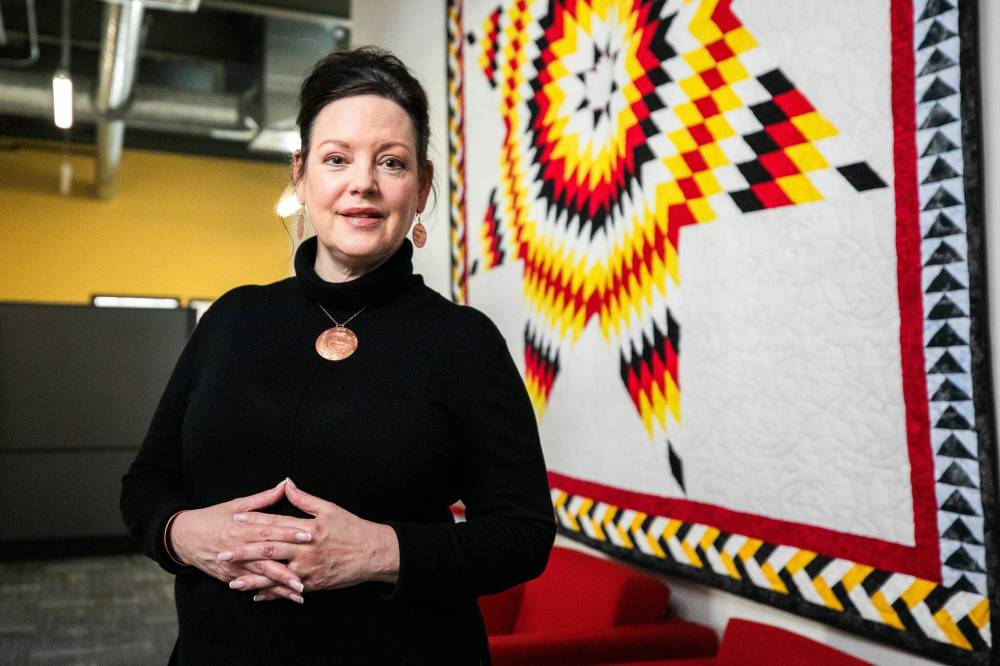
Jennifer Rattray says few challenges facing Winnipeg are as urgent as the homeless crisis.
“Collectively as a society, as a province, as a city, we need to do better,” the new executive director of End Homelessness Winnipeg told the Free Press.
She says a humanitarian crisis has unfolded on city streets.
“It’s awful,” she says. “We need to do something, and we need to do more than what we’re currently doing.”
Rattray is sitting in a second-floor corner office that overlooks Portage Avenue, boxes still unpacked weeks into her new job. A founding board member of End Homelessness Winnipeg in 2015, Rattray was hired at the end of January to lead the organization.
She has an extensive resume to back up her new role, including time as a special representative to the federal Crown–Indigenous relations minister, where she focused on advancing the creation of a national Indigenous and human rights ombudsperson. She was an assistant deputy minister with the provincial government, where she “worked to challenge systemic inequities and improve outcomes for marginalized people,” according to End Homelessness Winnipeg’s announcement of her hiring. Her last job was chief operating officer at the Southern Chiefs’ Organization, which is behind the transformation of the former Bay building in downtown Winnipeg — an area where the homeless problem is front and centre.
Rattray says her most direct connection to the work, however, comes from her time as executive director of the National Inquiry into Missing and Murdered Indigenous Women and Girls.
“I saw so clearly then the really direct connection between that issue, missing loved ones and being unsheltered, not having a safe place to stay, not having a safe place to be.”
“I saw so clearly then the really direct connection between that issue, missing loved ones and being unsheltered, not having a safe place to stay, not having a safe place to be,” she said. “So if I can use everything that I’ve learned in my career and all of the amazing people I’ve worked with to contribute to this issue, that’s what I want to do.”
More than a decade on from its inception, Rattray says much has been learned about the homeless issue.
In its latest street census, her organization reported a doubling in the number of homeless people, tallying 2,469 homeless people during one day of the census period — higher than any count since it began the initiative in 2015.
That was a 97 per cent increase compared with the previous census, when 1,256 homeless people were counted over a 24-hour period in 2022.
Rattray says there is a lot of important data that highlights gaps in the system, drop-offs when people leave the justice system and drop-offs when people age out of care and don’t have a place to live.
“We now have the data we need to make informed decisions,” she says. “It’s up to us as advocates to advocate like hell to make those changes.”
In the census, 80 per cent of respondents identified as Indigenous, and nearly half said they had been involved in the child-welfare system as a youth.
“We all know the data, all the stats show us that disproportionately this is an Indigenous issue, disproportionately for all the reasons we know about colonization, residential schools, 60s Scoop, day schools, etc.,” she says.
Her organization’s five-year strategic plan, released in June 2025, promises incorporate Indigenous culture into its actions.
“So many things have been done to Indigenous people, to First Nations, Metis and Inuit people for hundreds of years,” she says,adding that needs to stop.
“We need to provide housing, safe housing so that people can live in dignity.”
The number of homeless newcomers has increased significantly as well. Two per cent of people surveyed in 2022 were immigrants, while refugees made up less than one per cent. In 2024, the number was 13 per cent, nearly half of them refugees.
“We all know the data, all the stats show us that disproportionately this is an Indigenous issue, disproportionately for all the reasons we know about colonization, residential schools, 60s Scoop, day schools, etc.”
The majority of people surveyed said they have difficulty with substance use. Mobility issues, mental-health struggles and chronic medical conditions were also common.
One major hurdle stands above the rest in terms of addressing the problem.
“Bottom line, there’s been a reduction in the number of transitional homes, rent-geared-to-income homes, deeply affordable homes across the country…” she says. “So we can do an incredible job of connecting people to supports that are available, but if we can’t connect them to a home and a safe place where they can live in dignity, then it’s only going to get worse.”
End Homelessness Winnipeg tracks its monthly data, including inflows and outflows into homelessness, which consistently shows that youth who age out of care are among the largest contributors to chronic homelessness.
“Incrementally, we got into this situation, this humanitarian crisis,” she said, drawing parallels to the late justice Murray Sinclair, the chair of the Truth and Reconciliation Commission, who said it took seven generations for Canada to acknowledge its wrongdoings, and it’s going to take at least as many generations to reconcile them.
She hopes it will happen sooner.
Later this year, her organization expects 145 new mixed-housing units across the city, primarily funded through federal Reaching Home funding, will open up.
“There is progress being made,” she says. “That is really important for people to understand.”
The 145 units may not seem high enough given results of the street census.
“There is progress being made… That is really important for people to understand.”
“But for those’s 145 people it’s going to make a profound difference,” Rattray said. “It’s not just a number. It’s an individual, it’s a human being with a life and dreams and hopes…”

Rattray said she’s held introductory meetings with provincial officials and supports its Your Way Home strategy, which aims to curb chronic homelessness by 2031.
“I think any strategy that any organization or government puts out is only as good as its implementation,” she said, adding she looks forward to working with the province.
In terms of the city’s ban on homeless camps in high-priority public areas, including within 50 metres of schools, parks, and playgrounds, and 30 metres from transit shelters, Rattray says the focus for her group and sector partners, is the human impact.
“We need to use a human rights approach,” she said. “We want everybody to be able to be successful, to be happy, to have quality of life, to have a family if they want it, to be healthy, to fall in love, to do all the things that give us this beautiful but also very devastating human experience sometimes.”
scott.billeck@freepress.mb.ca
Scott Billeck is a general assignment reporter for the Free Press. A Creative Communications graduate from Red River College, Scott has more than a decade’s worth of experience covering hockey, football and global pandemics. He joined the Free Press in 2024. Read more about Scott.
Every piece of reporting Scott produces is reviewed by an editing team before it is posted online or published in print — part of the Free Press‘s tradition, since 1872, of producing reliable independent journalism. Read more about Free Press’s history and mandate, and learn how our newsroom operates.
Our newsroom depends on a growing audience of readers to power our journalism. If you are not a paid reader, please consider becoming a subscriber.
Our newsroom depends on its audience of readers to power our journalism. Thank you for your support.
Scott Billeck is a general assignment reporter for the Free Press. A Creative Communications graduate from Red River College, Scott has more than a decade’s worth of experience covering hockey, football and global pandemics. He joined the Free Press in 2024. Read more about Scott.
Every piece of reporting Scott produces is reviewed by an editing team before it is posted online or published in print — part of the Free Press‘s tradition, since 1872, of producing reliable independent journalism. Read more about Free Press’s history and mandate, and learn how our newsroom operates.
Our newsroom depends on a growing audience of readers to power our journalism. If you are not a paid reader, please consider becoming a subscriber.
Our newsroom depends on its audience of readers to power our journalism. Thank you for your support.
Related Articles
Exchange District businesses push for additional security







Advertisement Advertise With Us
Advertisement Advertise With Us
History
Updated on Tuesday, February 17, 2026 2:42 PM CST: Adds deck