

Champion curler Meleschuk never lost his passion for the game
‘The Big O’ being remembered as a fierce competitor

Advertisement
Read this article for free:
or
Already have an account? Log in here »
To continue reading, please subscribe:

Digital Subscription
One year of digital access for only $205*
- Enjoy unlimited reading on winnipegfreepress.com
- Read the E-Edition, our digital replica newspaper
- Access News Break, our award-winning app
- Play interactive puzzles
*First annual payment billed as $205.00 + GST for one year. This annual subscription will automatically renew at $233.00 + GST every 52 weeks (10% off the regular annual price of $259.35). Offer available to new and qualified returning subscribers only. Cancel any time.
To continue reading, please subscribe:
Add Free Press access to your Brandon Sun subscription for only an additional
$1 for the first 4 weeks*
- Enjoy unlimited reading on winnipegfreepress.com
- Read the E-Edition, our digital replica newspaper
- Access News Break, our award-winning app
- Play interactive puzzles
*Your next Brandon Sun subscription payment will increase by $1.00 and you will be charged $17.95 plus GST for four weeks. After four weeks, your payment will increase to $24.95 plus GST every four weeks.
Read unlimited articles for free today:
or
Already have an account? Log in here »
At the height of his curling career, Orest Meleschuk balanced ferocity and finesse like almost no one else.
The Winnipeg product was a fierce competitor skilful enough to thread a rock through a window and find the button.
Known as “The Big O,” he curled competitively for over six decades, finding success at the local, provincial, national and global level, and his longevity on the pebble was notable before lengthy careers became the norm.
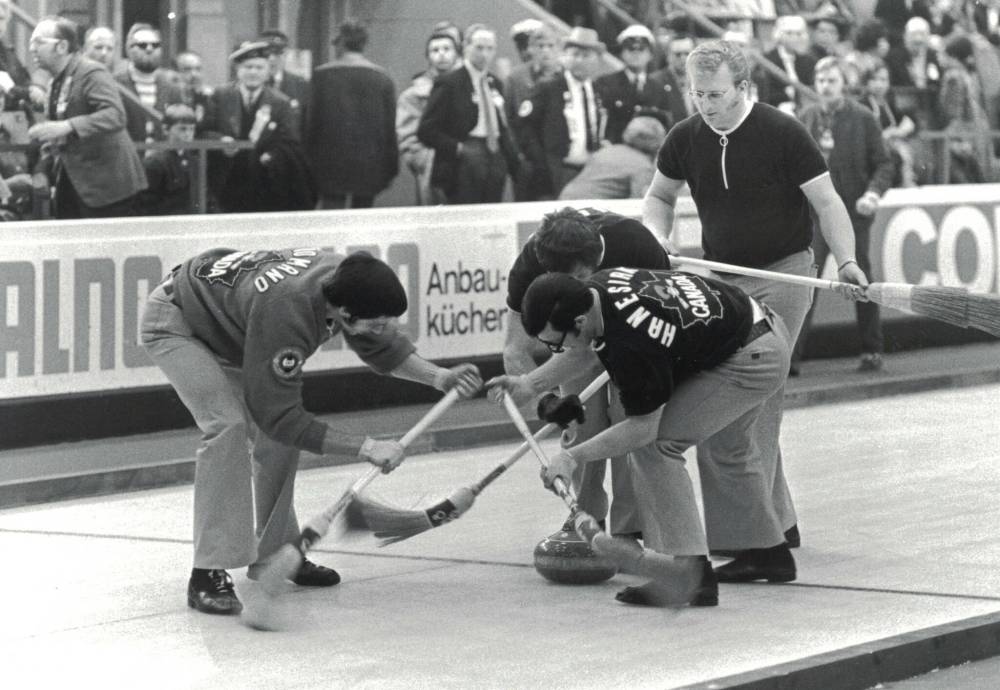
MICHAEL BURNS SR. PHOTO
Meleschuk (standing) with teammates Dave Romano (from left), Pat Hailley and John Hanesiak at the 1972 World Champion in Germany
Meleschuk is still tied with his good friend John Usackis for the most appearances in the Manitoba men’s provincial playdowns, at 30.
“He was a fiery guy. Very competitive. Hated to lose, and I didn’t like to lose either,” said Usackis, who threw third on Meleschuk’s Tankard-winning team in 1989, the second provincial title for the skip.
“The opposition would make a good shot and he’d get mad, and he’d kick rocks around, smash his broom. I remember one time I was curling with him, and we were curling in Regina, in a cash spiel … I missed a shot, peeling a guard or something, and he got mad, and he kicked rocks around. I said, ‘Orest, relax, take it easy.’ And then he says, ‘Oh, you want to relax?’ He was really competitive.”
That’s also what made The Big O so great.
Meleschuk died peacefully on June 23 in Selkirk, a short time after becoming ill. He was 86.
He grew up in St. Boniface with his parents and two sisters. His mother had immigrated to Winnipeg from Poland and his father from Ukraine in the mid-1920s, and they later met in the provincial capital.
As a youngster, Meleschuk played baseball in the summertime and hockey in the winter months, skating on a team with future NHLer Ted Green during his minor hockey years.
When he reached adolescence, Meleschuk became interested in curling and began to make the short walk down the road to the Heather Curling Club, where he would spend hours honing his craft, much to the chagrin of his mother, his son Sean said.
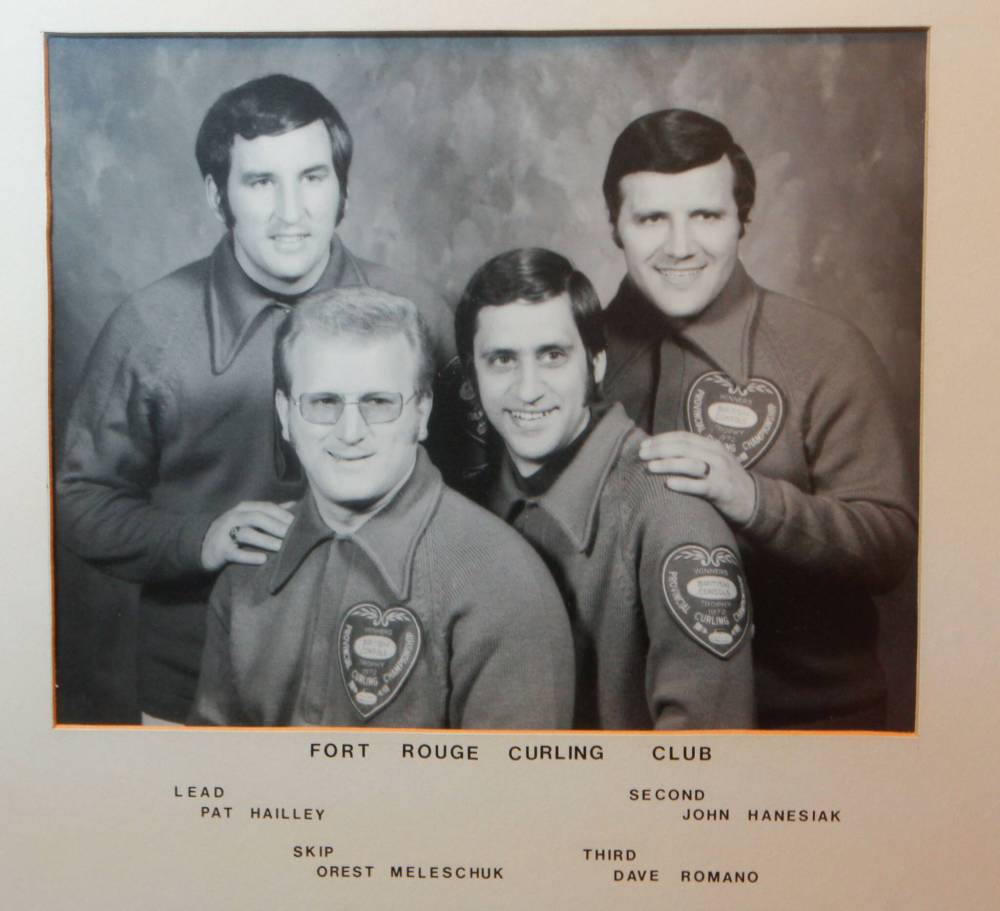
BORIS MINKEVICH / FREE PRESS FILES
From left: Pat Hailley, Orest Meleschuk, Dave Romano and John Hanesiak were the winners of the 1972 Brier.
“At that time, a lot of curlers would be delivering on their knees. They would have the Manitoba Tuck delivery, so not a lot of flat deliveries. So he really honed his delivery based on (three-time Brier champion) Ken Watson, and he spent a lot of time at the curling club,” said Sean.
“Growing up in a first-generation family, his mother would’ve wanted him to spend more time at school, pursuing a higher education than ‘wasting his time at the curling club.’”
Those hours would pay off, though.
Aside from his time at the rink, Meleschuk spent a decade as a civil technologist for the Canadian consulting firm Wardrop Engineering. He worked on several big projects, including one he was particularly fond of that took a couple of summers to complete: helping to bring safe drinking water to the Inuit communities of Cape Dorset and Frobisher Bay in the late 1960s and early ’70s.
Meleschuk then worked for the City of Selkirk for 20 years, finishing his career with the Town of Beauséjour — in both cases serving as a public works supervisor.
“Certainly, if I had to characterize it, growing up it was probably family, then curling, then career,” Sean said, ranking his father’s priorities. “And I’m sure in the wintertime it switched to curling as the top priority. He always enjoyed his work, and I think he was always pretty proud of the work he did, but I’m not sure if it was his driver.”
Sean and his father had a strong relationship. After Meleschuk and his first wife, Pat, divorced, Sean’s sister Karin moved with her mother to Vancouver while Sean stayed with his father in Selkirk.
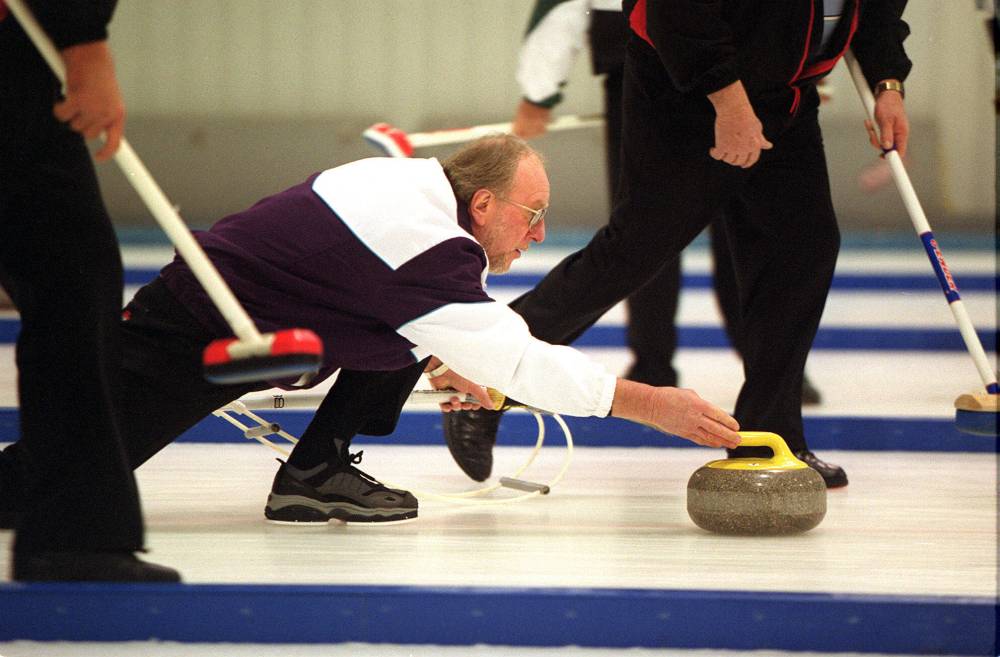
BORIS MINKEVICH / FREE PRESS FILES
Orest Meleschuk, seen here letting a rock go at the Strathcona Senior Mens Provincial Championship in 2002, died in June at the age of 86.
“We were pretty close, and I think he did a good job of raising me,” Sean said. “Raising a teenager on your own probably isn’t the easiest thing.”
Sean called his father’s demeanour at home “fair, firm and friendly.” They both loved the outdoors. Time spent playing sports and gardening was where they bonded — although Sean wasn’t particularly interested in the latter but says he sucked it up to please his father.
“One of the biggest memories for me, outside of curling, was skiing with him. Every winter we’d go to Banff, Lake Louise, Fernie — we’d go into the mountains and do a trip,” Sean recalled. “I remember him telling me that if he had discovered skiing, he probably wouldn’t have turned to curling as a young man, but he didn’t have those opportunities.”
But the path that Meleschuk chose worked out quite well.
By the mid-1960s he was one of the top competitive men’s curlers in the province, gaining steam as a potential future contender on the national stage.
Meleschuk curled in his first provincial championship in 1963 as the third for Barry Fry’s team, which kickstarted a longstanding career in the competitive scene.
Usackis knew Meleschuk as competition before he ever knew him as a friend. The two officially connected in the mid-’60s as Usackis’s team was down a player and needed someone to fill in for a bonspiel in Pine Falls. He turned to Fry first, but he declined and recommended Meleschuk, who quickly accepted the chance to get on the ice.
“He said, ‘OK, I’ll come out.’ And I said, ‘OK, we have to play at 8 o’clock the next morning.’ This was a Thursday night. So he showed up and we ended up winning the bonspiel,” said Usackis.
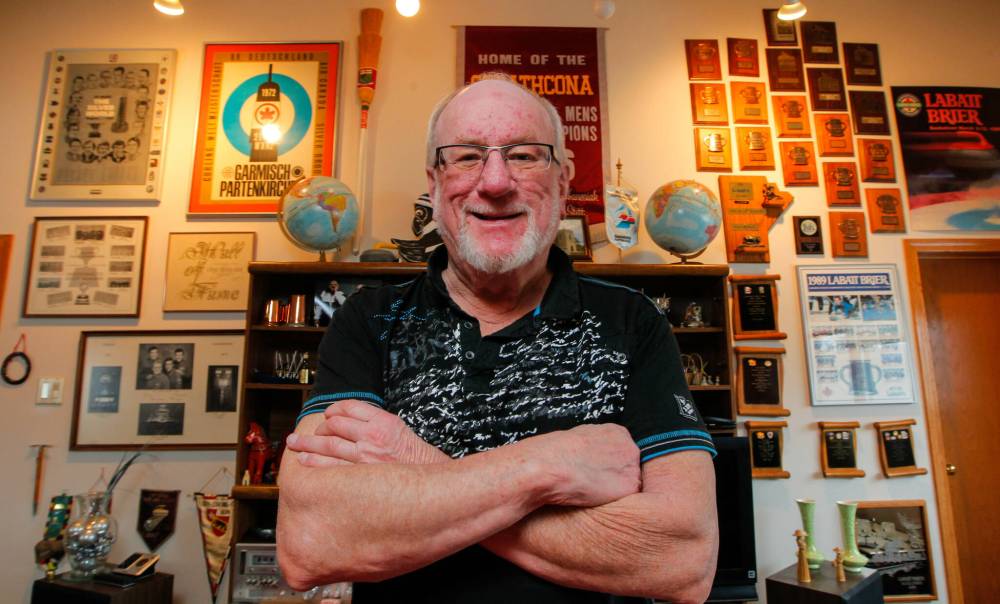
BORIS MINKEVICH / FREE PRESS FILES
Meleschuk, pictured in 2017, raised his son, Sean, in Selkirk.
“I knew I was getting a good player. He had a good delivery, threw a great rock. He was a great player.”
Although Meleschuk and Usackis went their separate ways and maintained their own teams on the ice for many years after that — due to Meleschuk playing out of Winnipeg and Usackis being in Lac Du Bonnet — they remained close friends for more than six decades.
After years of knocking on the door of provincial supremacy, Meleschuk finally broke through with his Fort Rouge rink of Dave Romano, John Hanesiak and Pat Hailley, going undefeated in the provincial playdowns. That preceded one of his greatest triumphs, the 1972 Brier in St. John’s, N.L., where the Manitobans went 9-1.
At the World Championships in Garmisch-Partenkirchen, Germany, Meleschuk faced the United States, skipped by Bob LaBonte, in the championship final where one of the most infamous moments in the sport took place.
After Meleschuk’s misthrow in the 10th end, LaBonte leaped in celebration, thinking his team had won the game, but slipped and kicked a stone on the way down. The burned rock awarded the Canadians a game-tying deuce to force an extra end.
Meleschuk, given new life, spun a beautiful draw to the button in the extra end that would prove to be the winning shot.
“I think he’d want to be remembered as a great competitive curler. He loved competitive curling more than he liked recreational curling,” Sean said.
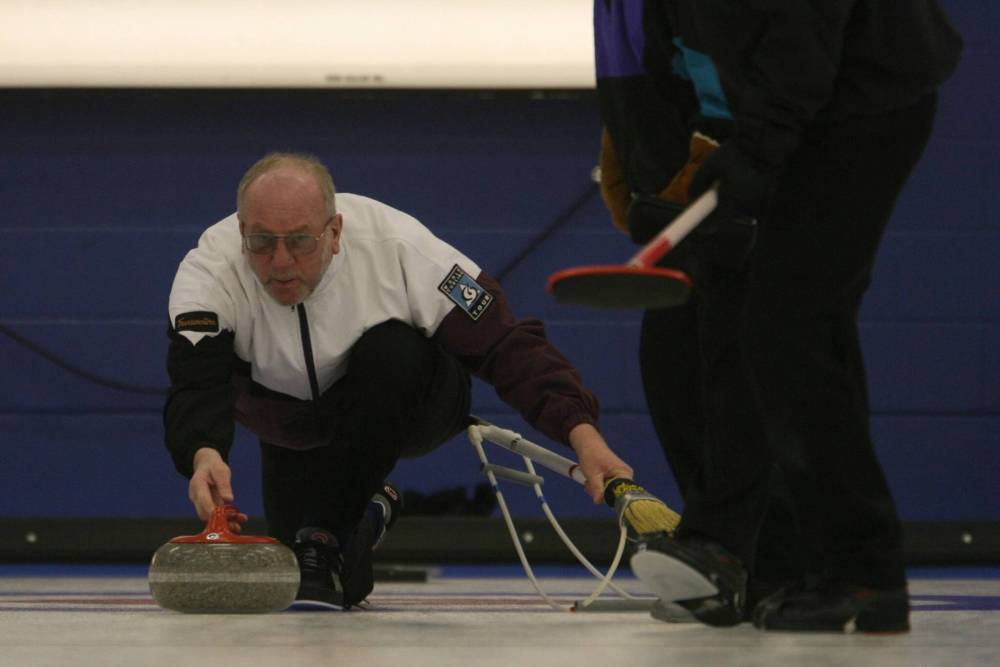
CHRISTOPHER PIKE / BRANDON SUN FILES
Orest Meleschuk Manitoba’s Credit Unions Masters Men’s Championship at the Brandon Curling club in Brandon on Friday March 9, 2007.
“I know that he was not particularly happy always being remembered for the way he won his world championship, as opposed to being the world champion,” Sean added. “He never really wanted to talk very much about that game and how it transpired, and the LaBonte Curse and whatnot, but he was certainly very proud of being a world champion.”
Orest continued to curl competitively in Manitoba until the early 2000s, achieving provincial titles in 1989 (Manitoba Men’s), 1996 (Manitoba Senior Men’s) and 2002 (Manitoba Masters).
He was inducted into the Manitoba Sports Hall of Fame (1985) and the Manitoba Curling Hall of Fame (1991, 2011, 2022) for his success.
Meleschuk’s 1989 squad included Sean at lead, Usackis at third and John Hyrich at second.
The foursome lost its zone to qualify for provincials and had to go through the Manitoba Curling Association bonspiel to qualify, which they wound up doing after reaching the semifinals. The Meleschuks, Usackis and Hyrich went 6-1 en route to winning the provincial playdowns. That run has a story of its own.
“It was a friend of John Usackis’s that had a dream. She had a dream that she saw John winning the province that year, and the team was all wearing white sweaters. So John’s wife went out and bought us all white sweaters, so we wore white sweaters to the provincial playdowns and we obviously then had a good run and won the province,” Sean explained.
“Certainly, that was a pretty exciting time for all of us, myself especially. Being able to win with my dad and curl with my dad and go on to the Brier, especially in Saskatoon where it’s a huge curling community. We were curling in front of 12,000-15,000 people in the Saskatoon arena at the time.”

Meleschuk and Usackis were in their late 40s at the time and were considered old for the sport, but they had built a national brand and received strong support from the Saskatchewan fans.
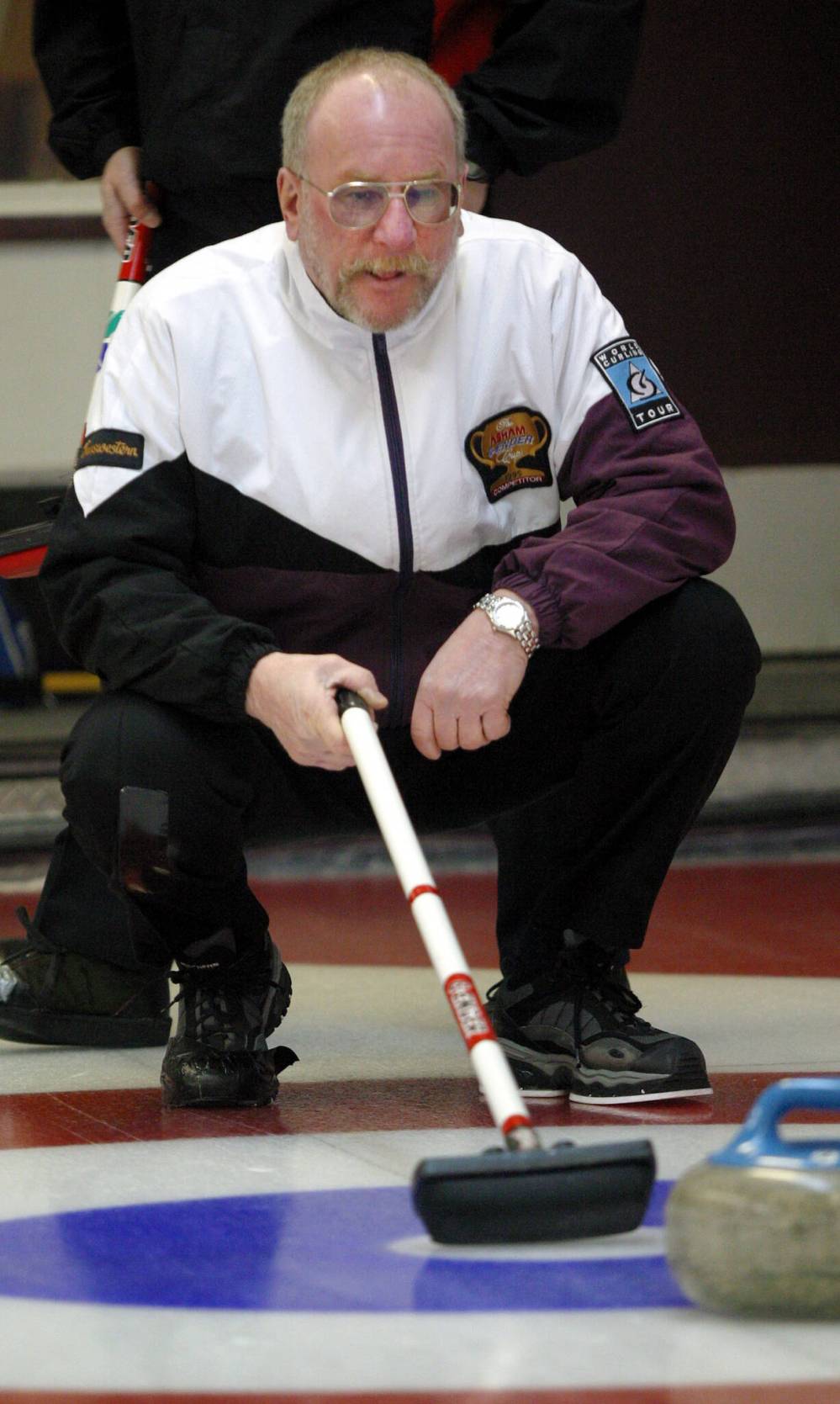
MIKE APORIUS/ FREE PRESS FILES
Orest Meleschuk at the CFB Winnipeg Curling Club in 2004.
The foursome finished in fourth place in their lone appearance at the Brier together.
“I think TSN televised more of our games because their viewing audience was looking to watch Orest play,” Sean said.
“As I look back on it, it was certainly the highlight of my career.”
winnipegfreepress.com/joshuafreysam
Josh Frey-Sam reports on sports and business at the Free Press. Josh got his start at the paper in 2022, just weeks after graduating from the Creative Communications program at Red River College. He reports primarily on amateur teams and athletes in sports. Read more about Josh.
Every piece of reporting Josh produces is reviewed by an editing team before it is posted online or published in print — part of the Free Press‘s tradition, since 1872, of producing reliable independent journalism. Read more about Free Press’s history and mandate, and learn how our newsroom operates.
Our newsroom depends on a growing audience of readers to power our journalism. If you are not a paid reader, please consider becoming a subscriber.
Our newsroom depends on its audience of readers to power our journalism. Thank you for your support.
A LIFE’S STORY
A tribute to those who left a mark on our province
Josh Frey-Sam reports on sports and business at the Free Press. Josh got his start at the paper in 2022, just weeks after graduating from the Creative Communications program at Red River College. He reports primarily on amateur teams and athletes in sports. Read more about Josh.
Every piece of reporting Josh produces is reviewed by an editing team before it is posted online or published in print — part of the Free Press‘s tradition, since 1872, of producing reliable independent journalism. Read more about Free Press’s history and mandate, and learn how our newsroom operates.
Our newsroom depends on a growing audience of readers to power our journalism. If you are not a paid reader, please consider becoming a subscriber.
Our newsroom depends on its audience of readers to power our journalism. Thank you for your support.
Advertisement Advertise With Us
Advertisement Advertise With Us