Man’s suffering could lead to better system
Advertisement
Read this article for free:
or
Already have an account? Log in here »
To continue reading, please subscribe:

Digital Subscription
One year of digital access for only $205*
- Enjoy unlimited reading on winnipegfreepress.com
- Read the E-Edition, our digital replica newspaper
- Access News Break, our award-winning app
- Play interactive puzzles
*First annual payment billed as $205.00 + GST for one year. This annual subscription will automatically renew at $233.00 + GST every 52 weeks (10% off the regular annual price of $259.35). Offer available to new and qualified returning subscribers only. Cancel any time.
To continue reading, please subscribe:
Add Free Press access to your Brandon Sun subscription for only an additional
$1 for the first 4 weeks*
- Enjoy unlimited reading on winnipegfreepress.com
- Read the E-Edition, our digital replica newspaper
- Access News Break, our award-winning app
- Play interactive puzzles
*Your next Brandon Sun subscription payment will increase by $1.00 and you will be charged $17.95 plus GST for four weeks. After four weeks, your payment will increase to $24.95 plus GST every four weeks.
Read unlimited articles for free today:
or
Already have an account? Log in here »
Hey there, time traveller!
This article was published 10/02/2009 (6444 days ago), so information in it may no longer be current.
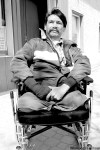
I don’t know much about Brian Sinclair’s first 44 years on Earth, but I know enough about his last year to tell you this.
It was brutally bookended. First by the kind of cruelty that could have killed him and finally by the kind of neglect that did.
The neglect was so disturbing that it’s become a national story, as it should be considering the aboriginal man with no legs and a profound speech impediment was found dead in an emergency waiting room 34 hours after arriving in a wheelchair.
That was early on a morning in late September.
The September before that, someone pushed Brian out of his wheelchair and down the stairs of an inner-city church. Then they threw sidewalk bricks on him.
By that time Brian had already lost his legs to amputation because no one had cared to help him when he passed out in a snowbank.
I only bring this to your attention because of how the little man in the wheelchair — who had trouble speaking for himself — continues to be abused by "the system" that killed him.
"ö "ö "ö
We still don’t know how long Brian lay dead in the Health Sciences Centre’s ER waiting room before a shocked citizen noticed him and called for help.
Or how the people at the top of the Winnipeg Regional Health Authority reacted when they heard what happened in one of the hospitals they’re responsible for.
All Brian needed, after all, was for someone to change his blocked catheter.
But two days later — and only after the story was leaked to the media — Dr. Brock Wright, the then-chief operating officer of the HSC, stammered out the following statement at a news conference.
"He… he… he, never made it to that triage desk."
Last week, nearly five months later, we learned that Wright’s statement was, at best, misleading.
It took another statement — this time as Manitoba’s chief medical examiner announced an inquest — for the public to learn that contrary to what Dr. Wright suggested, the hospital video surveillance cameras show Brian Sinclair trying to line up at the triage desk. Then a triage aide appears to speak to him and jot something on a clipboard, and Brian is seen wheeling into the waiting room where he’ll die.
But Dr. Thambirajah Balachandra’s revealing what the WRHA wouldn’t say didn’t end there.
Dr. Balachandra told me on Friday that security staff attempted to help Brian.
Little wonder.
He’d been vomiting in the waiting room.
Balachandra said security tried to alert medical staff "many times" but "to no avail."
Yet three days after Brian’s body was found, the WHRA issued a statement that read in part: "After spending 34 hours in the waiting room, the patient died, without ED (emergency department) staff being aware that he was there awaiting care."
That may be true — the staff may not have thought he was there for care — but it was misleading too.
Besides, if the emergency staff didn’t know Brian was there for care — if they thought he was just hanging out — one would have thought that his vomiting might have gotten their attention.
It certainly seemed to get security’s.
That’s another disturbing aspect of what Wright and the WRHA did — and didn’t — tell us originally.
Wright said that Brian had contact with security, housekeeping and, as they now tell it, a triage aide.
But he didn’t say what kind of contact.
Instead, he and the WRHA left the media — and hence the public — to believe that Brian wasn’t triaged because "he never made it to that triage desk."
When the video shows he did.
Wright stressed last week that it wasn’t Brian’s fault that he wasn’t triaged.
But the implication of Wright’s initial statement is clear.
At least it is to me.
After all if Brian Sinclair wasn’t triaged because Brian Sinclair didn’t get to the triage desk then that must be Brian Sinclair’s fault.
What bothers me just as much, though, is how — by misleading the public about what happened during those 34 hours, by failing to be open and transparent — they have continued to treat Brian the way the ER "system" did.
As if he doesn’t matter.
But he did, and maybe he still will.
"ö "ö "ö
Last Friday, when I spoke to Dr. Balachandra, he hinted at something else.
That the inquest he has called might not just be about how and why Brian Sinclair died in a city ER waiting for treatment.
It might also be about why we all have to wait so long in the ER.
And how the service can be improved for all of us.
"The government is holding a monopoly in health care," Dr. Balachandra said. "And in that case they have to deliver."
As I was suggesting, I don’t know much about Brian Sinclair’s first 44 years on earth, but maybe his last torturous year might turn out to have meaning far beyond what he could have ever known.
The little man in the wheelchair who could hardly speak for himself might just get to speak for all of us.
gordon.sinclair@freepress.mb.ca