

Puzzling illness spurs donation of diagnostic unit
Man had to wait months while epilepsy identified

Advertisement
Read this article for free:
or
Already have an account? Log in here »
To continue reading, please subscribe:
Monthly Digital Subscription
$1 per week for 24 weeks*
- Enjoy unlimited reading on winnipegfreepress.com
- Read the E-Edition, our digital replica newspaper
- Access News Break, our award-winning app
- Play interactive puzzles
*Billed as $4.00 plus GST every four weeks. After 24 weeks, price increases to the regular rate of $19.95 plus GST every four weeks. Offer available to new and qualified returning subscribers only. Cancel any time.
Monthly Digital Subscription
$4.99/week*
- Enjoy unlimited reading on winnipegfreepress.com
- Read the E-Edition, our digital replica newspaper
- Access News Break, our award-winning app
- Play interactive puzzles
*Billed as $19.95 plus GST every four weeks. Cancel any time.
To continue reading, please subscribe:
Add Free Press access to your Brandon Sun subscription for only an additional
$1 for the first 4 weeks*
- Enjoy unlimited reading on winnipegfreepress.com
- Read the E-Edition, our digital replica newspaper
- Access News Break, our award-winning app
- Play interactive puzzles
*Your next Brandon Sun subscription payment will increase by $1.00 and you will be charged $17.95 plus GST for four weeks. After four weeks, your payment will increase to $24.95 plus GST every four weeks.
Read unlimited articles for free today:
or
Already have an account? Log in here »
Hey there, time traveller!
This article was published 16/10/2009 (6052 days ago), so information in it may no longer be current.
JAMES Cook was 57 when complications of brain-tumour surgery he’d had as a teenager came back to cause seizures.
"I was in an important meeting of the Manitoba Runners Association as president and the next thing I remember is I was in hospital," Cook said.
"The people I was with thought I was staring off into space. They thought I’d had a stroke."
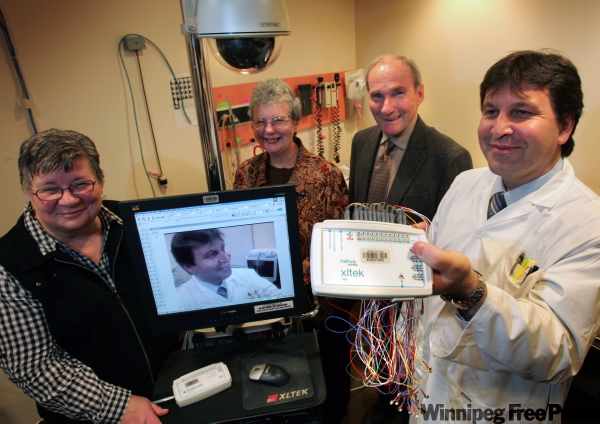
Cook said it took several months of procedures before doctors finally reached the diagnosis that Cook had suffered a seizure.
"I had a tumour when I was 14 and when they took it out they put in a small plastic shunt. The shunt moved forward and caused an injury. That’s when I started to have seizures," Cook said.
Cook said his seizures are now controlled by medication, but because of the help he and his family received from the Epilepsy and Seizure Association of Manitoba, he, along with his wife Morna, have donated $50,000 to help the organization purchase a Cyclops machine for the neurology department at the Health Sciences Centre.
The balance of the $70,000 needed was received from donations and proceeds from the association’s Healthy Living Marathon held last year. The next marathon is being held this coming Jan. 11 to 24.
The machine, which can be wheeled anywhere in the hospital, cannot only record brain waves from EEGs, but it has a single video camera — hence Cyclops — to record facial and body movements.
Morna Cook recalls it was actually good news when doctors diagnosed her husband as having seizures, sometimes occurring several times a day.
"At first, they thought that after all these years that the tumour had come back," she said.
"It took a whole year to get a diagnosis. It was scary. The doctor finally said the good news is he doesn’t have cancer, but he has epilepsy. That was whoo-hoo for us not being cancer," she said.
Phyllis Thomson, executive director of the Epilepsy and Seizure Association of Manitoba, said they bought the machine after consulting the doctors. She said there are 23,000 Manitobans who are affected by seizures.
"We asked them what they needed and they said Cyclops," Thomson said.
"It helps people not just with epilepsy. It helps anyone with a brain injury. Many times when a person is having a seizure, you might not see anything. This way, the machine records it on video so you can see it."
Dr. Yahya Agha-Khani, of the HSC’s neurology department, said the video capability of the machine "is fantastic."
"Somtimes you see something on the artifact and then we can look at the video to see what was happening," he said.
Agha-Khani said that because the machine is portable, it can be wheeled to places where the patient is in the hospital, especially the intensive care and emergency departments.
"The trend is to do longer readings now instead of 20 to 30 minutes. There’s no way we could bring an ICU patient down here for several hours."
Joanne Nikkel, discharge technologist, said the Cyclops, coupled with the unit’s new Trex, the world’s smallest ambulatory reader, allows patients to get their EEG readings at home.
"We’ll get all the daytime events and we’ll record their sleep patterns," Nikkel said.
"We hope to accomplish a diagnosis from the information we get while they’re at home.
"This just makes it really, really easy for patients to be monitored and not have to be in a hospital setting."
Both Jim and Morna Cook said they are glad the hospital has another tool to help patients.
"We felt we could do something because we had the money," Jim said.
"And anything you can do to give back is healing in itself," Morna said.
kevin.rollason@freepress.mb.ca
Kevin Rollason is a general assignment reporter at the Free Press. He graduated from Western University with a Masters of Journalism in 1985 and worked at the Winnipeg Sun until 1988, when he joined the Free Press. He has served as the Free Press’s city hall and law courts reporter and has won several awards, including a National Newspaper Award. Read more about Kevin.
Every piece of reporting Kevin produces is reviewed by an editing team before it is posted online or published in print — part of the Free Press‘s tradition, since 1872, of producing reliable independent journalism. Read more about Free Press’s history and mandate, and learn how our newsroom operates.
Our newsroom depends on a growing audience of readers to power our journalism. If you are not a paid reader, please consider becoming a subscriber.
Our newsroom depends on its audience of readers to power our journalism. Thank you for your support.
Kevin Rollason is a general assignment reporter at the Free Press. He graduated from Western University with a Masters of Journalism in 1985 and worked at the Winnipeg Sun until 1988, when he joined the Free Press. He has served as the Free Press’s city hall and law courts reporter and has won several awards, including a National Newspaper Award. Read more about Kevin.
Every piece of reporting Kevin produces is reviewed by an editing team before it is posted online or published in print — part of the Free Press‘s tradition, since 1872, of producing reliable independent journalism. Read more about Free Press’s history and mandate, and learn how our newsroom operates.
Our newsroom depends on a growing audience of readers to power our journalism. If you are not a paid reader, please consider becoming a subscriber.
Our newsroom depends on its audience of readers to power our journalism. Thank you for your support.
Advertisement Advertise With Us
Advertisement Advertise With Us