

No time to lose when submerged: professor

Advertisement
Read this article for free:
or
Already have an account? Log in here »
To continue reading, please subscribe:

Digital Subscription
One year of digital access for only $205*
- Enjoy unlimited reading on winnipegfreepress.com
- Read the E-Edition, our digital replica newspaper
- Access News Break, our award-winning app
- Play interactive puzzles
*First annual payment billed as $205.00 + GST for one year. This annual subscription will automatically renew at $233.00 + GST every 52 weeks (10% off the regular annual price of $259.35). Offer available to new and qualified returning subscribers only. Cancel any time.
To continue reading, please subscribe:
Add Free Press access to your Brandon Sun subscription for only an additional
$1 for the first 4 weeks*
- Enjoy unlimited reading on winnipegfreepress.com
- Read the E-Edition, our digital replica newspaper
- Access News Break, our award-winning app
- Play interactive puzzles
*Your next Brandon Sun subscription payment will increase by $1.00 and you will be charged $17.95 plus GST for four weeks. After four weeks, your payment will increase to $24.95 plus GST every four weeks.
Read unlimited articles for free today:
or
Already have an account? Log in here »
Hey there, time traveller!
This article was published 05/11/2009 (6129 days ago), so information in it may no longer be current.
THE three college softball players who drowned after driving into a North Dakota pond did what many people would do these days: They tried calling for help on their cellphones.
While what they did was a natural reaction, it helped seal their fate, said Gord Giesbrecht, an international expert in escaping from a submerged vehicle.
Giesbrecht, a professor of thermophysiology in the faculty of kinesiology and recreation management at the University of Manitoba, said the three women — including 21-year-old Ashley Neufeld of Brandon — instead should have rolled down their window.
"You have to get out of the vehicle while it’s still on the surface," Giesbrecht said Wednesday.
"If your vehicle ends up in the water, do not touch your cellphone. You have a one-minute opportunity to escape while it’s on the surface.
"A phone call just uses up that valuable time and you can’t accomplish anything with that call anyway — no one is going to rescue you.
"You’re on your own."
The bodies of Neufeld, 21, Kyrstin Gemar, 22, of San Diego, and Afton Williamson, 20, of Lake Elsinore, Calif., were found on Tuesday inside a Jeep Cherokee at the bottom of a three-metre-deep pond on a farm. The trio had gone stargazing on Sunday night.
Police in North Dakota said the doors and windows of the vehicle weren’t open.
Police said the cellphone calls were useful in helping them locate the vehicle.
Giesbrecht was part of a research project in 2005, which was presented at the Canadian Multidisciplinary Road Safety Conference in June 2006, which looked at vehicle submersion and how to get out.
At the time, 400 North Americans died annually in submerged vehicles with seven per cent of all drownings in Canada occurring in vehicles.
Giesbrecht said victims will quickly find opening doors is not an option because the pressure of water is holding them closed, so that leaves windows as the only escape route.
He said his study noted a vehicle will float for only a short period of time, from 30 seconds to a maximum two minutes, before the water reaches the bottom of the side windows so that’s the most optimum time to escape through windows.
And he said the study found that more than half of the public questioned during the study mistakenly believed the best strategy was to stay in the vehicle until it filled with water or sank to the bottom.
"Every second that goes by, your chances of escape decreases," Giesbrecht said.
"The conception is right — everyone hears about pressure equality so you can open the door when the vehicle is full of water — but the problem is when the vehicle is filled with water you have no margin for error."
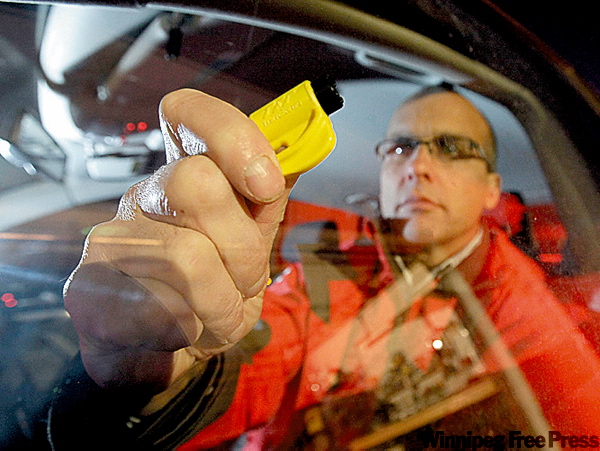
Giesbrecht said power windows should keep working for up to three minutes submerged in water, but just in case he keeps a device — called the ResQMe — hanging from his rear-view mirror to break the side window.
kevin.rollason@freepress.mb.ca
Survival tips
PROF. Gordon Giesbrecht’s advice for escaping from a vehicle that has just entered the water:
"ö Seatbelts unfastened

"ö Children remove their restraints and bring them close to an adult to help them escape
"ö Windows open, either by rolling down manually or with a switch, or by smashing them out
"ö Out children should be pushed out first followed by the adult
Kevin Rollason
Reporter
Kevin Rollason was a general assignment reporter at the Free Press.
Our newsroom depends on a growing audience of readers to power our journalism. If you are not a paid reader, please consider becoming a subscriber.
Our newsroom depends on its audience of readers to power our journalism. Thank you for your support.
Where do I get a device to break a window quickly?
If your vehicle ends up in the water, your only sure fire way to exit is by immediately breaking your side window/s and exiting as fast as possible.
One type, the ResQMe, can be found at many Safety Supply retailers in Winnipeg including Reliant Safety Equipment Inc., 1708 St. James St or ABC Fire and Safety Equipment Ltd., 9-846 Marion St.
— Source Professor Gord Giesbrecht, University of Manitoba
Kevin Rollason
Reporter
Kevin Rollason was a general assignment reporter at the Free Press.
Our newsroom depends on a growing audience of readers to power our journalism. If you are not a paid reader, please consider becoming a subscriber.
Our newsroom depends on its audience of readers to power our journalism. Thank you for your support.
Related Articles
How to escape from a submerged vehicle
Advertisement Advertise With Us
Advertisement Advertise With Us