

Painful lesson prevents deaths
Fatal crash in 2005 led to rule changes that now save lives

Advertisement
Read this article for free:
or
Already have an account? Log in here »
To continue reading, please subscribe:
Monthly Digital Subscription
$1 per week for 24 weeks*
- Enjoy unlimited reading on winnipegfreepress.com
- Read the E-Edition, our digital replica newspaper
- Access News Break, our award-winning app
- Play interactive puzzles
*Billed as $4.00 plus GST every four weeks. After 24 weeks, price increases to the regular rate of $19.95 plus GST every four weeks. Offer available to new and qualified returning subscribers only. Cancel any time.
Monthly Digital Subscription
$4.99/week*
- Enjoy unlimited reading on winnipegfreepress.com
- Read the E-Edition, our digital replica newspaper
- Access News Break, our award-winning app
- Play interactive puzzles
*Billed as $19.95 plus GST every four weeks. Cancel any time.
To continue reading, please subscribe:
Add Free Press access to your Brandon Sun subscription for only an additional
$1 for the first 4 weeks*
*Your next subscription payment will increase by $1.00 and you will be charged $16.99 plus GST for four weeks. After four weeks, your payment will increase to $23.99 plus GST every four weeks.
Read unlimited articles for free today:
or
Already have an account? Log in here »
Hey there, time traveller!
This article was published 13/01/2011 (5560 days ago), so information in it may no longer be current.
Consider two FedEx cargo planes taking off from Winnipeg, five years apart, in the same wintry conditions that threaten the dangerous buildup of ice on the wings.
In the case of the first FedEx flight, icing caused the fatal crash of the Cessna 208B plane.
Last week, another Cessna 208B plane flew into the same icing conditions but safely returned.
The difference? A tragedy may have prevented another tragedy.
Peter Hildebrand of the Transportation Safety Board of Canada said on Wednesday that after the October 2005 crash, and the TSB investigation, Transport Canada put in place new regulations for the piloting of this type of plane in icing conditions.
“We made recommendations for changes,” Hildebrand said.
“This (the latest flight and landing) is probably something that resulted in a change after the accident here.
“Things have changed since the terrible accident.”
The main change was recommending that the pilots of these types of planes have to immediately exit icing conditions if they can’t keep a minimum operating airspeed of 120 knots.
The Cessna company itself had recommended this type of plane’s minimum speed in icing conditions at 105 knots, but Canada’s aviation regulator believed that didn’t leave pilots with enough room and time to do something before a stall warning could occur, so it implemented a higher speed.
As well, at the time of the crash, the Cessna 208B, also known as the Cessna Caravan, had been in so many ice-related crashes that the manufacturer also told pilots to begin checking the wings and propellers for ice with their hands as well as the standard visual inspection. Between 1987 and 2003 there were 26 icing-related incidents and 36 deaths in the United States alone.
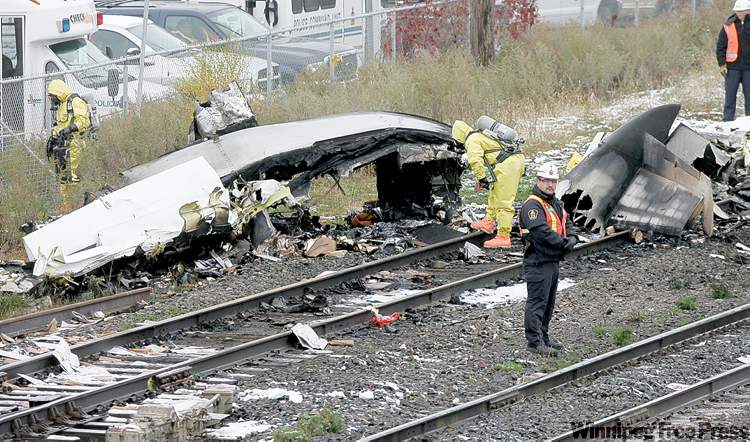
Nancy Chase-Allan, 49, was at the controls of a Morningstar Air Express Cessna 208B, on Oct. 6, 2005, when it crashed nose-first into the rail tracks behind the Masonic Temple at Confusion Corner.
Chase-Allan’s plane took off perfectly from Winnipeg’s airport at 5:37 a.m., but just four minutes later she was radioing the tower for permission to immediately return.
“I’m icing up to the point where, uh, I need to come back,” she said.
When the air-traffic controller told her to return by making a southwesterly loop south of the downtown over River Heights and maintaining her altitude, Chase said she heard the instructions, but then her final words were: “I don’t think I’m… “
Within minutes, the city’s 911 operators began getting calls about a plane crash.
Chase-Allen, a real estate agent in Moncton, N.B., who also spent five years flying with Morningstar, the first three in Winnipeg and the final two in Moncton, was killed instantly on impact.
Chase-Allen had been back in Winnipeg, flying the FedEx run from this city to Thunder Bay, because she was filling in for a colleague.
Last Friday, a Morningstar Air Express Cessna 208B took off from Winnipeg’s Richardson International Airport at 6:20 a.m.
But, according to a Transport Canada report, just minutes into the flight, the pilot radioed back to the tower saying they had “encountered moderate icing and (were) having difficulty maintaining speed and altitude.”
Following Transport Canada’s regulations, the pilot immediately descended out of the icing conditions and turned back.
Thirty-one minutes after it took off, the plane landed safely.
J.P. Mainville, Morningstar’s director of safety and security, said Chase-Allen was trying to get back to the airport when she crashed.
Mainville said while there is now a Transport Canada protocol for the speed of flying the plane in icing conditions, all pilots have known for years that you have to get out of the icing conditions as quickly as possible.
“(Icing) can happen in the blink of an eye… all of a sudden you are in it,” Mainville said from the company’s head office in Edmonton.

“The main thing is, if you enter icing, get out of icing… if you get out of the clouds you get out of the icing.”
Mainville said his company stresses to all of its pilots not to push the air envelope.
“Our company has never believed in putting the pilot or aircraft at risk to get the job done,” he said.
“Safety is paramount with us.”
kevin.rollason@freepress.mb.ca
Kevin Rollason is a general assignment reporter at the Free Press. He graduated from Western University with a Masters of Journalism in 1985 and worked at the Winnipeg Sun until 1988, when he joined the Free Press. He has served as the Free Press’s city hall and law courts reporter and has won several awards, including a National Newspaper Award. Read more about Kevin.
Every piece of reporting Kevin produces is reviewed by an editing team before it is posted online or published in print — part of the Free Press‘s tradition, since 1872, of producing reliable independent journalism. Read more about Free Press’s history and mandate, and learn how our newsroom operates.
Our newsroom depends on a growing audience of readers to power our journalism. If you are not a paid reader, please consider becoming a subscriber.
Our newsroom depends on its audience of readers to power our journalism. Thank you for your support.
Kevin Rollason is a general assignment reporter at the Free Press. He graduated from Western University with a Masters of Journalism in 1985 and worked at the Winnipeg Sun until 1988, when he joined the Free Press. He has served as the Free Press’s city hall and law courts reporter and has won several awards, including a National Newspaper Award. Read more about Kevin.
Every piece of reporting Kevin produces is reviewed by an editing team before it is posted online or published in print — part of the Free Press‘s tradition, since 1872, of producing reliable independent journalism. Read more about Free Press’s history and mandate, and learn how our newsroom operates.
Our newsroom depends on a growing audience of readers to power our journalism. If you are not a paid reader, please consider becoming a subscriber.
Our newsroom depends on its audience of readers to power our journalism. Thank you for your support.
Advertisement Advertise With Us
Advertisement Advertise With Us