

Protesters denounce government inaction
Reserve residents take to city streets
Advertisement
Read this article for free:
or
Already have an account? Log in here »
To continue reading, please subscribe:

Digital Subscription
One year of digital access for only $205*
- Enjoy unlimited reading on winnipegfreepress.com
- Read the E-Edition, our digital replica newspaper
- Access News Break, our award-winning app
- Play interactive puzzles
*First annual payment billed as $205.00 + GST for one year. This annual subscription will automatically renew at $233.00 + GST every 52 weeks (10% off the regular annual price of $259.35). Offer available to new and qualified returning subscribers only. Cancel any time.
To continue reading, please subscribe:
Add Free Press access to your Brandon Sun subscription for only an additional
$1 for the first 4 weeks*
- Enjoy unlimited reading on winnipegfreepress.com
- Read the E-Edition, our digital replica newspaper
- Access News Break, our award-winning app
- Play interactive puzzles
*Your next Brandon Sun subscription payment will increase by $1.00 and you will be charged $17.95 plus GST for four weeks. After four weeks, your payment will increase to $24.95 plus GST every four weeks.
Read unlimited articles for free today:
or
Already have an account? Log in here »
Hey there, time traveller!
This article was published 13/04/2011 (5613 days ago), so information in it may no longer be current.
ANGER over chronic flooding on an Interlake First Nation spilled over to the streets of Winnipeg on Tuesday when about 200 people from Lake St. Martin marched in protest against the provincial and federal governments.
“Administrative wrangling in the face of a flood is just plain irresponsible,” Lake St. Martin Chief Adrian Sinclair said as a crowd hoisted placards calling for federal action outside Indian and Northern Affairs’ downtown offices. “Our patience has run out.”
By late Tuesday afternoon, the chief said the water had risen above temporary dikes.
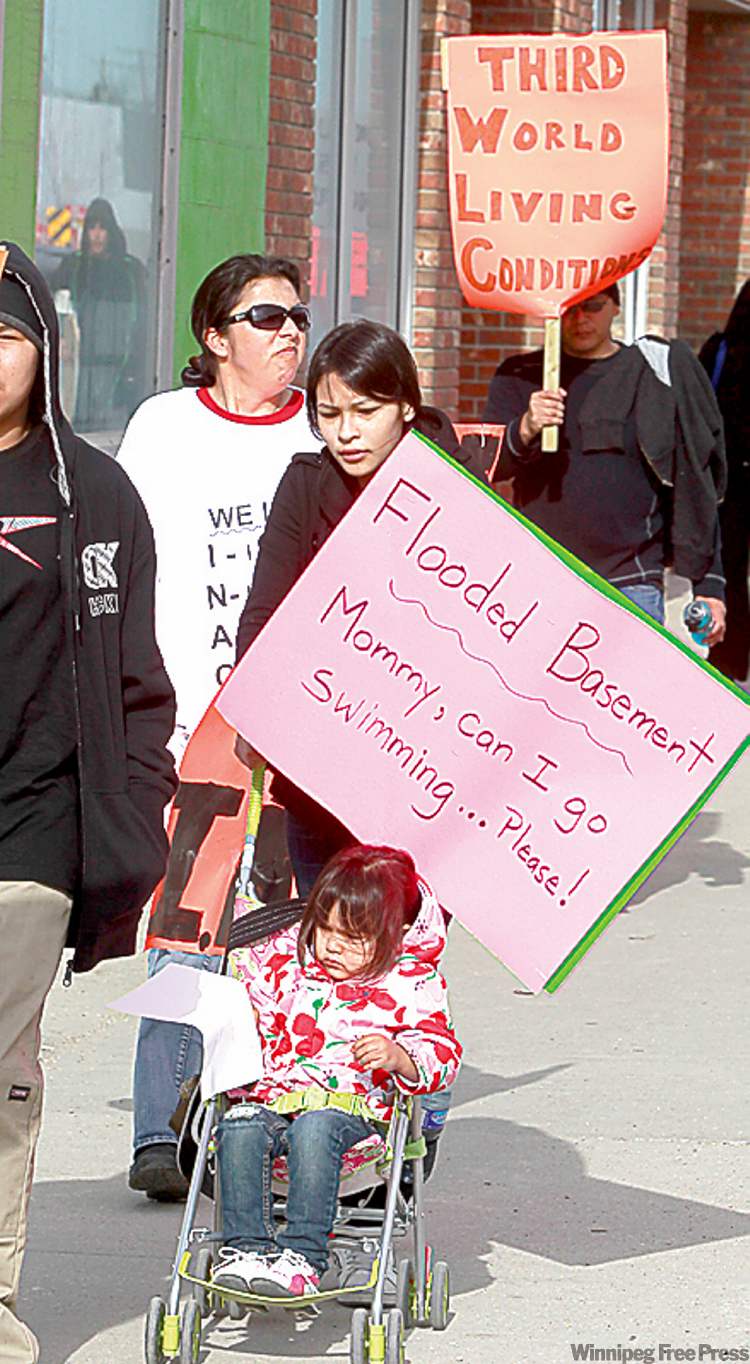
Residents bused and walked from their First Nation, 277 kilometres north of Winnipeg, Monday to draw attention to their living conditions. They want to be relocated to higher ground and say the governments let their lands flood to keep other parts of the province dry.
Deputy Premier Eric Robinson and Water Stewardship Minister Christine Melnick met with protest leaders late Tuesday to explain how the two levels of government are trying balance flood realities and spare Lake St. Martin as much as possible, a provincial spokeswoman said.
The province will launch a study into the flood’s impact on the First Nation, the spokeswoman said.
Both levels of government are monitoring flows through water-control structures that siphon off flood water to Lake Manitoba and Lake St. Martin.
The province altered its operations to help protect Lake St. Martin in 2005.
Lake St. Martin’s troubled spring began with heavy winter snows.
In January, Sinclair asked Indian Affairs for help. In February, the province opened the control gates at the Fairford River, which flows between Lake Winnipeg and Lake St. Martin. In March, Indian Affairs put aside $2.6 million and sent a contractor from the Manitoba Association of Native Firefighters to build dikes at Lake St. Martin and Little Saskatchewan First Nations and set up sandbags.
The dikes are failing because the land is super-saturated and water is welling up from underground, the chief said.
“We want to move to higher ground,” Sinclair said.
The grievance dates back decades and has languished in court. The First Nation and the federal government sued the province in separate lawsuits in 1999 for trespassing and ruining reserve lands with the flood-control measures. The cases were filed but never pursued, the chief said.
Once-rich hay lands are swampy. Most of the 200 homes are condemned because of water damage and mould. Children suffer chronic nosebleeds and asthma. Seniors are ailing with respiratory complaints.
Two weeks ago, the water saturated an area cemetery on a hill. An elder’s casket was lowered into a watery grave because there was nowhere else to bury her, the chief said.

A man also fell through his rotten roof trying to repair it.
The Assembly of Manitoba Chiefs, the province’s biggest First Nation lobby group, supported the call for action along with other chiefs, including Roseau River Chief Terry Nelson.
The Southern Chiefs Organization warned there could acts of civil disobedience without a settlement.
“If you want a hot summer, by God, we’ll deliver a hot summer,” SCO Grand Chief Morris Swan-Shannacappo said.
alexandra.paul@freepress.mb.ca
Related Articles
Red River's expected crest downgraded: forecasters
Advertisement Advertise With Us
Advertisement Advertise With Us