

Police praise officers-in-school program amid backlash

Advertisement
Read this article for free:
or
Already have an account? Log in here »
To continue reading, please subscribe:

Digital Subscription
One year of digital access for only $205*
- Enjoy unlimited reading on winnipegfreepress.com
- Read the E-Edition, our digital replica newspaper
- Access News Break, our award-winning app
- Play interactive puzzles
*First annual payment billed as $205.00 + GST for one year. This annual subscription will automatically renew at $233.00 + GST every 52 weeks (10% off the regular annual price of $259.35). Offer available to new and qualified returning subscribers only. Cancel any time.
To continue reading, please subscribe:
Add Free Press access to your Brandon Sun subscription for only an additional
$1 for the first 4 weeks*
- Enjoy unlimited reading on winnipegfreepress.com
- Read the E-Edition, our digital replica newspaper
- Access News Break, our award-winning app
- Play interactive puzzles
*Your next Brandon Sun subscription payment will increase by $1.00 and you will be charged $17.95 plus GST for four weeks. After four weeks, your payment will increase to $24.95 plus GST every four weeks.
Read unlimited articles for free today:
or
Already have an account? Log in here »
Hey there, time traveller!
This article was published 25/09/2020 (2210 days ago), so information in it may no longer be current.
Winnipeg police say social media posts lauding the police-in-schools program on its Instagram are not part of an organized campaign, but rather an effort to address misconceptions about an initiative that has been questioned recently.
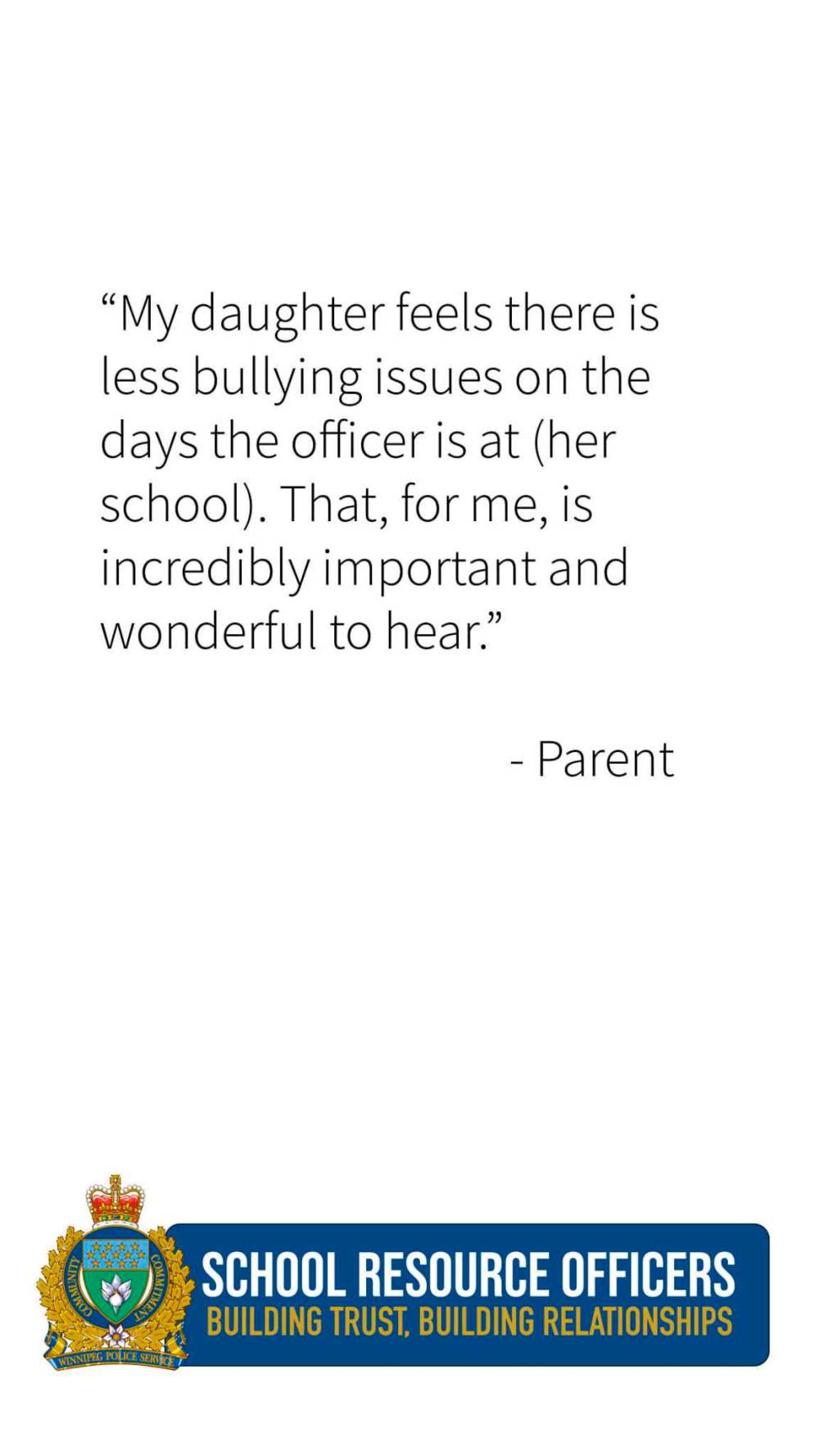
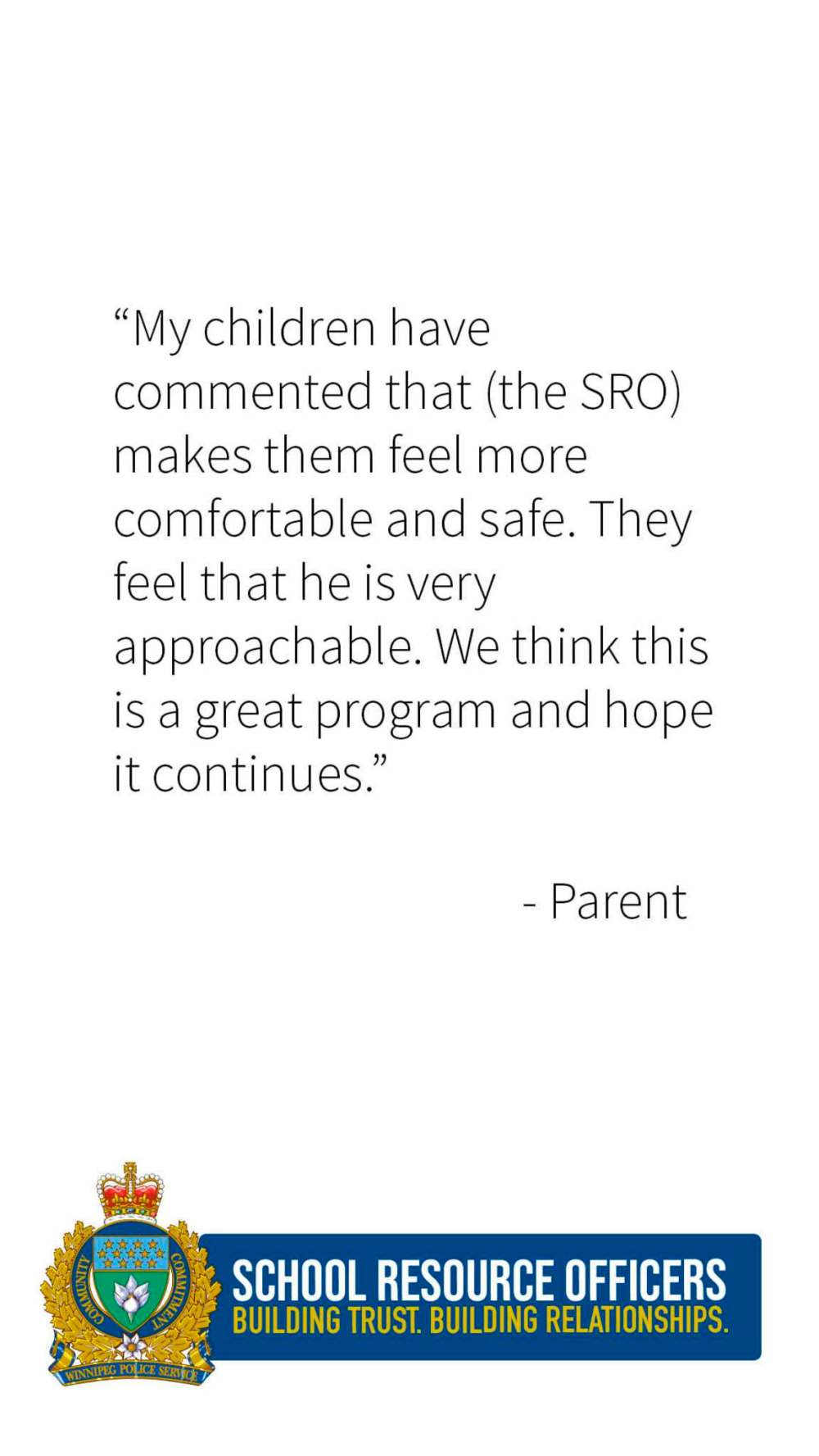
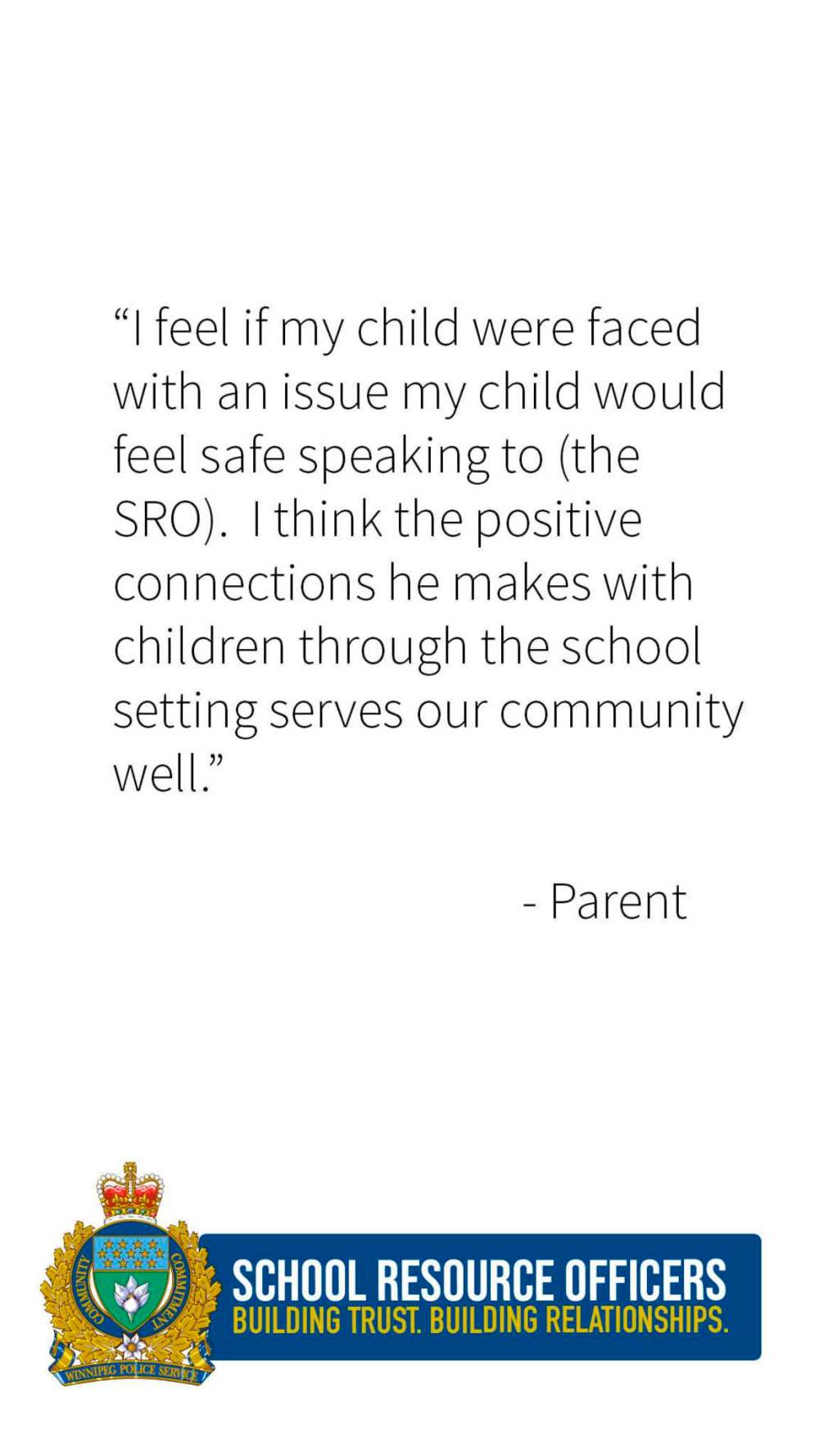
On Wednesday, the account @wpgpoliceofficial posted white tiles that display quotes from anonymous parents in the River East Transcona School Division who participated in a survey about the division’s school resource officer program in the spring.
The tiles mirror posts on the Police-Free Schools Winnipeg website — except they contain quotes that praise the program rather than call for its end.

One parent called a police presentation in school about internet safety “invaluable” to their child. Some parents reported their children saying police presence limits incidents, bullying included, at school. Multiple guardians cited the program as a way police build positive relationships.
“I have been receiving, as I oversee the school engagement section, specific questions about what the (officers) do and don’t do, so it’s clear that there’s some misunderstanding,” said Insp. Bonnie Emerson of the community support division at the Winnipeg Police Service.
Citing accountability as a key tenet of the service, Emerson said police are presenting information about the program and what it is intended for, as well as survey results compiled by River East Transcona; the division received positive feedback during the first year (2019-20) an officer visited area schools, prompting the administration to request more officers this year.
The police-in-schools program — a countrywide initiative introduced to Winnipeg in 2002 — currently includes 19 uniformed officers who work in six city school divisions. Officer duties range from giving presentations about drugs to “participation in a threat assessment.”
Since its inception, supporters have insisted the program builds understanding between officers, students and communities.
Cam Scott with Police-Free Schools Winnipeg says that isn’t always the case. He argues a spotlight must be put on the negative experiences faced by students and staff from low-income and racialised communities.
In recent months, community members in Vancouver and Edmonton have mobilized to call for an end to police programs in their respective cities. The movements argue hosting police affects the well-being, success and safety of Black, Indigenous and other students of colour who have had negative experiences with authorities.
Similar movements in Toronto and Hamilton have been successful. In 2017, the Toronto District School Board voted to remove police from its schools after a six-week community review.
The Winnipeg campaign is calling for “an equity-based, community-led evaluation” that breaks down respondents’ racial identities.
“If you’re privileged enough to feel at ease around police, we think it’s really important to hear and believe the voices of people harmed by policing rather than drown them out,” Scott said, adding that’s exactly what the @wpgpoliceofficial posts do: “contradict or shout over those voices.”
The posts are a stark contrast to those on the @policefreeschoolswpg page, which details accounts of police presence intimidating students and staff from marginalized communities and concerns about the glorification of violence in schools because police have guns and batons.
As far as Seven Oaks School Division superintendent Brian O’Leary is concerned, the officers — who are on a first-name basis with staff and students — devote time to problem-solving and proactive policing.
These officers work in interdisciplinary teams with school counsellors and other staff, O’Leary said. Without their de-escalation tactics, he said there would be more interactions with police who are called for emergency situations.

“It’s not a question of having police in schools or not,” O’Leary said. “It’s what kind of police we have in schools.”
The Manitoba Teachers’ Society declined to comment.
maggie.macintosh@freepress.mb.ca
Twitter: @macintoshmaggie
– with files from Joyanne Pursaga
Maggie Macintosh
Education reporter
Maggie Macintosh reports on education for the Free Press. Originally from Hamilton, Ont., she first reported for the Free Press in 2017. Read more about Maggie.
Funding for the Free Press education reporter comes from the Government of Canada through the Local Journalism Initiative.
Every piece of reporting Maggie produces is reviewed by an editing team before it is posted online or published in print — part of the Free Press‘s tradition, since 1872, of producing reliable independent journalism. Read more about Free Press’s history and mandate, and learn how our newsroom operates.
Our newsroom depends on a growing audience of readers to power our journalism. If you are not a paid reader, please consider becoming a subscriber.
Our newsroom depends on its audience of readers to power our journalism. Thank you for your support.
Maggie Macintosh
Education reporter
Maggie Macintosh reports on education for the Free Press. Originally from Hamilton, Ont., she first reported for the Free Press in 2017. Read more about Maggie.
Funding for the Free Press education reporter comes from the Government of Canada through the Local Journalism Initiative.
Every piece of reporting Maggie produces is reviewed by an editing team before it is posted online or published in print — part of the Free Press‘s tradition, since 1872, of producing reliable independent journalism. Read more about Free Press’s history and mandate, and learn how our newsroom operates.
Our newsroom depends on a growing audience of readers to power our journalism. If you are not a paid reader, please consider becoming a subscriber.
Our newsroom depends on its audience of readers to power our journalism. Thank you for your support.
Related Articles
Police-in-schools program easily passes at city hall
Advertisement Advertise With Us
Advertisement Advertise With Us
History
Updated on Friday, September 25, 2020 5:56 PM CDT: Adds quote, updates photo