

Teachers’ ideas get high marks from province

Advertisement
Read this article for free:
or
Already have an account? Log in here »
To continue reading, please subscribe:
Digital Subscription
One year of digital access for only $1.44 a week*
- Enjoy unlimited reading on winnipegfreepress.com
- Read the E-Edition, our digital replica newspaper
- Access News Break, our award-winning app
- Play interactive puzzles
*Billed as $5.77 plus GST every four weeks. After 52 weeks, price increases to the regular rate of $19.95 plus GST every four weeks. Offer available to new and qualified returning subscribers only. Cancel any time.
To continue reading, please subscribe:
Add Free Press access to your Brandon Sun subscription for only an additional
$1 for the first 4 weeks*
- Enjoy unlimited reading on winnipegfreepress.com
- Read the E-Edition, our digital replica newspaper
- Access News Break, our award-winning app
- Play interactive puzzles
*Your next Brandon Sun subscription payment will increase by $1.00 and you will be charged $17.95 plus GST for four weeks. After four weeks, your payment will increase to $24.95 plus GST every four weeks.
Read unlimited articles for free today:
or
Already have an account? Log in here »
Hey there, time traveller!
This article was published 17/07/2021 (1923 days ago), so information in it may no longer be current.
COVID-19 created a lot of drama for the theatre department at Grant Park High School, as staff and students grappled with the challenges of masked acting and remote rehearsals — but it also set the stage for new programming.
With students required to attend class in alternating cohorts and in-person performances off-limits, teachers at the Winnipeg high school decided to integrate film into their performing arts courses on the fly.
The school purchased ring lights and green screens. Students were assigned a project to study shorts and record their own homemade flicks. Classes also produced both musical productions and a play via video recordings and editing software.
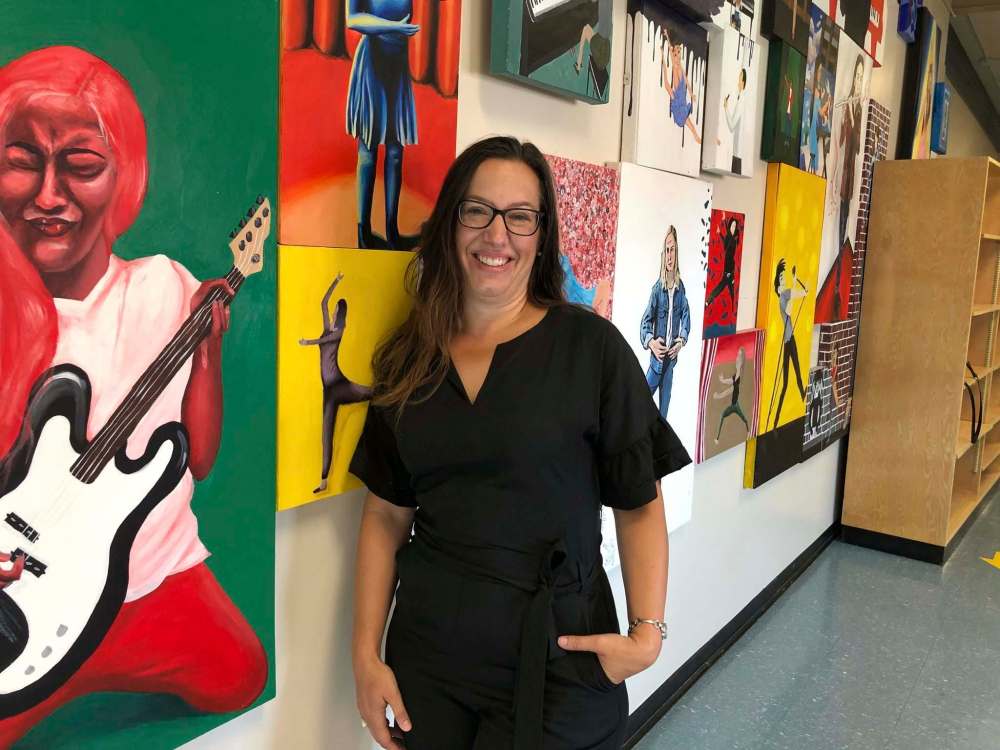
“It came from necessity, looking at the film piece, but it branched off into something that is really what’s best for student learning and engagement,” said principal Jamie Hutchison. “(Film training) is something that offers opportunity to kids and then connects to post-secondary opportunities, and that’s always what we want to do.”
Teacher pitches to launch a film program, install a school sensory pathway, and offer students morning storytime sessions with breakfast are among 27 ideas that have been given an A+ from the province.
On Friday, Education Minister Cliff Cullen unveiled a list of more than two dozen public school projects across 17 divisions in Manitoba that will be the first to receive funding through the Teachers’ Idea Fund.
The $25-million fund, to be dispersed over five years, is earmarked for educator-led projects focused on either targeted learning support, innovative teaching and learning models, mental health and well-being, transitions in education, family engagement, or a combination of the above.
The province received more than 100 applications for the first round of funding, in which recipients will receive a total of more than $425,000 to launch initiatives in 2021-22.
At Grant Park, its share will be used to purchase cameras, boom microphones and laptops, to integrate film training into theatre courses, expand the school’s limited film editing classes, and expose students to opportunities in the growing movie-making industry in Winnipeg.
“I want kids to be able to learn new ways of, not just performing, but of expressing and creating and telling stories,” said Jennifer Tomanek, a performing arts teacher who oversees the school’s theatre programming.
Tomanek was enthusiastic Friday about the fact the province is earmarking grants for arts-related ideas, especially given many such programs faced declining enrolment and challenges with public health protocols in 2020-21.
A review panel of cross-sectoral stakeholders recommended the chosen projects for approval and will continue to review applications ahead of a second announcement of successful pitches next month, according to a government release.
Brandon teacher Raven Willoughby said she is “in shock and disbelief” after learning her project was selected. Willoughby, who works with First Nations, Métis and Inuit students, will expand a program that connects at-risk pupils at Prairie Hope High School with cultural field trips and land-based learning.
“What really impacts those students that are at-risk is the relationships that they build and an opportunity to see Indigenous people in their community, and not just in the history books,” said the Métis educator, adding many of her students are not familiar with their own peoples’ history, which is often the result of residential schools and related trauma.
Also on the grant recipient list is Oak Lake Community School — an elementary building in Fort La Bosse School Division where teachers will address pandemic literacy gaps next year through targeted phonological awareness.

“Our classroom assessment data from June shows approximately half of the students in Grade 1 would have had their reading and writing impacted by (COVID-19),” said principal Brenda Masson.
New funding will staff a literacy support position that will co-teach the school’s youngest learners and support struggling middle schoolers in learning how-to read, write and spell by emphasizing sound bites and sound families.
The grant will have a lasting impact, said Masson, in that it will both patch learning gaps and build new instructional skill capacity among teachers.
maggie.macintosh@freepress.mb.ca
Twitter: @macintoshmaggie
Maggie Macintosh
Education reporter
Maggie Macintosh reports on education for the Free Press. Originally from Hamilton, Ont., she first reported for the Free Press in 2017. Read more about Maggie.
Funding for the Free Press education reporter comes from the Government of Canada through the Local Journalism Initiative.
Every piece of reporting Maggie produces is reviewed by an editing team before it is posted online or published in print — part of the Free Press‘s tradition, since 1872, of producing reliable independent journalism. Read more about Free Press’s history and mandate, and learn how our newsroom operates.
Our newsroom depends on a growing audience of readers to power our journalism. If you are not a paid reader, please consider becoming a subscriber.
Our newsroom depends on its audience of readers to power our journalism. Thank you for your support.
Maggie Macintosh
Education reporter
Maggie Macintosh reports on education for the Free Press. Originally from Hamilton, Ont., she first reported for the Free Press in 2017. Read more about Maggie.
Funding for the Free Press education reporter comes from the Government of Canada through the Local Journalism Initiative.
Every piece of reporting Maggie produces is reviewed by an editing team before it is posted online or published in print — part of the Free Press‘s tradition, since 1872, of producing reliable independent journalism. Read more about Free Press’s history and mandate, and learn how our newsroom operates.
Our newsroom depends on a growing audience of readers to power our journalism. If you are not a paid reader, please consider becoming a subscriber.
Our newsroom depends on its audience of readers to power our journalism. Thank you for your support.
Advertisement Advertise With Us
Advertisement Advertise With Us