

A picture of compassion
Faces to Graves project works to find image of Interlake medic killed in Battle of the Scheldt in 1944

Advertisement
Read this article for free:
or
Already have an account? Log in here »
To continue reading, please subscribe:

Digital Subscription
One year of digital access for only $205*
- Enjoy unlimited reading on winnipegfreepress.com
- Read the E-Edition, our digital replica newspaper
- Access News Break, our award-winning app
- Play interactive puzzles
*First annual payment billed as $205.00 + GST for one year. This annual subscription will automatically renew at $233.00 + GST every 52 weeks (10% off the regular annual price of $259.35). Offer available to new and qualified returning subscribers only. Cancel any time.
To continue reading, please subscribe:
Add Free Press access to your Brandon Sun subscription for only an additional
$1 for the first 4 weeks*
- Enjoy unlimited reading on winnipegfreepress.com
- Read the E-Edition, our digital replica newspaper
- Access News Break, our award-winning app
- Play interactive puzzles
*Your next Brandon Sun subscription payment will increase by $1.00 and you will be charged $17.95 plus GST for four weeks. After four weeks, your payment will increase to $24.95 plus GST every four weeks.
Read unlimited articles for free today:
or
Already have an account? Log in here »
Hey there, time traveller!
This article was published 10/11/2023 (1065 days ago), so information in it may no longer be current.
It was a twist of fate for Pte. John Lewis Hughes.
Before enlisting, Hughes worked at the Eriksdale hospital tending to patients. Hughes later died on a Second World War battlefield while helping wounded soldiers.
But despite that brief parallel in his life, not much more is known about Hughes — the soldier, nor the person.
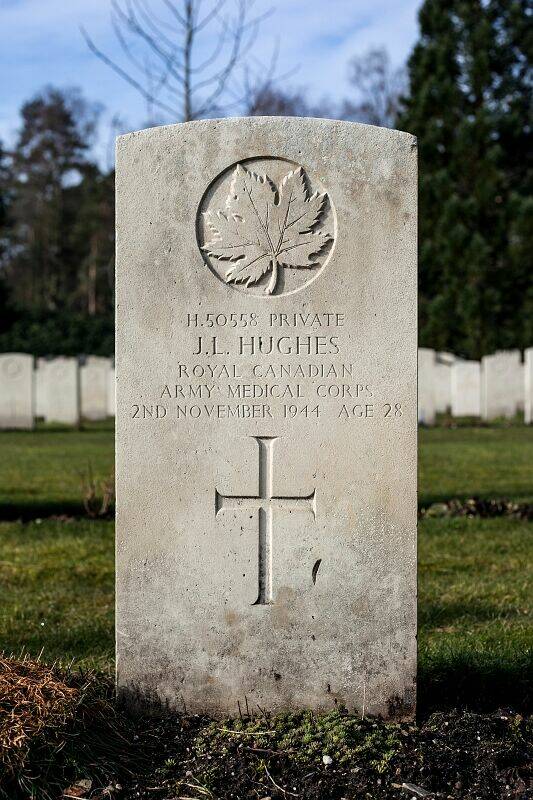
Commonwealth War Graves Commission
Pte. John Lewis Hughes gravestone
A retired Dutch diplomat is hoping to change that, part of which involves trying to find a photograph of Hughes so it can be added to a digital archive including every Canadian soldier interred in the Netherlands.
Pieter Valkenburg, now a resident of Prince Edward Island, has for years been helping the Faces to Graves project at the Canadian War Cemeteries to match photographs to graves. He has already found almost 200 photographs — 15 of them Manitobans — and he is working on locating many more.
However, Valkenburg said he has hit a dead end in his search to find a photograph — and relatives — of Hughes and he is hoping Free Press readers can help him.
“We’re really trying to get this, but it is strange,” he said.
“He had quite a lot of family, and I’ve even reached out to the Legion in Eriksdale, but they couldn’t help. There must be somebody out there who knows him.”
Details are sparse regarding Hughes’ life, and most of what is known comes from his Canadian Army file.
Hughes was born in the Interlake community of Eriksdale on Jan. 17, 1916. His dad was E.G. Hughes, who at the time of his son’s death was living in a hospital in Hearst, Ont. As for his mother, all Hughes’ widow, Irene, knew about her was that she had died “some years ago.”
He worked for 12 years as an orderly at E.M. Crowe Hospital in Eriksdale, and his army papers said he intended to return to the job when the war was over.
He moved to Winnipeg, living on Spence Street, and married Irene, of 57 Boyle St., in Winnipeg on June 22, 1940. He left for military training camp 13 days later.
For the next 1,581 days of his service — 1,231 days of which he was overseas — he was part of the Royal Canadian Army Medical Corps.
Hughes died near the end of the Battle of the Scheldt on Nov. 2, 1944. He was 28.
The battle, according to a historical account on the Veterans Affairs Canada website, is believed by some historians to have been the toughest battlefield on which conflict was carried out during the entire Second World War.
The Canadian Army was asked to clear German defences away between the English Channel and Antwerp so supplies could be shipped into the port for the Allied forces.
Five weeks later, on Nov. 8, the army was successful, but at a cost of 12,873 killed, wounded or missing, including 6,367 Canadians.
Hughes was originally buried in the Zoutelande Temporary Burial Ground. He was later reburied in the Bergen-op-Zoom Canadian War Cemetery on April 29, 1946.
An initial letter sent to Hughes’ widow said this was her husband’s final resting place, but a subsequent letter, sent a couple of years later, stated his remains had been moved to be buried at the Holten Canadian War Cemetery.
When Hughes died, his few possessions were sent to his grieving widow in Winnipeg. There were 140 Belgian francs, one leather writing case, two mechanical pencils, a fountain pen, an Eveready flashlight, a souvenir badge and his paybook.
That last item, containing charred and burned pages, gives evidence of the horrific nature of his death.
There were also 11 letters. Many, if not all, were likely from his wife, but there may also have been some sent to him by other family members.
Valkenburg said even though Hughes’ siblings would likely be dead, he is hoping a niece or nephew will come forward.
Hughes had two brothers — Sgt. A.L. Hughes, who served with the Canadian Army Division in the Italian campaign, and Dennis Hughes, who served with the Royal Canadian Air Force. He also had three sisters, Evelyn Laycock of Rosebank, Grace Hughes and Esther Hughes, who became Esther Schott when she married Gordon Schott in Winnipeg on April 23, 1949, and two half-sisters, Mrs. J. Carr and Mrs. Houston, both of Eriksdale.
Hughes’ widow remarried on Nov. 12, 1948 and became Irene Purdy of 506 Magnus St. — now the site of William Whyte School.

Valkenburg said he hopes a photograph of Hughes will soon be found to join the thousands of others in the digital archive.
“They all deserve this,” he said.
“I’m just hoping there is a family member with a photo somewhere.”
If a photo is found, Valkenburg can be reached at memorialtrail@gmail.com
kevin.rollason@freepress.mb.ca
Kevin Rollason
Reporter
Kevin Rollason was a general assignment reporter at the Free Press.
Our newsroom depends on a growing audience of readers to power our journalism. If you are not a paid reader, please consider becoming a subscriber.
Our newsroom depends on its audience of readers to power our journalism. Thank you for your support.
Kevin Rollason
Reporter
Kevin Rollason was a general assignment reporter at the Free Press.
Our newsroom depends on a growing audience of readers to power our journalism. If you are not a paid reader, please consider becoming a subscriber.
Our newsroom depends on its audience of readers to power our journalism. Thank you for your support.
Advertisement Advertise With Us
Advertisement Advertise With Us
History
Updated on Friday, November 10, 2023 9:25 AM CST: Adds web hed