

Native Americans under threat in Trump’s U.S.

Advertisement
Read this article for free:
or
Already have an account? Log in here »
To continue reading, please subscribe:

Digital Subscription
One year of digital access for only $205*
- Enjoy unlimited reading on winnipegfreepress.com
- Read the E-Edition, our digital replica newspaper
- Access News Break, our award-winning app
- Play interactive puzzles
*First annual payment billed as $205.00 + GST for one year. This annual subscription will automatically renew at $233.00 + GST every 52 weeks (10% off the regular annual price of $259.35). Offer available to new and qualified returning subscribers only. Cancel any time.
To continue reading, please subscribe:
Add Free Press access to your Brandon Sun subscription for only an additional
$1 for the first 4 weeks*
- Enjoy unlimited reading on winnipegfreepress.com
- Read the E-Edition, our digital replica newspaper
- Access News Break, our award-winning app
- Play interactive puzzles
*Your next Brandon Sun subscription payment will increase by $1.00 and you will be charged $17.95 plus GST for four weeks. After four weeks, your payment will increase to $24.95 plus GST every four weeks.
Read unlimited articles for free today:
or
Already have an account? Log in here »
Hey there, time traveller!
This article was published 29/01/2025 (617 days ago), so information in it may no longer be current.
In one of his first executive orders, U.S. President Donald Trump signed a memorandum directing the secretary of the interior to “submit a plan within 90 days” that explores legal pathways for the Lumbee tribe of North Carolina to receive “full federal recognition.”
The Lumbee claim to be the largest Native American tribe east of the Mississippi River with around 60,000 members. They were granted state recognition in 1885 and partial federal recognition from Congress in 1956, but the lack of “full” recognition means they have been denied federal funding for education, health care and other services.
Lumbee officials were vocal in their support of Trump during the 2024 presidential election and Trump promised them last September he would grant them their wish.
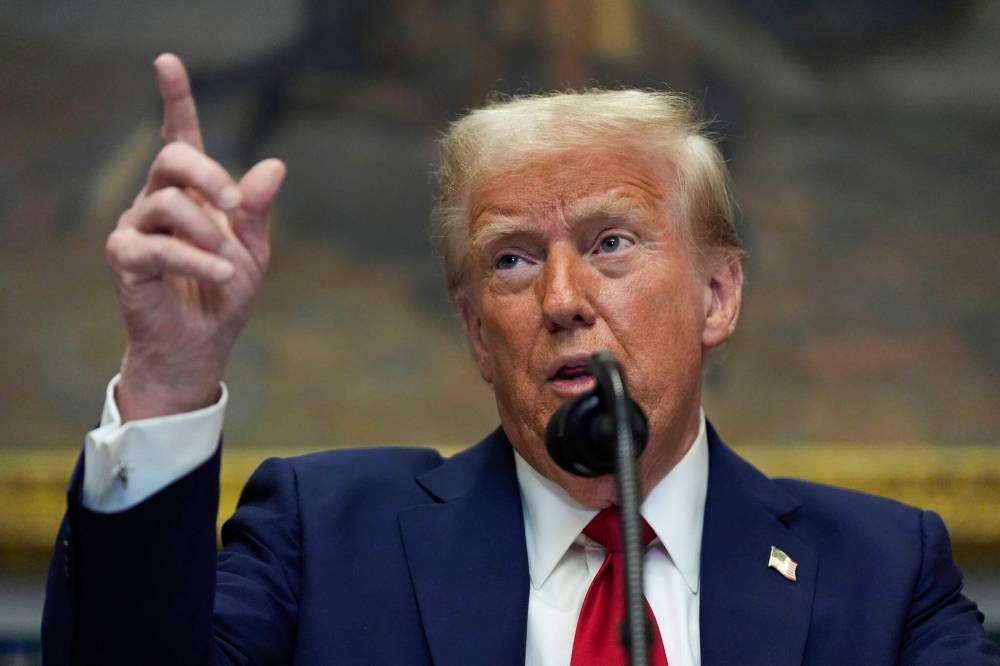
Birthright citizenship for Native Americans is becoming an issue under the administration of U.S. President Donald Trump. (Julia Demaree Nikhinson / Associated Press files)
“I love the Lumbee Tribe,” Trump said while signing the order. “They were with me all the way.”
This sounds positive but — as with most things since Trump took office — there’s chaos.
Trump’s recognition of the Lumbee has been condemned by the Eastern Band of Cherokee Indians, who also inhabit North Carolina and have argued for more than a century that the Lumbee are not a tribe but a “self-identifying” mixed-race group that has little ancestral and cultural connection.
“The Lumbees have a history of shifting claims, including claiming Cherokee ancestry and other historical tribes,” Cherokee Principal Chief Michell Hicks said in a statement. “Experts have repeatedly found that their claims cannot be verified through historical or genealogical evidence.”
According to their own self-published tribal history on their website, the Lumbee are “survivors of tribal nations from the Algonquian, Iroquoian, and Siouan language families, including the Hatteras, the Tuscarora, and the Cheraw” and — unlike most U.S. tribes who separated from urban communities — moved to cities and intermarried with other cultures and groups.
Achieving federal recognition means the Lumbee claims will compete with the Cherokee for the same lands, rights, and programs. In other words: territory, money, and power.
It’s just another example of the incredible chaos produced by the new president in and between Native American communities across Turtle Island.
Just this week, Native American leaders across the United States were scrambling after the Trump administration made the abrupt decision to freeze federal grants and loans — effectively stopping nearly a billion dollars in essential funding for tribal health care, youth programs, schools, environmental projects, farming, and law enforcement.
On Tuesday, a Washington judge granted an injunction to stop the Trump order and keep the money flowing.
At the same time, due to Trump’s order to round up and deport millions of immigrants by Immigration and Customs Enforcement, federal agents questioned, detained, and harmed Native Americans.
“My office has received multiple reports from Navajo citizens that they have had negative, and sometimes traumatizing, experiences with federal agents targeting undocumented immigrants,” Navajo president Buu Nygren said in Arizona.
Trump’s aggression has “raised concern among our tribal members, particularly regarding the potential targeting of our community by immigration agents,” Chippewa Cree Tribe chairman Harat BaRete said in Montana.
The moves have provoked tribes to lawyer up and evoke tribal rights.
“The Rosebud Sioux Tribe is in the process of assessing the legal effects of the unlawful and unconstitutional Trump administration executive orders and will fiercely defend against any threat to the sovereignty,” announced president Kathleen Wooden Knife in a published statement.
The relationship between the U.S. government and 574 federally recognized tribes is one of the most important administrative and economic relationships in our neighbour to the south.
The annual budget for Indian Affairs is US$4.7 billion, which not only oversees the administration of tribes and delivers essential programs, but operates as the conduit to how land, rights, and power are shared between Indigenous nations and the U.S. government.
This budget is on the chopping block due to Trump’s anti-diversity/equity inclusion and “efficiency” plans — the question is how much.
Then there is the ongoing saga of Trump’s end of the 14th amendment to the U.S. Constitution, also called “birthright citizenship.”
In one of this first executive orders, Trump eliminated it, justifying those he deemed “illegal” and therefore must be removed by ICE. A federal judge quickly blocked the order temporarily after nearly two dozen states mounted a legal challenge.
Native Americans have always been in a unique position in relation to the 14th amendment as they are obviously born in the U.S. but also pre-date it.
After a long legal debate, tribal citizens were granted U.S. citizenship in 1924.

Defending the Trump order to end birthright citizenship in court, justice department officials stated that because tribal nations are “sovereign,” Native Americans do not have the right to U.S. citizenship.
“The United States’ connection with the children of illegal aliens and temporary visitors is weaker than its connection with members of Indian tribes,” the justice department said. “If the latter link is insufficient for birthright citizenship, the former certainly is.”
This means that Indians, like immigrants, are fit to be removed under Trump.
Chaos.
niigaan.sinclair@freepress.mb.ca
Niigaan Sinclair is Anishinaabe from Peguis First Nation and a professor in the Department of Indigenous Studies at the University of Manitoba. He’s been a columnist for the Free Press since 2018. Read more about Niigaan.
Every piece of writing Niigaan produces is reviewed by an editing team before it is posted online or published in print — part of the Free Press‘s tradition, since 1872, of producing reliable independent journalism. Read more about Free Press’s history and mandate, and learn how our newsroom operates.
Our newsroom depends on a growing audience of readers to power our journalism. If you are not a paid reader, please consider becoming a subscriber.
Our newsroom depends on its audience of readers to power our journalism. Thank you for your support.
Niigaan Sinclair is Anishinaabe from Peguis First Nation and a professor in the Department of Indigenous Studies at the University of Manitoba. He’s been a columnist for the Free Press since 2018. Read more about Niigaan.
Every piece of writing Niigaan produces is reviewed by an editing team before it is posted online or published in print — part of the Free Press‘s tradition, since 1872, of producing reliable independent journalism. Read more about Free Press’s history and mandate, and learn how our newsroom operates.
Our newsroom depends on a growing audience of readers to power our journalism. If you are not a paid reader, please consider becoming a subscriber.
Our newsroom depends on its audience of readers to power our journalism. Thank you for your support.
Advertisement Advertise With Us
Advertisement Advertise With Us