

Free bus rides for all might be what’s needed to save Winnipeg Transit

Advertisement
Read this article for free:
or
Already have an account? Log in here »
To continue reading, please subscribe:

Digital Subscription
One year of digital access for only $205*
- Enjoy unlimited reading on winnipegfreepress.com
- Read the E-Edition, our digital replica newspaper
- Access News Break, our award-winning app
- Play interactive puzzles
*First annual payment billed as $205.00 + GST for one year. This annual subscription will automatically renew at $233.00 + GST every 52 weeks (10% off the regular annual price of $259.35). Offer available to new and qualified returning subscribers only. Cancel any time.
To continue reading, please subscribe:
Add Free Press access to your Brandon Sun subscription for only an additional
$1 for the first 4 weeks*
- Enjoy unlimited reading on winnipegfreepress.com
- Read the E-Edition, our digital replica newspaper
- Access News Break, our award-winning app
- Play interactive puzzles
*Your next Brandon Sun subscription payment will increase by $1.00 and you will be charged $17.95 plus GST for four weeks. After four weeks, your payment will increase to $24.95 plus GST every four weeks.
Read unlimited articles for free today:
or
Already have an account? Log in here »
Hey there, time traveller!
This article was published 10/12/2025 (284 days ago), so information in it may no longer be current.
When you look at the multitude of problems facing Winnipeg Transit — declining ridership, increasing costs and chronic concerns about safety — it becomes increasingly clear that some new, and even radical, ideas need to be embraced.
One such idea is eliminating fares to use the service. That might seem like a pipe dream until you acknowledge just how critically important public transit is for the future of all cities, including Winnipeg.
Robust transit ridership not only helps reduce carbon emissions — desperately needed to slow climate change — but also reduces the wear and tear on municipal infrastructure, adding years to the lifespans of roads, bridges and other transportation assets.
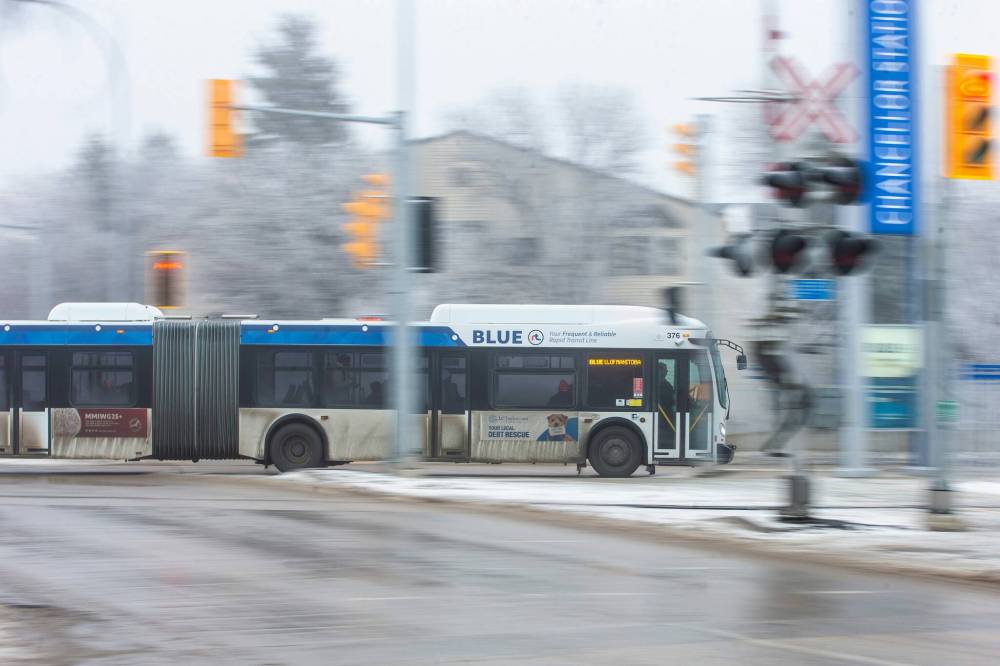
MIKAELA MACKENZIE / FREE PRESS FILES
Robust transit ridership not only helps reduce carbon emissions, but also reduces the wear and tear on municipal infrastructure.
Transit is also a tool that creates socio-economic opportunities for even the poorest of citizens, enabling them to move about the city.
Unfortunately, following the worst years of the pandemic, ridership has dropped in just about every city, threatening the viability of public transit.
Winnipeg is an excellent case in point.
This week, a City of Winnipeg committee was told Transit would earn $8.5 million less than budgeted for the current year, as nearly five million fewer rides were taken. Transit finance manager Laurie Fisher told the committee “the erosion of fare revenue” is a problem that has no easy explanation and, thus, no current solution.
The city is working to improve transit services with last summer’s launch of a redesigned network and improved schedules. Although city officials believe the new system will, ultimately, be better for most riders, there are concerns the transition — combined with ongoing concerns about safety — has discouraged some people from taking the bus.
And that is making Winnipeg Transit less viable.
It will cost roughly $264 million this year to operate the service. Fares and provincial grants contribute about $140 million, but the balance — about $124 million — has to be taken out of the city’s general revenues.
Despite the lost revenue from fewer rides, Winnipeg Transit is expected to end the year with a small surplus, thanks to lower costs of fuel and carbon taxes. However, unless paid ridership increases substantially in the next few years, it will find itself trapped in a revenue death spiral.
Fewer riders every year, against a backdrop of increasing costs.
It may seem counterintuitive to address the problem by eliminating fares. However, the broader analysis suggests the benefits would far outweigh the overall costs.
Increasingly, we’re seeing other cities, faced with the same dilemma as Winnipeg, taking that bold step.
In 2023, Iowa City, Iowa, decided to eliminate bus fares for two years on a pilot basis. Ridership rose above pre-pandemic levels by nearly 20 per cent. The city’s residents put 2.9 million fewer vehicle kilometres on city streets, reducing carbon emissions by 778 metric tons.
Of course, with only about 80,000 citizens, Iowa City might not make the best point of comparison with a city such as Winnipeg that is 10 times bigger. Thankfully, we are also starting to see larger jurisdictions launch similar initiatives.
Luxembourg, the landlocked western European nation bordered by Belgium, Germany and France, has a population of about 680,000. It made buses, trams and second-class train tickets free in 2020 and has experienced a 12 per cent increase in ridership over pre-pandemic levels and an eight per cent drop in CO2 emissions.
What about bigger jurisdictions?
When he was a member of the state assembly, New York City mayor-elect Zohran Mamdani helped launch a one-year pilot project that provided a free bus line in each of the city’s five boroughs. Service was faster, ridership on the free lines increased by as much as 38 per cent and — perhaps more importantly — 38 per cent fewer assaults were reported.
After he is sworn in on Jan. 1, Mamdani has promised to expand his “fast and free” vision for bus service within the Metropolitan Transportation Authority, arguing that increased revenue from vehicular-congestion pricing will help him cover the cost of citywide free bus service.
For advocates of free transit, there is a lot of excitement focused on Belgrade, a Serbian city of 1.7 million that eliminated fares at the beginning of 2025. No results have been made public yet, but the net impacts on ridership, infrastructure, emissions and safety will be of enormous value in determining the viability of free public transit.
Could Winnipeg jump on the free transit wave? It would take an enormous amount of support from the federal and provincial governments, as the city on its own would be unable to cover the nine figures of lost fare revenue.
If a deal could be cobbled together, however, the benefits to the city could be limitless.

Along with non-financial benefits such as lower CO2 emissions, there would be millions of fewer vehicle miles crossing city streets and bridges. Increased ridership could free the city from wasting billions of dollars on expanding over-burdened commuter routes.
For residents, it would mean faster commutes and greater safety by reducing injuries from vehicle collisions. That, in turn, would also bring down the cost of automobile insurance.
Unless something radical is done, Winnipeg will be faced with a transit system that is increasingly more expensive and less appealing to riders.
This is most definitely one of those situations where the costs of doing nothing are ultimately much larger than the costs of doing something bold.
dan.lett@winnipegfreepress.com
Dan Lett is a columnist for the Free Press, providing opinion and commentary on politics in Winnipeg and beyond. Born and raised in Toronto, Dan joined the Free Press in 1986. Read more about Dan.
Dan’s columns are built on facts and reactions, but offer his personal views through arguments and analysis. The Free Press’ editing team reviews Dan’s columns before they are posted online or published in print — part of the our tradition, since 1872, of producing reliable independent journalism. Read more about Free Press’s history and mandate, and learn how our newsroom operates.
Our newsroom depends on a growing audience of readers to power our journalism. If you are not a paid reader, please consider becoming a subscriber.
Our newsroom depends on its audience of readers to power our journalism. Thank you for your support.
Dan Lett is a columnist for the Free Press, providing opinion and commentary on politics in Winnipeg and beyond. Born and raised in Toronto, Dan joined the Free Press in 1986. Read more about Dan.
Dan’s columns are built on facts and reactions, but offer his personal views through arguments and analysis. The Free Press’ editing team reviews Dan’s columns before they are posted online or published in print — part of the our tradition, since 1872, of producing reliable independent journalism. Read more about Free Press’s history and mandate, and learn how our newsroom operates.
Our newsroom depends on a growing audience of readers to power our journalism. If you are not a paid reader, please consider becoming a subscriber.
Our newsroom depends on its audience of readers to power our journalism. Thank you for your support.
Related Articles
Transit loses millions in ridership revenue



Advertisement Advertise With Us
Advertisement Advertise With Us
History
Updated on Thursday, December 11, 2025 6:32 PM CST: Corrects to one-year pilot project from two