

City a bad host to Welcoming Winnipeg committee

Advertisement
Read this article for free:
or
Already have an account? Log in here »
To continue reading, please subscribe:

Digital Subscription
One year of digital access for only $205*
- Enjoy unlimited reading on winnipegfreepress.com
- Read the E-Edition, our digital replica newspaper
- Access News Break, our award-winning app
- Play interactive puzzles
*First annual payment billed as $205.00 + GST for one year. This annual subscription will automatically renew at $233.00 + GST every 52 weeks (10% off the regular annual price of $259.35). Offer available to new and qualified returning subscribers only. Cancel any time.
To continue reading, please subscribe:
Add Free Press access to your Brandon Sun subscription for only an additional
$1 for the first 4 weeks*
- Enjoy unlimited reading on winnipegfreepress.com
- Read the E-Edition, our digital replica newspaper
- Access News Break, our award-winning app
- Play interactive puzzles
*Your next Brandon Sun subscription payment will increase by $1.00 and you will be charged $17.95 plus GST for four weeks. After four weeks, your payment will increase to $24.95 plus GST every four weeks.
Read unlimited articles for free today:
or
Already have an account? Log in here »
Hey there, time traveller!
This article was published 15/12/2025 (300 days ago), so information in it may no longer be current.
The City of Winnipeg introduced the Welcoming Winnipeg committee, under the purview of its Indigenous relations division, during the pandemic in 2020.
After launching during such an inauspicious time, it’s perhaps unsurprising how complicated and frustrating the committee’s work has been since then.
In January 2019, after a great deal of public pressure to address problematic and divisive names of city streets, parks and markers, former mayor Brian Bowman announced a public engagement process to analyze sites and devise a citizen-led process to commemorate the history, diversity and contributors in the city.
An overwhelming message from a majority of Winnipeggers (most non-Indigenous) was that all spaces and names be reassessed and that Indigenous historical spaces, contributions and even the traditional names of places be reinstalled, if possible.
A process was created where individuals and groups could apply to the city for changes in installations that offer “a balanced perspective/story; honours Indigenous peoples as the original peoples of this land and the contemporary context in which Indigenous peoples continue to have relationship with this land; promotes Indigenous reclamation of land, space and/or language; offers an educational opportunity; and supports telling the complete history of Winnipeg.”
This birthed the idea of the committee, which would perform all of this and make recommendations to the mayor’s executive policy committee and, eventually, city council for approval.
Due to the findings of the public engagement, the committee was mandated to be made up half with Indigenous members, too.
At the time, it was an unprecedented, progressive idea, soliciting the interest and applications of academics, historians and local leaders to join the committee.
And work they did, wading through hundreds of sites, researching thousands of pages of documents and sifting through the near-endless applications by Winnipeggers — a monumental task.
The committee has had several notable achievements.
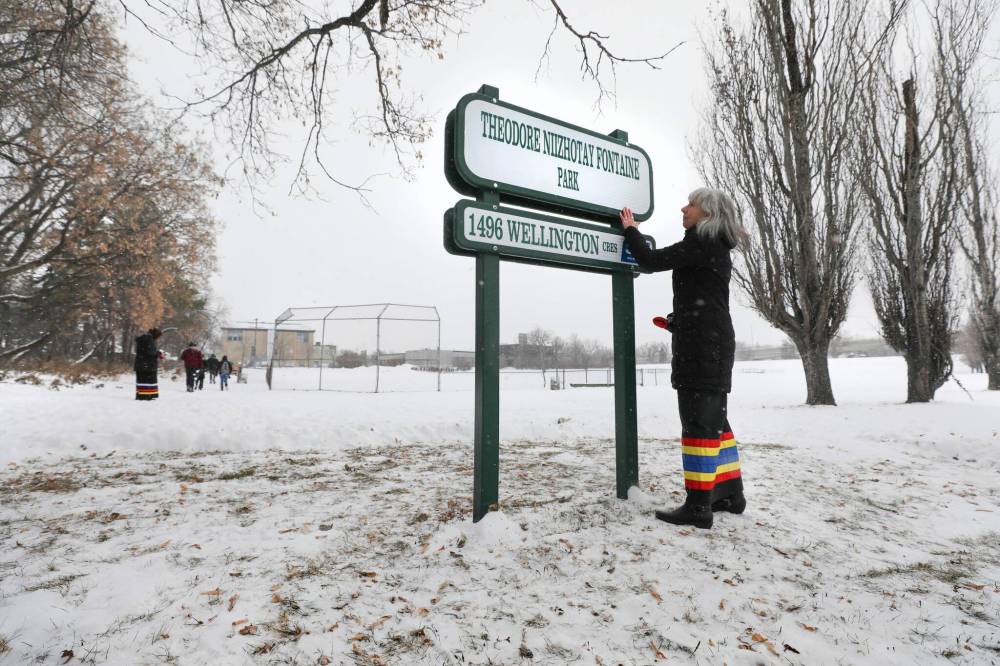
There is, of course, the lauded changes in June 2024 of Bishop Grandin Boulevard to Abinojii Mikanah and the renaming of Wellington Park to Theodore Niizhotay Fontaine Park.
There were also some smaller notable changes, such as the creation of the Dr. Jose Rizal statue and the renaming of Shady Shores Park to Waterside Rotary Park.
The work has gone at a frustratingly slow pace, with hundreds of applications and thousands of pages of research to wade through. This has created conflict.
For instance, in 2020, I assisted the Royal Aviation Museum of Western Canada in a commemorative project to honour the pilot and the eight residential school students from Bunibonibee Cree Nation who died in a 1972 plane crash.
The intention was to have the monument installed in time for the 50th anniversary of the crash, but the application was not approved by the committee until 2024, which deeply upset the leadership of Bunibonibee and the family members of the victims.
This is just one example.
The committee once numbered more than 10 people; it is now six after numerous resignations due to the sheer demand placed on the group and the criticism the committee receives.
This is mostly due to the fact the city really hasn’t resourced, supported or staffed the committee adequately.
It has no budget and is assisted by city bureaucrats in addition to their regular duties.
If anyone emails to request an update on the status of an application (as I know from personal experience), a response takes a month, if one comes at all.
Committee members, who all have full-time jobs yet are expected to attend one meeting per month, are only paid $75.
Then there is the role the committee plays in city governance, which is barely a blip.
For years committee members complained to whomever would listen — and went public to media recently — that city council members do not engage with, or even respect, the committee.
This year, the committee’s work was halted after a city report found its mandate was uncertain and conflicts were emerging between the committee’s goal to include Indigenous contributions and some Winnipeggers wanting other non-Indigenous commemorations.

The report listed over 20 recommendations in five areas to clarify the policy of the committee, review its mandate, identify a political advocate, provide a budget and redefine the application process.
At the time of the report, in February, Mayor Scott Gillingham said the committee is “not working as it could and I want it to be successful” and ordered a review about how the recommendations could be implemented.
Last month, city council approved a 90-day extension of the review — meaning that for one year, the committee will not have met or made progress on hundreds of applications.
It’s led to a frustrating and disheartening place — hardly welcoming — for the committee. There’s little hope in sight.
niigaan.sinclair@freepress.mb.ca
Niigaan Sinclair is Anishinaabe from Peguis First Nation and a professor in the Department of Indigenous Studies at the University of Manitoba. He’s been a columnist for the Free Press since 2018. Read more about Niigaan.
Every piece of writing Niigaan produces is reviewed by an editing team before it is posted online or published in print — part of the Free Press‘s tradition, since 1872, of producing reliable independent journalism. Read more about Free Press’s history and mandate, and learn how our newsroom operates.
Our newsroom depends on a growing audience of readers to power our journalism. If you are not a paid reader, please consider becoming a subscriber.
Our newsroom depends on its audience of readers to power our journalism. Thank you for your support.
Niigaan Sinclair is Anishinaabe from Peguis First Nation and a professor in the Department of Indigenous Studies at the University of Manitoba. He’s been a columnist for the Free Press since 2018. Read more about Niigaan.
Every piece of writing Niigaan produces is reviewed by an editing team before it is posted online or published in print — part of the Free Press‘s tradition, since 1872, of producing reliable independent journalism. Read more about Free Press’s history and mandate, and learn how our newsroom operates.
Our newsroom depends on a growing audience of readers to power our journalism. If you are not a paid reader, please consider becoming a subscriber.
Our newsroom depends on its audience of readers to power our journalism. Thank you for your support.
Related Articles
Thoroughfare that bore residential school proponent’s name now honours missing children in Indigenous language



Advertisement Advertise With Us
Advertisement Advertise With Us