

Cameron’s degrading, one-dimensional take on Indigenous people a money-making machine

Advertisement
Read this article for free:
or
Already have an account? Log in here »
To continue reading, please subscribe:
Monthly Digital Subscription
$1 per week for 24 weeks*
- Enjoy unlimited reading on winnipegfreepress.com
- Read the E-Edition, our digital replica newspaper
- Access News Break, our award-winning app
- Play interactive puzzles
*Billed as $4.00 plus GST every four weeks. After 24 weeks, price increases to the regular rate of $19.95 plus GST every four weeks. Offer available to new and qualified returning subscribers only. Cancel any time.
Monthly Digital Subscription
$4.99/week*
- Enjoy unlimited reading on winnipegfreepress.com
- Read the E-Edition, our digital replica newspaper
- Access News Break, our award-winning app
- Play interactive puzzles
*Billed as $19.95 plus GST every four weeks. Cancel any time.
To continue reading, please subscribe:
Add Free Press access to your Brandon Sun subscription for only an additional
$1 for the first 4 weeks*
*Your next subscription payment will increase by $1.00 and you will be charged $16.99 plus GST for four weeks. After four weeks, your payment will increase to $23.99 plus GST every four weeks.
Read unlimited articles for free today:
or
Already have an account? Log in here »
In James Cameron’s blockbuster film Avatar: Fire and Ash — the third entry in the director’s franchise, released this past weekend — there is a scene that attempts to represent a real-life ceremony Cameron witnessed in 2012 in Papua New Guinea.
“I heard that the Indigenous Baining people were in the mountains, and a local guide negotiated with the elders to let us go up there and film their fire ceremony,” Cameron explained to Condé Nast Traveler’s website.
“Right after dark, when the only light came from the fire and the moon, these guys danced the masks out of the forest; they looked vaguely humanoid but also animal. They went in and out of the woods, they let the fire burn to a big pile of embers, and then they ran through and kicked it so it would explode 20, 30 feet in the air… It was spectacular, honestly, the most amazing thing I had ever seen.”
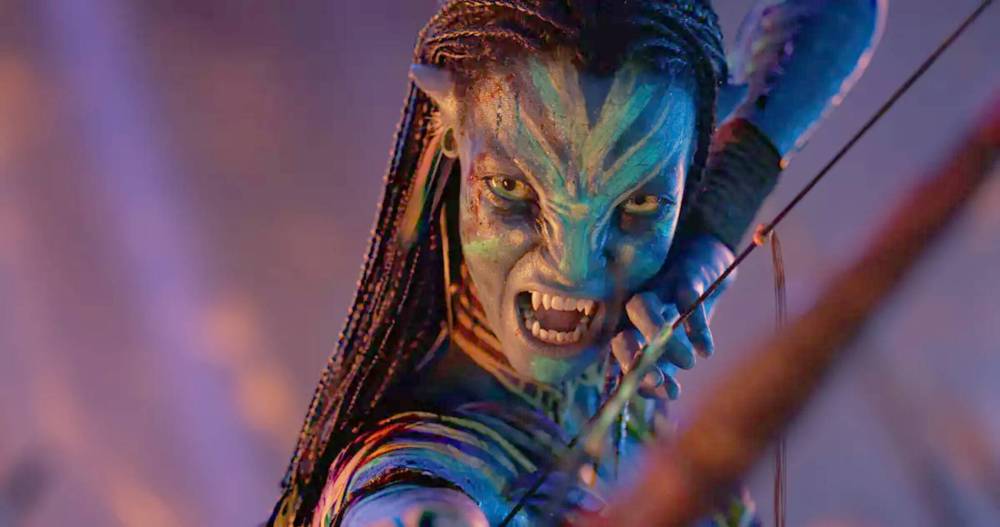
Zoe Saldaña as Neytiri in “Avatar: Fire and Ash.” (20th Century Studios/TNS)
The ceremony is restaged in the movie by beings called the Mangkwan, a brutally violent tribe of Na’vi (the Indigenous beings on the planet) who selfishly destroy the lives of others because their home was obliterated by a volcano, forcing them to live — literally — in ashes.
In the movie, the Mangkwan ally with the invading Americ… I mean, the humans, in trying to take over the planet of Pandora.
The alliance allows the Mangkwan to obtain guns and technology that can aid in their ability to pillage other Na’vi tribes (leaving them, ironically, also in ashes and presumably sharing their pain).
For humans, the bloodthirsty, savage nature of the Mangkwan make them perfect warriors to distract everyone while the planet’s valuable resources are stolen and sold for billions of dollars back on Earth.
The goal of both (and the primary conflict of the movie) is to install the Mangkwan in power and rid Pandora of the tribes of “good” Na’vi — who are split into various replicas of real-life, earthy Indigenous peoples such as the Metkayina (stand-ins for Maori) and the Omatikaya (who represent a hodgepodge of South American and North American cultures).
The worst of these “good” Na’vi is the protagonist of the first two Avatar movies; former-human and now-Na’vi Jake Sully, his Na’vi wife and a mixture of their biological and adopted human/Na’vi kids.
I’m sure I’ve confused you by this point so let me save you any more details and just say the movie is basically a series of degrading copies, one on top of the other, of real-life cultures and historical events from this world.
Cameron has stated many times how his Avatar films tell the stories of European colonization of the New World that began in the 15th century.
“Avatar is a science fiction retelling of the history of North and South America in the early colonial period,” Cameron said in 2012, “with all its conflict and bloodshed between the military aggressors from Europe and the Indigenous peoples.”
The problem is that the movies aren’t a retelling, but a drive-by skimming, of a history textbook the director probably received when he was going to high school in southern Ontario in the 1960s.
Nothing gets any nuance from Cameron. Not demonized newcomers or altruistic messianic saviours. Not Indigenous tails; the Na’vi have prehensile appendages that, among other things, allow them to communicate emotion. Not the ability to talk to animals or the blue of their skin that makes them blend into the trees, water and sky, making them a living (sort of) embodiment of a song from the Disney movie Pocahontas.
Cameron’s understanding of anything resembling real-life Indigenous cultures and communities is as one-dimensional as the director’s description of that 2012 ceremony by the Baining featuring masked Indigenous men running back and forth in a forest, kicking fire for no stated purpose other than entertaining tourists.
But the movies sure make money.
Avatar: Fire and Ash made $345 million worldwide on its opening weekend, paying off most of the film’s $400-million price-tag.
The last chapter, 2022’s Avatar: The Way of Water, made $435 million on its opening weekend on its way to a total $2.3 billion on screens around the world.
That box-office return is the third highest in history, behind only the first Avatar (2009) and Avengers: Endgame (2019).

Simply put, much of the world seems to love caricatures of history and, in particular, simplistic, stereotypical and one-dimensional representations of Indigenous peoples.
I know this is stating the obvious, but what’s most depressing is the missed opportunity. It’s clear that Cameron has met Indigenous peoples and attended ceremonies and witnessed traditions.
Instead of looking closely, asking questions and learning something, he has been far more interested in copying and pasting.
And doing it badly, creating more misrepresentations — and fire and ash — as a result.
niigaan.sinclair@freepress.mb.ca
Niigaan Sinclair is Anishinaabe and is a columnist at the Winnipeg Free Press.
Our newsroom depends on a growing audience of readers to power our journalism. If you are not a paid reader, please consider becoming a subscriber.
Our newsroom depends on its audience of readers to power our journalism. Thank you for your support.
Niigaan Sinclair is Anishinaabe and is a columnist at the Winnipeg Free Press.
Our newsroom depends on a growing audience of readers to power our journalism. If you are not a paid reader, please consider becoming a subscriber.
Our newsroom depends on its audience of readers to power our journalism. Thank you for your support.
Related Articles
'Avatar: Fire and Ash' launches with $88M domestically, $345M worldwide


Advertisement Advertise With Us
Advertisement Advertise With Us
History
Updated on Wednesday, December 24, 2025 11:11 AM CST: Corrects typo