

Carney’s response a concern after Trump goes looting in South America

Advertisement
Read this article for free:
or
Already have an account? Log in here »
To continue reading, please subscribe:

Digital Subscription
One year of digital access for only $205*
- Enjoy unlimited reading on winnipegfreepress.com
- Read the E-Edition, our digital replica newspaper
- Access News Break, our award-winning app
- Play interactive puzzles
*First annual payment billed as $205.00 + GST for one year. This annual subscription will automatically renew at $233.00 + GST every 52 weeks (10% off the regular annual price of $259.35). Offer available to new and qualified returning subscribers only. Cancel any time.
To continue reading, please subscribe:
Add Free Press access to your Brandon Sun subscription for only an additional
$1 for the first 4 weeks*
- Enjoy unlimited reading on winnipegfreepress.com
- Read the E-Edition, our digital replica newspaper
- Access News Break, our award-winning app
- Play interactive puzzles
*Your next Brandon Sun subscription payment will increase by $1.00 and you will be charged $17.95 plus GST for four weeks. After four weeks, your payment will increase to $24.95 plus GST every four weeks.
Read unlimited articles for free today:
or
Already have an account? Log in here »
Hey there, time traveller!
This article was published 05/01/2026 (272 days ago), so information in it may no longer be current.
Over the past year, Prime Minister Mark Carney has demonstrated an ability to push back against bullying by the United States without provoking the bully into a more aggressive response. Canada hasn’t prevailed in every skirmish with President Donald Trump, but our prime minister’s calm resolve has not made the situation worse.
Unfortunately, it appears Carney’s role as the nuanced bully whisperer may be reaching its best before date.
Following an attack on Venezuela on Saturday, and the arrest and extradition of Venezuelan President Nicolás Maduro and his wife, Trump has launched new and unfathomed threats against Canada and other countries in the Western Hemisphere.
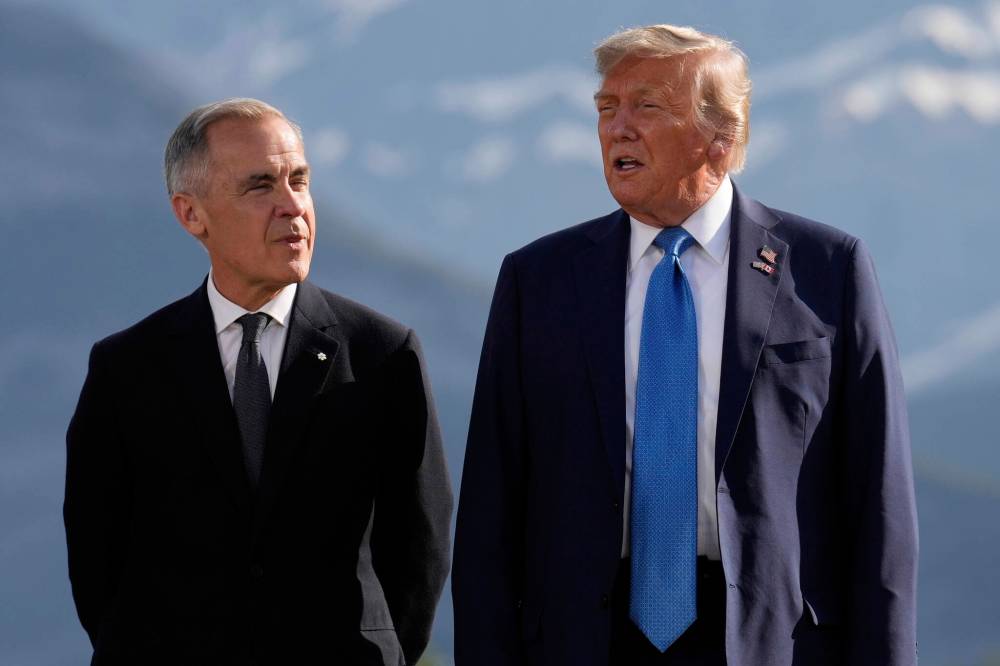
Prime Minister Mark Carney and U.S. President Donald Trump at the G7 Summit in June. It appears Carney’s role as the nuanced bully whisperer may be reaching its best before date, Dan Lett writes. (Mark Schiefelbein / The Associated Press files)
Maduro’s capture is not necessarily the issue of concern; the Venezuelan dictator was universally disavowed for his brutal repression and his clear involvement in the trafficking of illegal drugs. Canada previously condemned the Maduro regime and imposed economic sanctions.
The greater concern is Trump’s assertion the U.S. would “run” Venezuela or, at the very least, play an active role in picking a successor and take a direct hand in reviving the country’s flagging oil industry. And that these actions would signal a new era of American imperialism in the Western Hemisphere.
In the face of a threat like that, Carney’s response seems entirely insufficient.
“In keeping with our long-standing commitment to upholding the rule of law, sovereignty, and human rights, Canada calls on all parties to respect international law,” Carney said in a statement released over the weekend.
Calling on everyone to “respect international law” after the U.S. has signalled its intent to gut international law is sort of like calling on an arsonist “not to play with matches” after starting a raging house fire.
Carney’s response appears to be particularly weak-kneed in the wake of Trump’s reference to “the Monroe Doctrine,” an artifact of U.S. foreign policy that asserted a right to intervene and control all countries in the hemisphere.
Drafted in 1823 by then-president James Monroe, the doctrine asserted the right of the U.S. to combat meddling by foreign powers in the Americas. In December, “the Trump corollary” was added to the doctrine to “restore American pre-eminence in the Western Hemisphere.”
Following the attack, Trump suggested the U.S. would “run (Venezuela) until such time as we can do a safe, proper and judicious transition.” He also specifically noted he had put his own stamp on the Monroe Doctrine.
“And the Monroe Doctrine is a big deal, but we’ve superseded it by a lot, by a real lot,” Trump said. “They now call it the ‘Donroe doctrine.’”
How far would Trump go to enforce the Donroe doctrine? The president suggested he might invade Colombia — the single largest source of cocaine imported to North America — while also repeating his suggestion Greenland willingly join the U.S. to bolster continental security.
Although last year Trump suggested he might annex Canada, we have not been explicitly mentioned in Trump’s latest imperialist musings.
When Trump first mentioned Canada as the 51st state, Carney previously expressed Canada’s concerns in a firm but restrained fashion, making it clear that annexation was simply not on.
This time, Carney is just as restrained but far less firm, refusing to come right out and denounce Trump’s actions. Some have theorized the prime minister’s unwillingness to criticize Trump may be inspired by upcoming negotiations on the next iteration of the Canada-U.S.-Mexico Agreement.
CUSMA’s survival is, ultimately, the most important issue for Canada right now. Notwithstanding punitive Trump tariffs, the agreement still protects about 85 per cent of all the goods and services that move back and forth across North American borders.
But is soft-peddling criticism of Trump on Venezuela the best way to ease CUSMA negotiations? There are some who think the prime minister’s strategy is making us look weak at a time when we should appear strong.
Lloyd Axworthy, former Winnipeg Liberal MP and foreign affairs minister, has been consistent in criticizing Carney for being too compliant with Trump’s bullying. The failure to condemn the U.S. for its actions in Venezuela being the latest and, perhaps, gravest example of Carney’s capitulation, he said.
“We have to be really careful that in this effort to appease Trump in the hope of getting some sort of concession that we don’t surrender some of the basic values and commitments we have,” Axworthy told The Hill Times on Saturday.

Axworthy, and others, have pointed out the third party in the CUSMA deal, Mexico, has already strongly condemned the U.S. for its actions in Venezuela. It remains a bit of a mystery why Carney did not consider using a similar tone to create a united continental front before CUSMA negotiations start.
Other leaders who were quick to criticize Trump have suggested that anything less than a global condemnation of the Venezuelan invasion will embolden imperialist regimes in China and Russia to claim coveted territory from neighbours.
To date, Carney has used a deft touch to stickhandle through Trump’s bluster without drawing more of the bombastic president’s fire.
However, as Trump becomes emboldened to take what he wants from the hemisphere, when he wants, Carney may have to be reminded that his commitment to keeping his “elbows up” may also require him to “drop the gloves.”
dan.lett@freepress.mb.ca
Dan Lett is a columnist for the Free Press, providing opinion and commentary on politics in Winnipeg and beyond. Born and raised in Toronto, Dan joined the Free Press in 1986. Read more about Dan.
Dan’s columns are built on facts and reactions, but offer his personal views through arguments and analysis. The Free Press’ editing team reviews Dan’s columns before they are posted online or published in print — part of the our tradition, since 1872, of producing reliable independent journalism. Read more about Free Press’s history and mandate, and learn how our newsroom operates.
Our newsroom depends on a growing audience of readers to power our journalism. If you are not a paid reader, please consider becoming a subscriber.
Our newsroom depends on its audience of readers to power our journalism. Thank you for your support.
Dan Lett is a columnist for the Free Press, providing opinion and commentary on politics in Winnipeg and beyond. Born and raised in Toronto, Dan joined the Free Press in 1986. Read more about Dan.
Dan’s columns are built on facts and reactions, but offer his personal views through arguments and analysis. The Free Press’ editing team reviews Dan’s columns before they are posted online or published in print — part of the our tradition, since 1872, of producing reliable independent journalism. Read more about Free Press’s history and mandate, and learn how our newsroom operates.
Our newsroom depends on a growing audience of readers to power our journalism. If you are not a paid reader, please consider becoming a subscriber.
Our newsroom depends on its audience of readers to power our journalism. Thank you for your support.
Related Articles
Experts say Canada should co-ordinate Western Hemisphere response to Maduro's ouster



Advertisement Advertise With Us
Advertisement Advertise With Us
History
Updated on Monday, January 5, 2026 10:07 PM CST: Corrects multiple typos