

Is Trump channelling James Monroe?
Advertisement
Read this article for free:
or
Already have an account? Log in here »
To continue reading, please subscribe:
Digital Subscription
One year of digital access for only $1.44 a week*
- Enjoy unlimited reading on winnipegfreepress.com
- Read the E-Edition, our digital replica newspaper
- Access News Break, our award-winning app
- Play interactive puzzles
*Billed as $5.77 plus GST every four weeks. After 52 weeks, price increases to the regular rate of $19.95 plus GST every four weeks. Offer available to new and qualified returning subscribers only. Cancel any time.
To continue reading, please subscribe:
Add Free Press access to your Brandon Sun subscription for only an additional
$1 for the first 4 weeks*
- Enjoy unlimited reading on winnipegfreepress.com
- Read the E-Edition, our digital replica newspaper
- Access News Break, our award-winning app
- Play interactive puzzles
*Your next Brandon Sun subscription payment will increase by $1.00 and you will be charged $17.95 plus GST for four weeks. After four weeks, your payment will increase to $24.95 plus GST every four weeks.
Read unlimited articles for free today:
or
Already have an account? Log in here »
Hey there, time traveller!
This article was published 06/01/2026 (288 days ago), so information in it may no longer be current.
Let’s set to one side the trashing of Europe in U.S. President Donald Trump’s newly minted National Security Strategy. And let’s situate it within the context of Trump’s missile strikes against Venezuela and the capture of its president, Nicolás Maduro.
The real shift here is in the administration’s rediscovery of the Americas in the 21st century. We haven’t seen anything like this since the low-key Alliance for Progress initiative of the John F. Kennedy White House in the early 1960s.
But Kennedy’s program was less about exercising military power and hegemony and more about economic development, social reform and greater democratization.
AP Photo/Alex Brandon
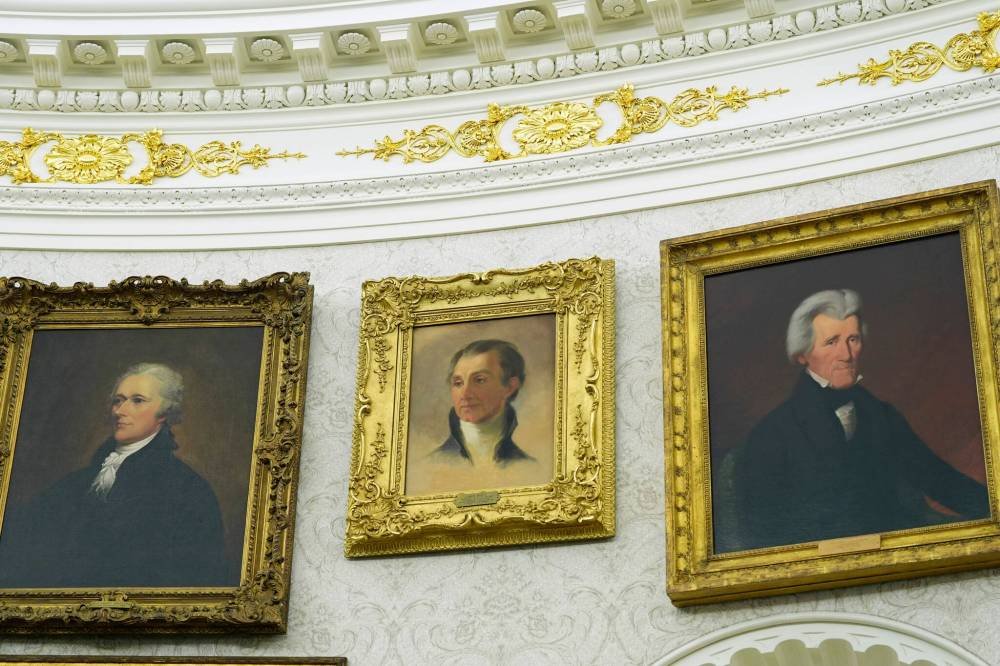
A portrait of former U.S. president James Monroe (centre) hanging in the Oval Office at the White House in April 2025.
With a funding commitment of US$20 billion over 10 years, the core idea was to promote revolutionary change in Latin America through peaceful means and financial inducements. Simply put, it called for the U.S. gunboats to return safely to port and to allow the locals to figure things out.
The Trump security strategy couldn’t be further from the message that Kennedy was trying to send to the people of the Americas. In fact, the bald reference in the opening pages to the “my way or the highway” Monroe Doctrine is stunningly jaw-dropping and unnerving.
Integrating issues such as migration, transnational criminal networks, foreign interference and drug trafficking, the Trump strategy points out that it wants to “ensure our continued access to key strategic locations” in the hemisphere. It then goes on to emphasize: “In other words, we will assert and enforce a ‘Trump Corollary’ to the Monroe Doctrine.”
The 1823 Monroe Doctrine, articulated in a state of the union address by then-president James Monroe, was intended to keep Spain from reconquering its former colonies in the Americas.
Monroe was adamant that “the American continents, by the free and independent condition which they have assumed and maintained, are henceforth not to be considered as subject for colonization by any European powers.”
The doctrine itself, though mostly crafted by then-secretary of state John Quincy Adams, was created to keep the Europeans out of America’s so-called “backyard.” At its heart was the critical notion that the U.S. was now the most dominant power in the hemisphere.
In the words of the latest security strategy: “After years of neglect, the United States will reassert and enforce the Monroe Doctrine to restore American pre-eminence in the Western Hemisphere and to protect our homeland and our access to key geographies throughout the region.” It goes on to add for good measure: “This ‘Trump Corollary’ to the Monroe Doctrine is a common-sense and potent restoration of American power and priorities, consistent with American security interests.”
Translation: don’t even think about challenging the supremacy of the United States in the Americas.
Of course, the “Trump Corollary” is a nod to the “Roosevelt Corollary” (to the Monroe Doctrine) of 1904 — a foreign policy directive on Latin America issued by U.S. President Theodore Roosevelt. As Roosevelt enunciated: “Chronic wrongdoing, or an impotence which results in a general loosening of the ties of society, may in America, or elsewhere, ultimately require intervention by some civilized nation … however reluctantly, in flagrant cases of such wrongdoing or impotence, to the exercise of an international police power.”
The message was clear: when it comes to Latin America and the Caribbean — especially when it involves outside or European encroachment — the U.S. will not hesitate to intervene at will.
In the wake of the Monroe Doctrine and the Roosevelt Corollary, the U.S. made a habit of militarily intervening in dozens of countries in Latin America and the Caribbean. Much of this sad record explains why the U.S. government is still viewed today with disdain and deep distrust by the people of the Americas.
Perhaps these recent menacing words and official intentions don’t mean much when it comes to the mercurial Trump. But what if they do?
We’ve already seen Trump talk about turning Canada into the 51st U.S. state, confiscating the Panama Canal and taking over Greenland. He has unlawfully blown out of the water alleged Venezuelan drug-smuggling boats and now unleashed direct attacks on Venezuela.
Trump has even mused out loud that he is prepared to intervene forcefully in Mexico to dismantle the drug cartels. Just the other day he made a point of saying that Colombia could be next now that Maduro’s Venezuela has been dealt with.

Although there is no specific reference to Canada or any nonsense about annexing this country, the National Security Strategy can still have significant implications for Ottawa. Indeed, much of Canada’s foreign policy interests are inextricably linked to international peace and security, global order and regional stability and war-avoidance and system-maintenance.
The truth is that the whole section on the Western Hemisphere reads like a page torn from the 19th century chapter of U.S.-Latin American relations. It sounds an awful lot like a modern-day version of “America for Americans,” “speak softly and carry a big stick” and “gunboat diplomacy.”
I hate to say it, but we’ve seen this movie before.
And it doesn’t end well for the U.S. or the people of the Americas.
Peter McKenna is professor of political science at the University of Prince Edward Island in Charlottetown.
Related Articles
White House says military 'always an option' in Greenland as European leaders reject US takeover

Advertisement Advertise With Us
Advertisement Advertise With Us