

PR loss as NDP’s friends criticize poverty reduction strategy

Advertisement
Read this article for free:
or
Already have an account? Log in here »
To continue reading, please subscribe:

Digital Subscription
One year of digital access for only $205*
- Enjoy unlimited reading on winnipegfreepress.com
- Read the E-Edition, our digital replica newspaper
- Access News Break, our award-winning app
- Play interactive puzzles
*First annual payment billed as $205.00 + GST for one year. This annual subscription will automatically renew at $233.00 + GST every 52 weeks (10% off the regular annual price of $259.35). Offer available to new and qualified returning subscribers only. Cancel any time.
To continue reading, please subscribe:
Add Free Press access to your Brandon Sun subscription for only an additional
$1 for the first 4 weeks*
- Enjoy unlimited reading on winnipegfreepress.com
- Read the E-Edition, our digital replica newspaper
- Access News Break, our award-winning app
- Play interactive puzzles
*Your next Brandon Sun subscription payment will increase by $1.00 and you will be charged $17.95 plus GST for four weeks. After four weeks, your payment will increase to $24.95 plus GST every four weeks.
Read unlimited articles for free today:
or
Already have an account? Log in here »
Hey there, time traveller!
This article was published 19/01/2026 (188 days ago), so information in it may no longer be current.
Families Minister Nahanni Fontaine had every reason to believe that her new poverty reduction strategy was going to be a triumph.
Flanked by Housing and Homelessness Minister Bernadette Smith, Fontaine unveiled a new array of supports last week for three demographic groups that have typically slipped through the cracks of the social safety net: youth leaving the child welfare system, seniors and children under five.
The support will come via improved resources for early childhood education and stable housing options for youth and seniors.
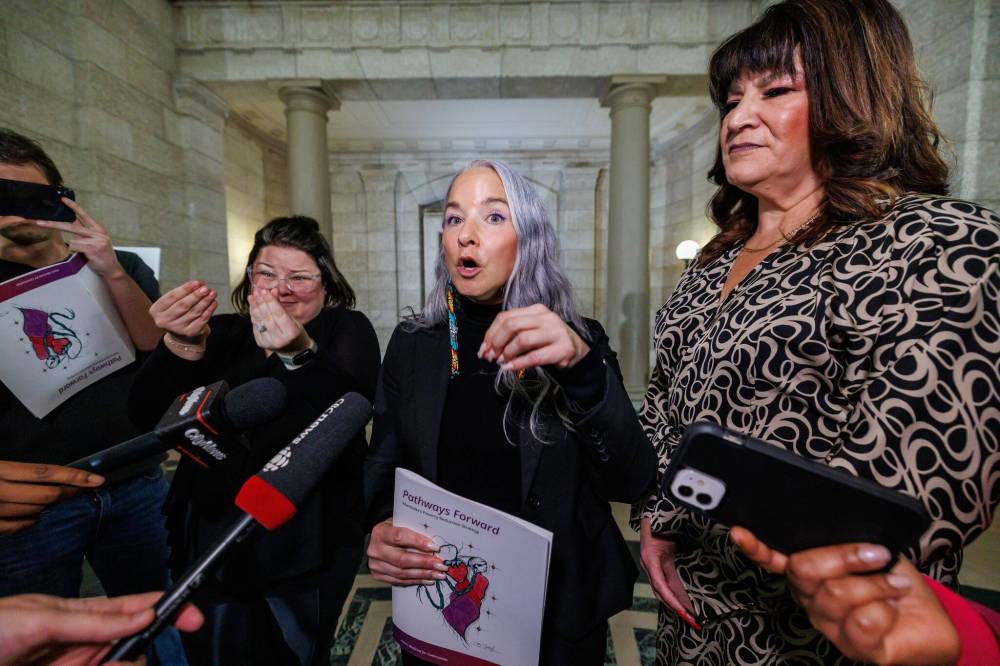
The grand rotunda of the Manitoba Legislative Building was full of organizations that work in supporting those living in poverty. It was all thoughtfully, if not deliberately, designed to give the NDP government a public relations win.
Unfortunately, the event fell short of the government’s expectations.
Instead of kudos, there were blank stares of concern and criticism. The consensus that simmered in the rotunda was that the new strategy, while worthy, wasn’t actually going to do that much to lift people out of poverty.
In particular, advocates, activists and officials from service agencies were blunt in pointing out there were no financial resources to boost the income of those living in poverty.
“We are disappointed that there’s not more substantial action in this report,” said Molly McCracken, chair of Make Poverty History Manitoba. “Given the rising income inequality and increases in poverty we’re seeing here in Manitoba, the strategy does not go far enough.”
Programs that promote health, well-being and housing stability are important adjunct elements to any effective poverty reduction strategy.
… only a meaningful effort to boost income can ensure that people escape the destructive poverty trap.
However, only a meaningful effort to boost income can ensure that people escape the destructive poverty trap. We know this because the greatest progress we’ve seen in reducing poverty came from mechanisms that put more money into their pockets.
The biggest and best example of this is the Canada child benefit, introduced in 2016 by former prime minister Justin Trudeau’s Liberal government. The benefit replaced a broad array of complex, boutique tax credits and benefits with a single monthly payment geared to income and the number of children in a household.
Currently, all families that earn less than $37,487 receive the maximum benefit of $7,997 annually per child under six and $7,748 per child between 6 and 17 years of age. Families that earn less than $81,222 are eligible to receive reduced amounts. The payments are inflation indexed.
Poverty is a difficult problem to measure in large part because there are wildly different definitions. Most social scientists would agree the Canada child benefit significantly reduced the number of children living in poverty. The bigger concern now is that even with indexing, the effectiveness of the benefit is being eroded by inflation and high housing costs.
Poverty is a difficult problem to measure in large part because there are wildly different definitions.
This is where the provinces are supposed to play a role in helping to boost income.
Most provinces provide their own income supports. In Manitoba, the two main pillars of support are Employment and Income Assistance and Rent Assist. The former is not indexed to inflation, and has not been increased since 2022; the latter was cut by the former Progressive Conservative government when it clawed back a portion of the benefit for those receiving EIA.
The NDP has not increased Rent Assist despite promising a significant boost during the 2023 election campaign. It did not promise nor has it made any attempt to index or increase the EIA.
There are other, more modest income supports offered by the province, like the Manitoba Child Benefit, which offers low-income families up to $420 annually per child. However, it’s pretty easy to see that this kind of benefit is a very small drop in a bucket that is being massively increased by inflation.
Not addressing the issue of income in a poverty reduction strategy is, quite frankly, like attempting to do life-saving surgery without a scalpel. Your intentions may be good, but ultimately, your efforts are doomed to fail.
Not addressing the issue of income in a poverty reduction strategy is, quite frankly, like attempting to do life-saving surgery without a scalpel.
Why would the NDP deliberately avoid measures to improve income? The obvious answer is because it would be expensive and the Kinew government has already blown hundreds of millions of dollars on “affordability” gestures that were not targeted to people in poverty.

Gasoline tax holidays and an electricity rate freeze were no doubt popular, but they are not effective ways of addressing poverty.
Broad-based tax cuts, credits, benefits or payments always provide more benefit to people on the higher end of the income spectrum. To get the full benefit of frozen Hydro rates and no-tax gasoline, you’d have to have a place to live and the disposable income to have your own vehicle. These two policies did next to nothing to help the people targeted by the poverty reduction strategy.
The best of best friends are the ones who will put aside their affection for you and tell you bluntly when you are making a mistake. The NDP’s friends have proven their worth by pointing out the massive flaws in this anti-poverty strategy.
Now, we can only hope the NDP are still listening to those friends.
dan.lett@freepress.mb.ca
Dan Lett is a columnist for the Free Press, providing opinion and commentary on politics in Winnipeg and beyond. Born and raised in Toronto, Dan joined the Free Press in 1986. Read more about Dan.
Dan’s columns are built on facts and reactions, but offer his personal views through arguments and analysis. The Free Press’ editing team reviews Dan’s columns before they are posted online or published in print — part of the our tradition, since 1872, of producing reliable independent journalism. Read more about Free Press’s history and mandate, and learn how our newsroom operates.
Our newsroom depends on a growing audience of readers to power our journalism. If you are not a paid reader, please consider becoming a subscriber.
Our newsroom depends on its audience of readers to power our journalism. Thank you for your support.
Dan Lett is a columnist for the Free Press, providing opinion and commentary on politics in Winnipeg and beyond. Born and raised in Toronto, Dan joined the Free Press in 1986. Read more about Dan.
Dan’s columns are built on facts and reactions, but offer his personal views through arguments and analysis. The Free Press’ editing team reviews Dan’s columns before they are posted online or published in print — part of the our tradition, since 1872, of producing reliable independent journalism. Read more about Free Press’s history and mandate, and learn how our newsroom operates.
Our newsroom depends on a growing audience of readers to power our journalism. If you are not a paid reader, please consider becoming a subscriber.
Our newsroom depends on its audience of readers to power our journalism. Thank you for your support.
Related Articles
Province’s poverty reduction strategy doesn’t go far enough, critics say
Advertisement Advertise With Us
Advertisement Advertise With Us