

Councillors brace for impact when provincial education property tax hikes crash into Winnipeggers’ mailboxes

Advertisement
Read this article for free:
or
Already have an account? Log in here »
To continue reading, please subscribe:

Digital Subscription
One year of digital access for only $205*
- Enjoy unlimited reading on winnipegfreepress.com
- Read the E-Edition, our digital replica newspaper
- Access News Break, our award-winning app
- Play interactive puzzles
*First annual payment billed as $205.00 + GST for one year. This annual subscription will automatically renew at $233.00 + GST every 52 weeks (10% off the regular annual price of $259.35). Offer available to new and qualified returning subscribers only. Cancel any time.
To continue reading, please subscribe:
Add Free Press access to your Brandon Sun subscription for only an additional
$1 for the first 4 weeks*
- Enjoy unlimited reading on winnipegfreepress.com
- Read the E-Edition, our digital replica newspaper
- Access News Break, our award-winning app
- Play interactive puzzles
*Your next Brandon Sun subscription payment will increase by $1.00 and you will be charged $17.95 plus GST for four weeks. After four weeks, your payment will increase to $24.95 plus GST every four weeks.
Read unlimited articles for free today:
or
Already have an account? Log in here »
Hey there, time traveller!
This article was published 18/03/2026 (205 days ago), so information in it may no longer be current.
The despondency in the voices of Winnipeg city councillors Jeff Browaty and Evan Duncan was palpable.
The two suburban councillors took the opportunity this week to slam the provincial NDP government for increases in the education portion of property taxes that many Winnipeg property owners will see later this spring when they receive their tax bills.
According to Browaty (North Kildonan) and Duncan (Charleswood-Tuxedo-Westwood), even though the tax increases are mostly due to provincial policies and school division decisions, the city will end up bearing the brunt of criticism.
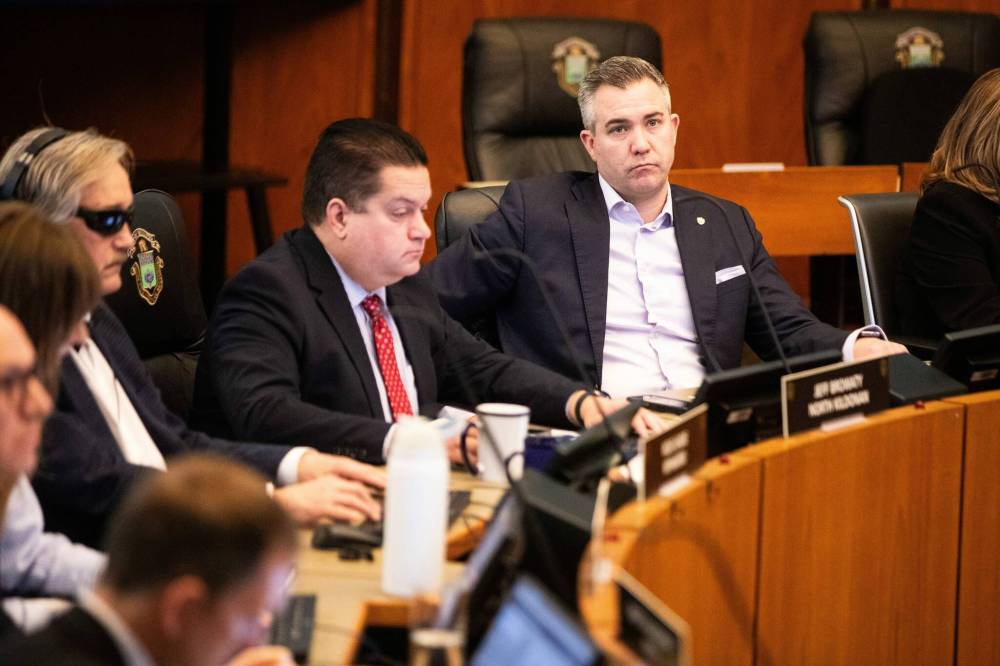
MIKAELA MACKENZIE / FREE PRESS FILES
According to councillors Jeff Browaty (North Kildonan) and Evan Duncan (Charleswood-Tuxedo-Westwood), the city will end up bearing the brunt of criticism for tax increases even though they’re mostly the result of provincial policies and school division decisions.
“I’d like to see them take accountability and ownership of it,” said Duncan, pointing south from city hall to the Manitoba legislature.
Duncan and Browaty are, of course, referring to the fact that while property taxes fund both municipal services and public education, both levies appear on the same bill and are paid at the same time.
Many homeowners likely do understand the dual purposes of property taxes. But many do not, and when a change in policy at the provincial level or a particularly steep mill rate increase from a school division increases the education portion of the tax bill, it is true that city hall usually gets most of the grief.
Although the two councillors are worthy of some sympathy for this injustice, they are both patently aware of how we got into our current property tax dilemma.
The former PC government under premiers Brian Pallister and Heather Stefanson drastically underfunded public education during its eight years in office, while also putting a cap on the size of annual education tax bumps. And what did the Tories do with all the money they were saving from funding public education? They channelled it back into enormous property tax rebates.
Starting with Pallister, and then continued by Stefanson, the Tories ultimately handed back 50 per cent of the education portion of property taxes, a policy that drained hundreds of millions of dollars from the provincial treasury.
To understand the enormity of that tax cut, you need only look at the windfall experienced by Pallister on his personal home.
In 2021, a few weeks after the Tories introduced their enhanced rebate, we learned Pallister was due to receive a $4,000 discount on the taxes for his 9,000-square-foot, $2.4-million Wellington Crescent mansion. Pallister sold the home later that year after he was ousted as leader of the PC party, but if he had kept it until 2023, when the rebate was boosted to 50 per cent, he could have received $8,000.
In the 2024-25 NDP budget, the first following its election win in the 2023 general election, Premier Wab Kinew elected to cap the rebate at $1,500, a pretty big political risk at the time. Tories howled that this was tantamount to a tax increase, but hardly anyone wanted to defend the gratuitous rebates designed by Pallister et al.
The huge school division hikes in property taxes are directly attributable to the Pallister-Stefanson rebate plan, which completely ignored the true costs of public education.
The NDP moved quickly after winning the 2023 election to boost direct funding to school divisions, cap the rebate at $1,500 and remove the property tax cap, meaning that school divisions could backfill the financial holes created by Tory austerity. Some homeowners will bristle at the size of the increases, but public education is a core function of government.
As disingenuous as they are about the origin story of our current property tax dilemma, the rant by Browaty and Duncan is spot-on about one thing: Manitoba’s current system for funding education is a hot mess.
The hybrid taxation model — in which education is co-financed by direct provincial funding and a portion of property taxes — is archaic and opaque. Manitoba premiers have, for more than a generation, mused about removing education from property tax bills, but the enormous upfront costs have discouraged anyone from giving it a shot.

Public education is a $3-billion system funded directly by government ($2 billion) and through education property taxes ($1 billion). Within provincial government expenditures, more than $472 million is returned to property owners through the Homeowners Affordable Tax Credit.
To remove the burden of public education from homeowners entirely, the province would have to maintain its current expenditures on the HATC and other credits for renters and seniors, and also cover the remaining funds generated by the education portion of property taxes. It’s not a stretch to suggest that, over the long term, this is a challenge measured in billions, not millions, of dollars.
To even contemplate this kind of a shift, the province would have to reduce support to municipalities, with the understanding they could backfill some of the reduction by increasing property taxes. That is such a tricky and potentially dangerous political challenge, it has discouraged political leaders in this province from engaging in any meaningful fashion.
For now, all we can hope for is that elected officials at both the local and provincial level talk honestly about what is driving property tax increases, with the knowledge that under-funding public education — or any core service, for that matter — leads to the creation of fiscal time bombs.
dan.lett@freepress.mb.ca
Dan Lett is a columnist for the Free Press, providing opinion and commentary on politics in Winnipeg and beyond. Born and raised in Toronto, Dan joined the Free Press in 1986. Read more about Dan.
Dan’s columns are built on facts and reactions, but offer his personal views through arguments and analysis. The Free Press’ editing team reviews Dan’s columns before they are posted online or published in print — part of the our tradition, since 1872, of producing reliable independent journalism. Read more about Free Press’s history and mandate, and learn how our newsroom operates.
Our newsroom depends on a growing audience of readers to power our journalism. If you are not a paid reader, please consider becoming a subscriber.
Our newsroom depends on its audience of readers to power our journalism. Thank you for your support.
Dan Lett is a columnist for the Free Press, providing opinion and commentary on politics in Winnipeg and beyond. Born and raised in Toronto, Dan joined the Free Press in 1986. Read more about Dan.
Dan’s columns are built on facts and reactions, but offer his personal views through arguments and analysis. The Free Press’ editing team reviews Dan’s columns before they are posted online or published in print — part of the our tradition, since 1872, of producing reliable independent journalism. Read more about Free Press’s history and mandate, and learn how our newsroom operates.
Our newsroom depends on a growing audience of readers to power our journalism. If you are not a paid reader, please consider becoming a subscriber.
Our newsroom depends on its audience of readers to power our journalism. Thank you for your support.
Related Articles
City councillors fear backlash over tax bills thanks to huge increases in education portion
Advertisement Advertise With Us
Advertisement Advertise With Us