

Chief justice’s last act ‘revolutionary’ step forward

Advertisement
Read this article for free:
or
Already have an account? Log in here »
To continue reading, please subscribe:

Digital Subscription
One year of digital access for only $205*
- Enjoy unlimited reading on winnipegfreepress.com
- Read the E-Edition, our digital replica newspaper
- Access News Break, our award-winning app
- Play interactive puzzles
*First annual payment billed as $205.00 + GST for one year. This annual subscription will automatically renew at $233.00 + GST every 52 weeks (10% off the regular annual price of $259.35). Offer available to new and qualified returning subscribers only. Cancel any time.
To continue reading, please subscribe:
Add Free Press access to your Brandon Sun subscription for only an additional
$1 for the first 4 weeks*
- Enjoy unlimited reading on winnipegfreepress.com
- Read the E-Edition, our digital replica newspaper
- Access News Break, our award-winning app
- Play interactive puzzles
*Your next Brandon Sun subscription payment will increase by $1.00 and you will be charged $17.95 plus GST for four weeks. After four weeks, your payment will increase to $24.95 plus GST every four weeks.
Read unlimited articles for free today:
or
Already have an account? Log in here »
Weeks before being nominated to the Supreme Court of Canada, Manitoba Court of King’s Bench Chief Justice Glenn Joyal rendered one of the most remarkable decisions in this province’s history.
You may not have heard about it, but it was a big one — and not just in the financial sense but in a change-the-face-of-this-province kind of way.
In October 2022, three First Nations chiefs joined with the Assembly of Manitoba Chiefs and launched a proposed class-action lawsuit seeking $2.1 billion in damages for three decades of harms by child and family services agencies run by the provincial and federal governments.
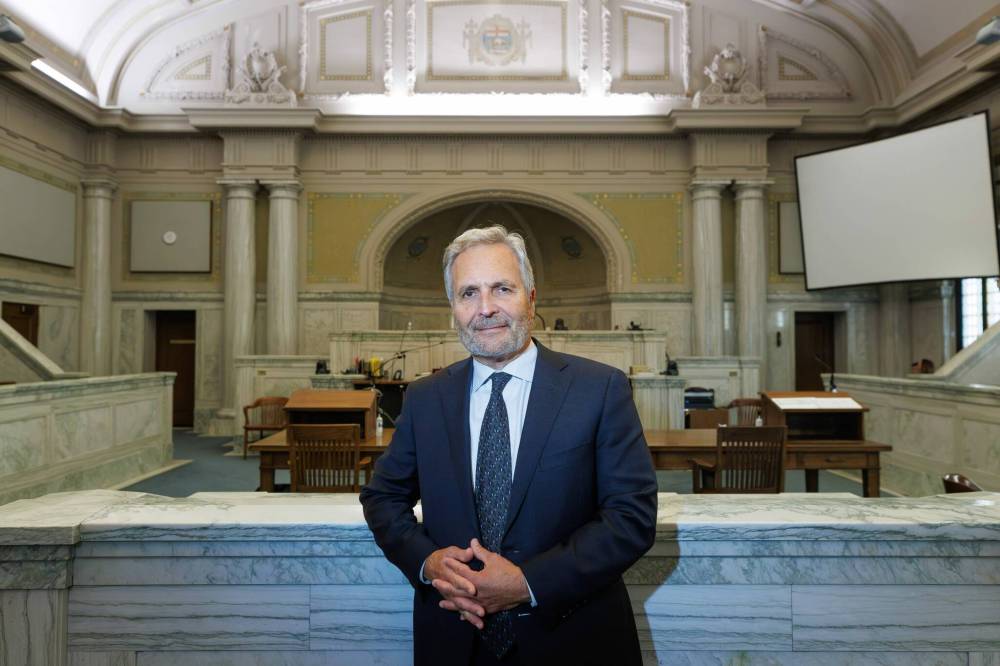
MIKE DEAL / FREE PRESS FILES
Glenn Joyal, as Chief Justice of Court of King’s Bench, issued a remarkable landmark ruling in May that will change the face of Indigenous relations, Sinclair writes.
Joyal presided over the case in one of his last duties as chief judge of Manitoba’s Court of King’s Bench.
In his May 11 decision, he wrote that the “plaintiffs sought monetary, declaratory and injunctive relief for collective harms” that violated their right to self-government and resulted in “loss of language, culture, spirituality, and identity. Those harms are alleged to have been caused by the separation of First Nations children (under the age of 18) from their lands and communities (on and off reserve) through the child welfare system in Manitoba.”
Joyal not only certified the class action lawsuit (potentially allowing 60 other First Nations to join the first three) but he issued a summary judgment determining that further court proceedings were not necessary to prove Manitoba and Canada violated the rights of First Nations.
Due to this decision, a number of things will happen.
First, 60 First Nations must determine whether their members have been harmed by provincial- or federal-run CFS agencies since Jan. 1, 1992 (the start date of the class action) and join the case.
With every addition, millions will be added to the $2.1 billion claim and a to-be-determined negotiated agreement.
But that’s not the big part.
Joyal’s decision means that Canadian legislators have to grapple with the fact provincial- and federal-run CFS agencies — many of which still operate — continue to harm children by the mere sake of asserting control over them.
This ain’t some small number of impacted individuals.
Manitoba’s families department said there were 9,172 youth in care in 2025 — with approximately 90 per cent of them (or 8,254) Indigenous.
Some of these are in one of the province’s 18 First Nations-run CFS agencies. Many are not.
Joyal’s decision puts immense pressure to hand over control of First Nations children currently in the system to First Nations-run agencies.
These changes would require investment, support, and a radical alteration to the ways CFS operates in Manitoba.
This is why Joyal appears to have done what virtually no other judge, including those on the Supreme Court, has done.
Referencing recent federal legislation recognizing Indigenous rights in Paragraph 618 of his decision, Joyal says simply that First Nations have a “right of self-government in the area of CFS.”
This is the judicial equivalent of a mic drop.
For years, judicial bodies throughout Canada — and especially the Supreme Court — have recognized that various forms of harm have been perpetrated upon First Nations but only recently sought remedies to stop that harm.
These remedies have basically said more investment is needed in the status quo.
The most well known is the 2016 Canadian Human Rights Tribunal ruling (later upheld by federal courts) that determined the government of Canada wilfully and recklessly discriminated against First Nations children by underfunding on-reserve child welfare and failing to properly implement Jordan’s Principle, which states children must have equal access to social and health services.
The ordered settlement by the tribunal required Ottawa to invest billions to adequately fund on-reserve CFS service delivery but not significantly change the system from what it is.
This is why for the past 10 years the implementation of the tribunal ruling has been slow and mired in political fighting, with little change beyond a relatively small regional agreement with Ontario First Nations.
Joyal’s decision is the pronouncement that, by not handing over the welfare of First Nations children immediately to Indigenous-run CFS agencies, Canadian governments will be violating First Nations rights to self-government — and breaking the law.

This week, my Free Press colleague Dan Lett wrote a column suggesting Joyal’s Supreme Court nomination comes after years of what he called “compassionate and empathic” gestures in the vein of truth and reconciliation with Indigenous peoples.
He referenced Joyal’s apology for wrongful convictions, incorporation of Indigenous cultural protocols in court proceedings, and a sensitivity surrounding the imbalanced relationships Indigenous peoples have with the Manitoba justice system.
In his likely final act as one of Manitoba’s top judges, Joyal forced this province to take a revolutionary step to return First Nations children home once and for all.
It’s a decision that may just end up in the institution he has just been nominated to.
niigaan.sinclair@freepress.mb.ca
Niigaan Sinclair is Anishinaabe from Peguis First Nation and a professor in the Department of Indigenous Studies at the University of Manitoba. He’s been a columnist for the Free Press since 2018. Read more about Niigaan.
Every piece of writing Niigaan produces is reviewed by an editing team before it is posted online or published in print — part of the Free Press‘s tradition, since 1872, of producing reliable independent journalism. Read more about Free Press’s history and mandate, and learn how our newsroom operates.
Our newsroom depends on a growing audience of readers to power our journalism. If you are not a paid reader, please consider becoming a subscriber.
Our newsroom depends on its audience of readers to power our journalism. Thank you for your support.
Niigaan Sinclair is Anishinaabe from Peguis First Nation and a professor in the Department of Indigenous Studies at the University of Manitoba. He’s been a columnist for the Free Press since 2018. Read more about Niigaan.
Every piece of writing Niigaan produces is reviewed by an editing team before it is posted online or published in print — part of the Free Press‘s tradition, since 1872, of producing reliable independent journalism. Read more about Free Press’s history and mandate, and learn how our newsroom operates.
Our newsroom depends on a growing audience of readers to power our journalism. If you are not a paid reader, please consider becoming a subscriber.
Our newsroom depends on its audience of readers to power our journalism. Thank you for your support.
Advertisement Advertise With Us
Advertisement Advertise With Us
History
Updated on Saturday, July 4, 2026 10:32 AM CDT: Fixes typo
Updated on Tuesday, July 21, 2026 2:19 PM CDT: Corrects references to Manitoba's top judge, clarifying Joyal was chief justice of Manitoba's Court of King's Bench