

Police resuming drug-enforcement crackdown, working with outreach community

Advertisement
Read this article for free:
or
Already have an account? Log in here »
To continue reading, please subscribe:

Digital Subscription
One year of digital access for only $205*
- Enjoy unlimited reading on winnipegfreepress.com
- Read the E-Edition, our digital replica newspaper
- Access News Break, our award-winning app
- Play interactive puzzles
*First annual payment billed as $205.00 + GST for one year. This annual subscription will automatically renew at $233.00 + GST every 52 weeks (10% off the regular annual price of $259.35). Offer available to new and qualified returning subscribers only. Cancel any time.
To continue reading, please subscribe:
Add Free Press access to your Brandon Sun subscription for only an additional
$1 for the first 4 weeks*
- Enjoy unlimited reading on winnipegfreepress.com
- Read the E-Edition, our digital replica newspaper
- Access News Break, our award-winning app
- Play interactive puzzles
*Your next Brandon Sun subscription payment will increase by $1.00 and you will be charged $17.95 plus GST for four weeks. After four weeks, your payment will increase to $24.95 plus GST every four weeks.
Read unlimited articles for free today:
or
Already have an account? Log in here »
Winnipeg police are relaunching a drug enforcement campaign in some neighbourhoods Friday after they say a 10-day sweep led to more than 100 arrests and a drop in reported crime earlier this summer.
Police said the renewed initiative, targeting open drug use and trafficking, will continue into November with an outreach-first approach and a partnership with a coalition of community groups in response to criticism of the initial campaign.
“While there was a great deal of support for the enforcement actions we undertook to address public safety issues, there was also criticism about the lack of collaboration,” Winnipeg Police Service Chief Gene Bowers told reporters.
“At that time, I acknowledged that community organizations should have been part of our efforts. Hence, we’re here today.”
MIKE DEAL / FREE PRESS WPS Chief Gene Bowers says community outreach teams will work with uniformed officers on continued drug-enforcement efforts.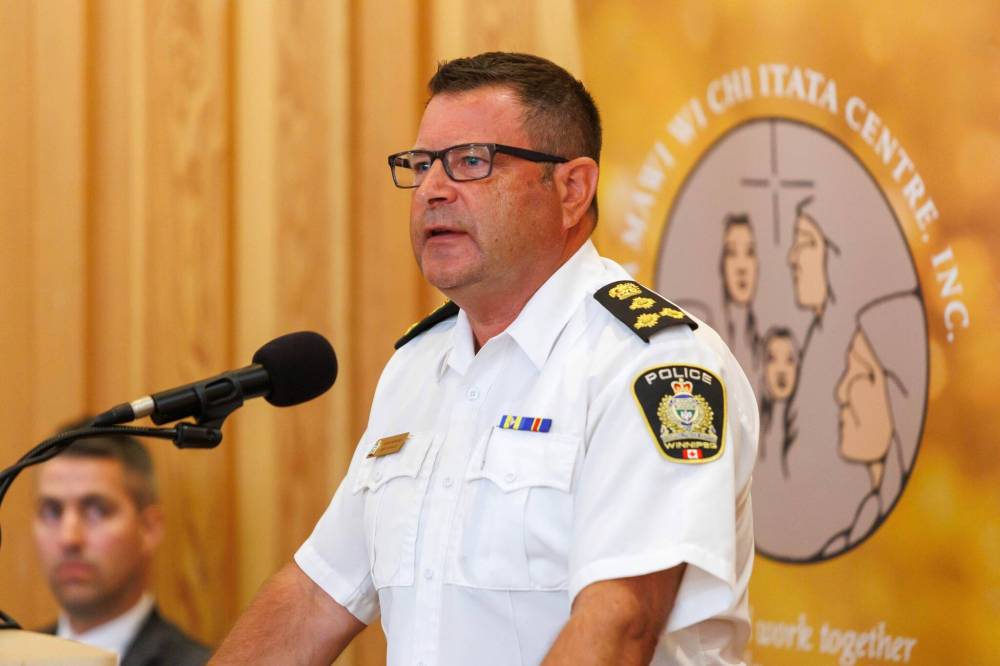
Bowers said the “marked difference” is that community outreach teams will work with uniformed officers to provide help on the spot or to connect people with resources and services they require during the renewed campaign.
The target group includes people who are homeless and/or addicted to drugs.
“We want to have the different community groups there to engage with the people to ensure they’re getting a referral and a follow-up,” Bowers said.
“We want to have the different community groups there to engage with the people to ensure they’re getting a referral and a followup.”
Enforcement isn’t a solution, but it has a place, he said. The campaign will be reassessed in November to determine where it will go from there.
David Bowman, a data analyst and director of organizational development and support with the WPS, said officers will continue to focus on areas such as downtown, Point Douglas and Osborne Village.
Decisions about locations are partly based on police, fire and paramedic data, including reports of crime and where drug overdoses occur more frequently.
The 10-day sweep, which began June 24, focused on the downtown, Point Douglas, Osborne Village, West End and West Broadway areas after complaints about drug use and social disorder.
MIKE DEAL / FREE PRESS David Bowman, a data analyst and director of organizational development and support with the WPS, said officers will continue to focus on downtown, Point Douglas and Osborne Village.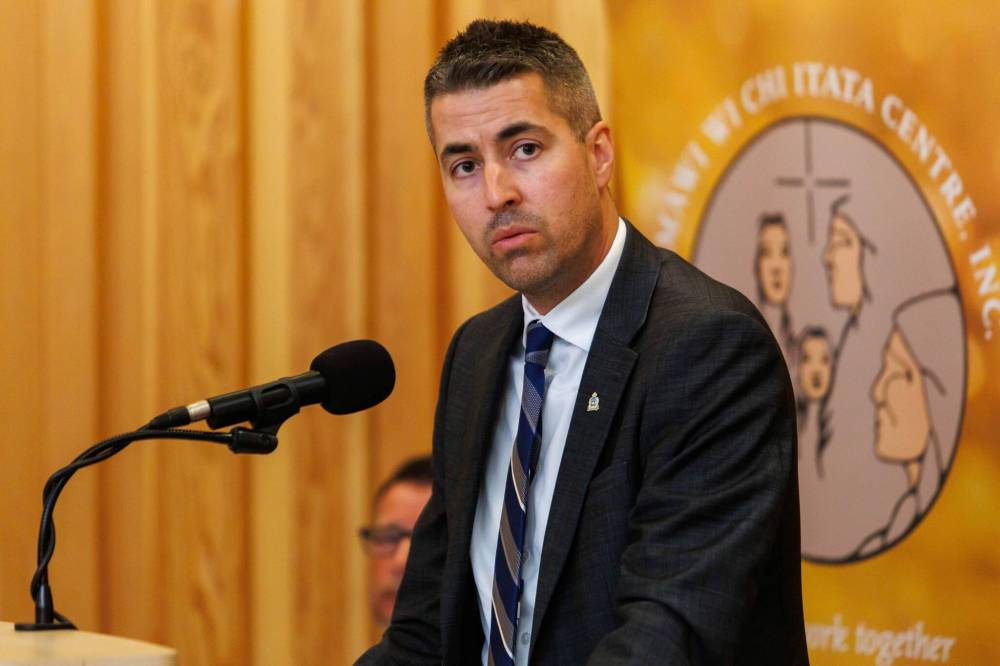
Downtown and Point Douglas had the highest rates of naloxone administrations by Winnipeg Fire Paramedic Service members. Naloxone is a medication used to temporarily reverse opioid overdoses.
Bowman said the initiative involved 1,099 officer-generated and related calls for service, and 106 arrests, including 93 for warrants and/or breaches of release conditions.
Three arrests were drug trafficking-related and five were for drug possession. Seven people were taken to the drug detox centre at 200 Disraeli Fwy.
Bowers said additional drug-related investigations happened in the background. The number of naloxone administrations over the 10-day period was not available.
Bowman said crime and public disorder increased in the “hot spots” within the project’s boundaries in the four weeks before the first campaign began.
During the sweep, reports of violent crime in those areas were 16.5 per cent lower than the same period in 2025, and property crime reports were down 10.5 per cent, police said. Emergency calls were six per cent lower.
The original campaign was met by criticism from some groups who said they were not consulted to ensure supports were available to people during or after encounters with police.
That led to meetings between police and some community organizations, leading to a partnership between WPS and an Indigenous-led coalition of 11 groups, including Ka Ni Kanichihk, which provides prevention and intervention programs.
Jackie Anderson, executive director of Ka Ni Kanichihk, said the coalition formed to work with WPS using an Indigenous model of care.
“This model recognizes that many of our relatives remain on the streets because of trauma, complex needs and a lack of accessible resources,” Anderson said.
MIKE DEAL / FREE PRESS “This model recognizes that many of our relatives remain on the streets because of trauma, complex needs and a lack of accessible resources,” says Jackie Anderson, executive director of Ka Ni Kanichihk.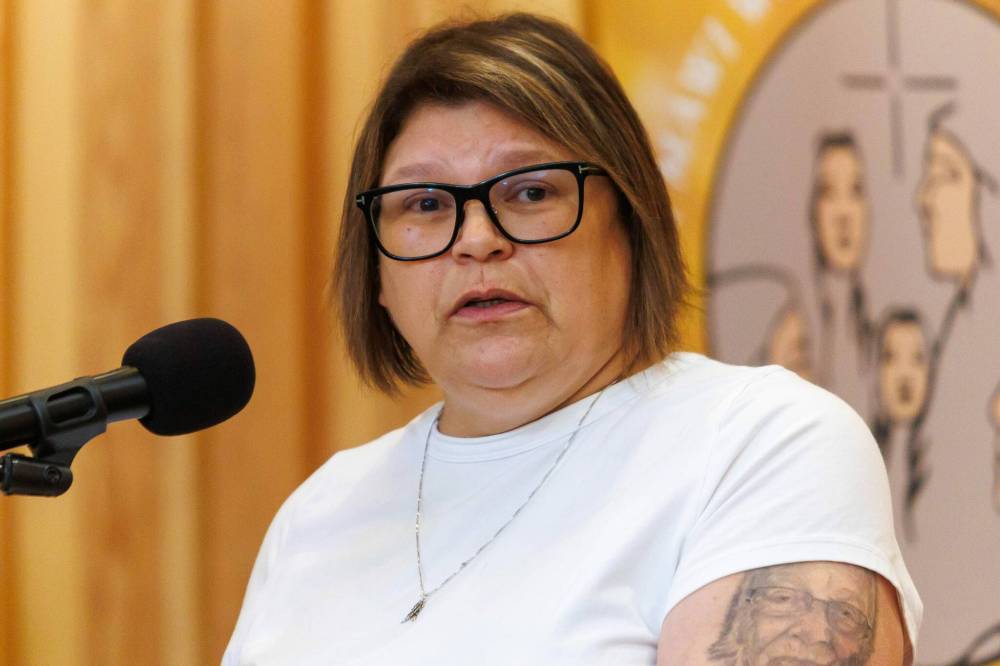
She said Indigenous outreach organizations will lead the engagement to try to connect people with supports such as emergency shelter, detox or reunification with family in their home communities, where appropriate.
A dedicated co-ordinator from Ka Ni Kanichihk will work closely with police. Anderson said additional funding is needed for wraparound supports and services.
When the first sweep began, some groups said drug users would be pushed into less visible places, increasing the likelihood of tragic outcomes.
“This model recognizes that many of our relatives remain on the streets because of trauma, complex needs and a lack of accessible resources.”
Kate Sjoberg, executive director of West Broadway-based Resource Assistance for Youth, said the non-profit and some other groups decided to step away from the meetings with police because it became clear after the second meeting there was an intention to move toward the plan announced Thursday.
“For RaY, it was because this idea of coupling outreach and police work (and) that’s not an approach that’s backed up by any evidence,” Sjoberg said. “It’s unclear what the practical application of that approach is actually for.”
People who have negative interactions with police can become less trusting or less interested in obtaining support, she said.
Sjoberg said Winnipeg lacks detox spaces, and rapid access to addictions medicine clinics are very busy, raising questions about whether people will be able to access care if and when they are referred.
Susan Lockhart, president of the Just Like New to You thrift store on Portage Avenue, near Sherbrook Street, welcomed the project’s extension.
“I’m very happy to hear about the outreach and support for the population and their needs,” she said.
Lockhart raised concerns earlier this year about crime, open drug use, overdoses and safety near the store.
She said the 10-day sweep made a difference, but it was a “Band-Aid,” with the same problems returning afterward.
“After the crackdown, it got almost considerably worse,” Lockhart said.
She said the renewed program must be “far-reaching,” with harm reduction prioritized alongside enforcement.
The West End Business Improvement Zone signed an open letter of support, which also called for collaboration, after the 10-day sweep concluded.
“I’m pleased to see the action is being renewed,” executive director Joe Kornelsen said. “Working with outreach organizations makes sense.”
MIKE DEAL / FREE PRESS Winnipeg Mayor Scott Gillingham commended the partnership between police and the coalition.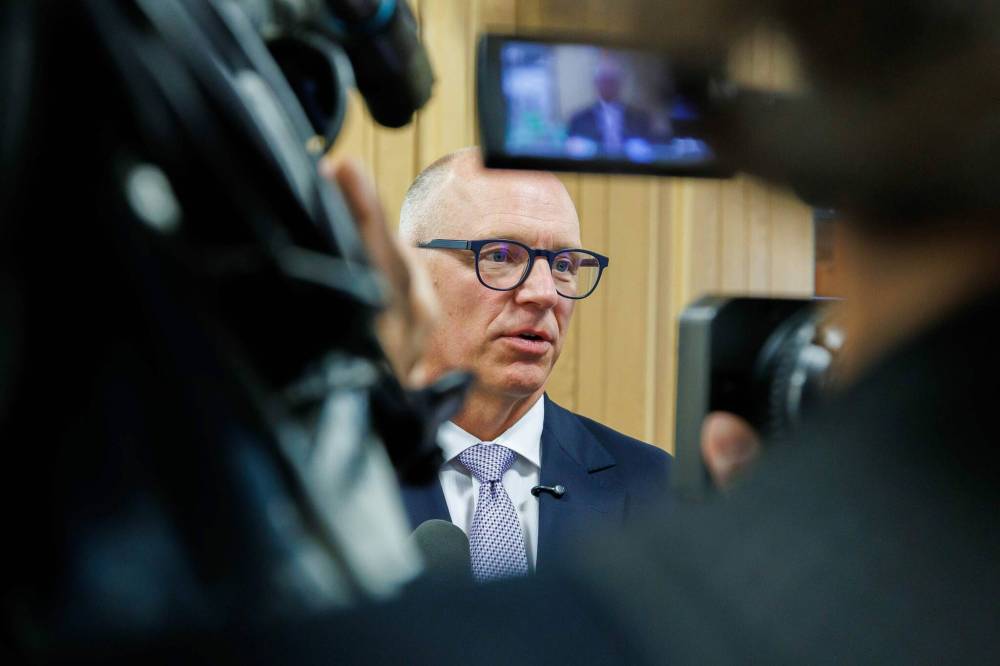
Mayor Scott Gillingham commended the partnership between police and the coalition.
The challenge, he said, is to find a “better way forward” that protects public safety and recognizes that addiction is a health crisis requiring a path to care and recovery.
“We can be compassionate towards those who are struggling with addiction, and yet still not tolerate open, illegal drug use,” Gillingham said.
In response to questions about additional provincial support, Justice Minister Matt Wiebe said the NDP government funded 24 WPS foot patrol officers, and provides annual funding to the Downtown Community Safety Partnership.
“This ongoing collaboration with community partners is essential to our efforts to respond to the toxic drug crisis, and we look forward to continuing this holistic approach in conjunction with our community partners and law enforcement,” he said in a statement.
chris.kitching@freepress.mb.ca
Chris Kitching is a general assignment reporter at the Free Press. He began his newspaper career in 2001, with stops in Winnipeg, Toronto and London, England, along the way. After returning to Winnipeg, he joined the Free Press in 2021, and now covers a little bit of everything for the newspaper. Read more about Chris.
Every piece of reporting Chris produces is reviewed by an editing team before it is posted online or published in print — part of the Free Press‘s tradition, since 1872, of producing reliable independent journalism. Read more about Free Press’s history and mandate, and learn how our newsroom operates.
Our newsroom depends on a growing audience of readers to power our journalism. If you are not a paid reader, please consider becoming a subscriber.
Our newsroom depends on its audience of readers to power our journalism. Thank you for your support.
Chris Kitching is a general assignment reporter at the Free Press. He began his newspaper career in 2001, with stops in Winnipeg, Toronto and London, England, along the way. After returning to Winnipeg, he joined the Free Press in 2021, and now covers a little bit of everything for the newspaper. Read more about Chris.
Every piece of reporting Chris produces is reviewed by an editing team before it is posted online or published in print — part of the Free Press‘s tradition, since 1872, of producing reliable independent journalism. Read more about Free Press’s history and mandate, and learn how our newsroom operates.
Our newsroom depends on a growing audience of readers to power our journalism. If you are not a paid reader, please consider becoming a subscriber.
Our newsroom depends on its audience of readers to power our journalism. Thank you for your support.
Related Articles
Police chief promises drug crackdown data will be made public




Advertisement Advertise With Us
Advertisement Advertise With Us
History
Updated on Thursday, August 6, 2026 5:21 PM CDT: Adds details, photos.
Updated on Thursday, August 6, 2026 5:35 PM CDT: Adds statement